Details
Product prices and availability are accurate as of the date/time indicated and are subject to change. Any price and availability information displayed on Amazon.co.uk at the time of purchase will apply to the purchase of this product.Review
Acer Predator Triton 300 review
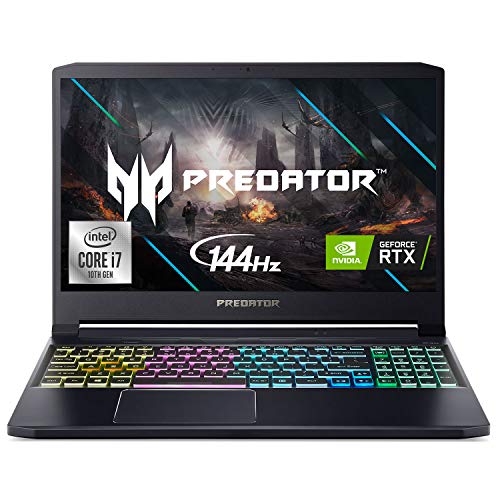
Frame rates
1920×1080, High preset, upscaling off.
Measured on this machine. Source: Notebookcheck, 2020-12-14.
Not scored: incomplete benchmark suite
Every scored laptop on this site is averaged over the same 5 games, and this one is short of Cyberpunk 2077, Baldur's Gate 3, GTA V. A mean over 3 games is not comparable to a mean over 5, so we publish the figures we have and leave the score blank rather than rank it against machines tested on a different set. The numbers below are real - the suite is just incomplete.
How these numbers were produced
Frame rates here are not measured by us, and we label how each one was arrived at. A figure marked measured comes from a published run on that exact machine. A figure marked representative is derived from the GPU and its power limit (TGP) and cross-referenced against published reviews - a sound estimate of what that configuration delivers, but not a measurement of that specific laptop. Unless stated otherwise, numbers are 1920x1080, High preset, upscaling off. Where a laptop ships in several power configurations we use the wattage of the exact SKU listed, because a 140W RTX 5070 and a 115W one are not the same product.
In use
The short version
The Acer Predator Triton 300 PT315-52-79LP is difficult to recommend at £1,763 on the information available. Its Core i7-10750H, 16GB of memory, 1TB SSD and RTX 2060 are a coherent gaming specification, and the measured results show that it can play the tested games competently at its native 1920x1080 resolution with the High preset and upscaling disabled. Dota 2 reaches 121fps, X-Plane 11 manages 78fps and Final Fantasy XV records 52fps. Those are usable figures, but they do not make the 120Hz display equally worthwhile in every measured game.
The central problem is not that the Triton 300 fails to run games. It does run the games in the available benchmark set. The problem is that the available data describes a machine with very uneven results depending on the title, paired with a price that demands a stronger and more consistently high-refresh experience than the figures demonstrate. Dota 2 can make practical use of the 120Hz panel. X-Plane 11 is below the panel’s full refresh rate but still substantially quicker than Final Fantasy XV. Final Fantasy XV, at 52fps, is the result that matters most when judging whether this is a sensible £1,763 gaming purchase: it shows that the RTX 2060 is not providing a dependable route to the display’s 120Hz ceiling in every demanding game at the stated settings.
There is also an important limitation to the published scoring information. We have measured figures for Dota 2, X-Plane 11 and Final Fantasy XV, giving a mean of 84fps across those three games. We do not have figures for GTA V or Strange Brigade. That means the scoring suite is incomplete, and this machine cannot honestly be ranked against laptops whose results are averaged across the same five games. A partial set should not be treated as if it were a complete league-table result. The available numbers are useful, but they support a measured conclusion rather than a broad claim that this is faster or slower than every competing laptop.
Notebookcheck’s numbers do show where the Triton 300 sits among several relevant machines from the same GPU generation. It is 13fps ahead of the Acer Aspire 17 with its RTX 2050 at 35W across the three shared games. It is level with the MSI Stealth 15M, despite both systems using an RTX 2060. It trails the Aorus 5 KB, also with an RTX 2060, by 5fps across the shared games. It is then 37fps behind the MSI GT76 Titan DT with an RTX 2080. That spread is useful because it places the Predator between a lower-powered RTX 2050 system and much larger RTX 2080-class performance, while also showing that merely seeing “RTX 2060” on a specification sheet does not guarantee a single level of performance.
The right buyer is therefore very specific. This Acer suits someone who values a 15.6in IPS display, 1TB of SSD storage, 16GB of memory and a 2.146kg chassis, and whose priority is mainly the lighter end of the measured game set, especially Dota 2. It may also suit a buyer who has found this exact configuration at a considerably different price, because the page price is a major part of the verdict. At the stated £1,763, though, the data does not make a compelling case for paying a premium for a laptop that reaches 121fps in one measured game but only 52fps in another at the same resolution and High preset.
It is not the obvious choice for someone buying specifically for the 120Hz screen. The display is capable of refreshing at 120Hz, but the measured results show that this capability is fully met in Dota 2 rather than across the set. Nor is it a convincing choice for someone who wants the strongest performance available from this GPU generation, because the Aorus 5 KB is ahead in the shared games and the MSI GT76 Titan DT establishes a much higher level of measured performance. The GT76 Titan DT is not automatically the better purchase, since no confirmed UK price is available for it here, but the performance gap is real and substantial.
Performance
The measured results
The benchmark data is straightforward: at 1920x1080, using the High preset with upscaling switched off, Notebookcheck recorded 121fps in Dota 2, 78fps in X-Plane 11 and 52fps in Final Fantasy XV. The mean across those three measured scoring-suite games is 84fps. That mean gives a broad indication of the performance available, but the individual results are more valuable than the average because the gap between the games is large.
Dota 2 is the best case for this configuration. Its 121fps result slightly exceeds the 120Hz refresh rate of the panel. In this title, the Triton 300 can supply enough measured frames to match the display’s stated refresh ceiling. That does not mean every moment of play will necessarily remain at that figure, because the fact sheet provides a benchmark result rather than a full frame-time record or a minimum frame rate. It does mean that, under the stated benchmark conditions, Dota 2 is the game in which the specification makes the clearest sense. The RTX 2060, Core i7-10750H and 120Hz IPS screen are aligned here: the graphics hardware produces a result that reaches the display’s refresh capability.
X-Plane 11 tells a different story. At 78fps, it is clearly below 120fps, so the screen’s full refresh rate is not being fed by the measured result. It is still much closer to the display’s capability than Final Fantasy XV is, and the figure is 26fps above the three-game mean? No: the mean is 84fps, so X-Plane 11 is below it. The useful comparison is instead with the other measured games. X-Plane 11 is 43fps below Dota 2 and 26fps above Final Fantasy XV. That places it in the middle of the Triton 300’s demonstrated performance range.
Final Fantasy XV is the demanding result in the set. Its 52fps measurement is 69fps behind Dota 2 and 26fps behind X-Plane 11. It is also well below the panel’s 120Hz refresh rate. Again, there is no published minimum or average beyond the stated benchmark figure, so it would be wrong to invent a detailed account of how every scene behaves. But the published 52fps result makes the broader point clearly enough: the Predator Triton 300 cannot be described as a laptop that routinely turns its 120Hz display into a 120fps gaming experience at 1920x1080 and the High preset. The data supports that claim in Dota 2, not in Final Fantasy XV.
This is why the 84fps mean should be treated carefully. It is not a false number; it is the correct mean across the three measured games. But it conceals the difference between a title that reaches the panel’s refresh rate and a title that is far below it. Someone choosing a laptop for games that behave more like Dota 2 could find the Predator’s measured output appropriate for the display. Someone whose priorities resemble the more demanding Final Fantasy XV result should not assume that an 84fps mean means a broadly 84fps experience in every game. The available evidence says the opposite: results vary heavily by title.
What the benchmark spread means
The 69fps spread between Dota 2 and Final Fantasy XV is the defining performance characteristic of this laptop. It matters more than a single average because it sets expectations for actual game choice. A purchaser who mostly plays titles that are light enough to allow the platform to run close to or beyond the panel refresh rate will see a very different outcome from a purchaser who prioritises games that are closer to the Final Fantasy XV result.
The fact sheet also gives a useful explanation for why small differences between otherwise different laptops can disappear in the shared-game averages. At 1920x1080, lighter titles in the shared set can be CPU-bound, compressing genuine GPU gaps. That matters when reading the Predator’s comparison with the MSI Stealth 15M. The two machines are level across the three shared games, despite both being RTX 2060 systems. A zero difference should not be dismissed as missing information or treated as evidence that all aspects of the machines are identical. It is a real result in the available shared-game comparison, but a lighter or CPU-bound game can reduce the visible effect of a graphics-performance difference.
The same caution applies in the other direction. A 5fps deficit to the Aorus 5 KB across the shared games is meaningful as a measured average, but it does not tell us that the difference will be identical in every game or every setting. The shared figures are limited to the games both systems hold. They establish that the Aorus is ahead in that comparison, not that it will lead by the same amount in every workload a buyer might run. Likewise, the 37fps advantage held by the MSI GT76 Titan DT is a strong gap across the available shared set, yet it should not be transformed into a claim about every possible game.
That is the appropriate way to read the Triton 300’s figures: as evidence of demonstrated performance under fixed conditions, not as a promise of a universal frame rate. The fixed conditions are important. These are 1920x1080 results, using the High preset, with upscaling disabled. If a buyer intends to use other presets or enable upscaling, the fact sheet does not provide measured results for those choices. It would be easy to assume that different settings would change the numbers, but Laptop Gaming’s purpose is attributable frame-rate reporting, so an assumption is not a substitute for a published measurement.
RTX 2060 performance and the missing power-limit information
The Triton 300 uses an RTX 2060, but the fact sheet does not state its GPU power limit. That is a significant omission when attempting to explain precisely why it performs as it does against other RTX 2060 laptops. It would be wrong to assign a wattage to this machine, wrong to state that it runs at a particular power level, and wrong to blame the 5fps deficit to the Aorus 5 KB on a power limit that is not published here.
What can be said is narrower and more useful. This RTX 2060 configuration produces 121fps in Dota 2, 78fps in X-Plane 11 and 52fps in Final Fantasy XV at the stated settings. It matches the MSI Stealth 15M across the three shared games and trails the Aorus 5 KB by 5fps across that same comparison. Those are outcomes. They do not reveal the cause. The cause could involve GPU configuration, cooling behaviour, processor behaviour, memory configuration, software state or characteristics of the benchmarked games, but the fact sheet does not provide enough evidence to attribute the difference to any one of those factors.
That distinction matters particularly for buyers who see the same GPU name in several laptops. The comparison set shows that “RTX 2060” is not enough information to predict an identical result. The Predator and MSI Stealth 15M are level in the shared-game average, while the Aorus 5 KB is ahead by 5fps. The sensible conclusion is not that one RTX 2060 is necessarily defective or that another must have a particular unpublished specification. The sensible conclusion is that buyers should use attributable benchmark data for the exact machine where possible, rather than assuming the GPU label determines everything.
The 35W figure supplied for the Acer Aspire 17’s RTX 2050 makes that rival a useful contrast. The Triton 300 is 13fps ahead across the three shared games. That is a measurable advantage for the Predator. But it does not allow an exact calculation of how much of the lead comes from the GPU model and how much comes from the Aspire’s stated 35W limit, because the fact sheet provides no corresponding power-limit figure for the Triton. The outcome is clear; the detailed explanation remains unconfirmed.
What the incomplete suite prevents us from saying
There are no published figures here for GTA V or Strange Brigade. As a result, there is no complete five-game scoring-suite average for the Predator Triton 300. Every scored laptop is averaged over the same five games, so using this machine’s three-game mean of 84fps as though it were directly comparable with a completed five-game average would be misleading.
This does not make the three published results worthless. They are still enough to show the laptop’s behaviour in Dota 2, X-Plane 11 and Final Fantasy XV, and they are enough to compare with the named rivals across the games both machines hold. What they cannot do is support an absolute placement within a full scored list. The responsible verdict must therefore remain tied to the evidence available: good measured output in Dota 2, middling output in X-Plane 11 relative to the 120Hz panel, and much lower output in Final Fantasy XV.
For a £1,763 laptop, that uncertainty matters. A buyer is entitled to want evidence across a broader set before treating the machine as a complete performance proposition. The fact sheet does not provide that broader evidence. It is better to acknowledge the gap than to hide it behind an attractive mean or an RTX badge.
The screen
The Predator Triton 300 has a 15.6in IPS display with a 1920x1080 resolution and 120Hz refresh rate. On paper, that is a sensible gaming-panel specification for an RTX 2060 laptop. The resolution matches the benchmark resolution exactly, so there is no need to infer how the machine might perform at a different native pixel count. The published frame rates are directly relevant to this panel: Notebookcheck’s results were measured at 1920x1080.
The refresh rate is the key feature to assess alongside the benchmark data. A 120Hz display can show up to 120 refreshes per second, but the graphics hardware must produce frames at a similar rate for a game to reach that ceiling. In Dota 2, the measured 121fps result does that. It is the strongest demonstration that the display and GPU can work together as intended. The result is one frame per second above the stated refresh rate, so the panel rather than the measured game output becomes the limiting ceiling in that benchmark scenario.
X-Plane 11, at 78fps, does not reach the panel’s 120Hz limit. That does not make the screen inappropriate, but it means the display’s maximum refresh capability is not fully utilised by the measured output. The same is more pronounced in Final Fantasy XV at 52fps. These figures establish a clear practical pattern: the 120Hz panel is an advantage in the lighter measured title, while the more demanding measured title cannot drive it to its full rate at High settings with upscaling off.
This is an important purchasing distinction. A 120Hz label can sound like a blanket promise of high-refresh gaming, but the measured figures do not support that blanket promise here. They support a conditional one. If the games a buyer plays resemble Dota 2 in their demand on this configuration, the display can be used at its full stated refresh rate. If they resemble Final Fantasy XV under the measured conditions, the experience is governed by a much lower frame-rate result. X-Plane 11 sits between those poles.
The IPS panel type is also a positive part of the stated specification, but the available fact sheet does not include brightness, contrast, colour coverage, response-time measurements, backlight behaviour or any display calibration data. Therefore, it would be unsupported to claim that this is a bright screen, a colour-accurate screen, a fast-response screen or a good outdoor screen. The only display qualities confirmed here are its 15.6in size, 1920x1080 resolution, IPS panel type and 120Hz refresh rate.
That lack of additional panel data is worth keeping in mind because the screen is central to the value proposition. At £1,763, a buyer should not have to infer display quality from the IPS label alone. IPS identifies the panel type, not the whole viewing experience. The gaming evidence is similarly focused: the GPU can match the panel in Dota 2, but not in the other two measured games. The fact sheet gives no reason to claim more than that.
There is no stated support information here for refresh synchronisation, no stated response-time figure and no measured display latency result. Those may matter to some high-refresh buyers, but they cannot be judged from this information. The honest recommendation is therefore directed at those who value the 120Hz ceiling primarily for games where the measured data suggests the laptop can approach it, rather than those who require confirmation of every aspect of display behaviour.
Build, size and portability
The confirmed physical figure is a weight of 2.146kg. That makes the Predator Triton 300 a laptop rather than a desktop replacement in the literal sense: it can be moved between places, and it is not in the class of a fixed tower system. But weight is only one part of portability, and the fact sheet does not provide dimensions, charger weight, battery-life measurements or battery capacity. It would therefore be irresponsible to describe it as especially thin, compact, travel-friendly or easy to carry all day.
What the 2.146kg figure does tell a buyer is the mass of the laptop itself. Anyone comparing it with another machine can use that exact figure, rather than relying on vague labels such as “lightweight” or “heavy”. Whether 2.146kg is acceptable depends on how the machine will be used. For a buyer moving it occasionally between a desk, a shared home space, a place of study or work, the stated weight may be manageable. For someone carrying it frequently alongside other equipment, the figure deserves more scrutiny. The missing charger weight is especially relevant to that decision, but it is not supplied.
There is no published information in the fact sheet about chassis material, lid rigidity, keyboard layout, touchpad, webcam, ports, upgrade access, fan noise, thermals or internal layout. None of those should be guessed from the Predator name or from the word “Triton”. A gaming-laptop buyer may reasonably care about them, particularly at this price, but they remain unknown on the evidence given.
The available specification does confirm 16GB of memory and a 1TB SSD. Those are meaningful practical components because they describe the installed memory capacity and storage capacity. However, the fact sheet does not state memory speed, memory configuration, SSD model, SSD performance, spare storage space or upgrade options. It would be inaccurate to call the memory dual-channel, the SSD fast, or the storage expandable without those details.
The 15.6in screen size places the laptop in a familiar portable-gaming format, but the dimensions are not provided, so the footprint cannot be quantified. A 15.6in display does not by itself reveal bezel size, depth or thickness. Buyers who need a precise bag fit should seek dimensions rather than treating the screen size as a substitute for them.
There is also no battery result. That means there is no attributable evidence for how long the Triton 300 lasts away from mains power, whether in light use or gaming. Gaming performance figures should not be repurposed as battery evidence. The frame rates were measured under a defined gaming benchmark condition; they do not tell us anything about battery duration. For a buyer whose main requirement is regular untethered use, that is a major unknown rather than a small missing detail.
The practical conclusion is restrained. The Predator has a 2.146kg weight, 15.6in display, 16GB of memory and 1TB SSD, all of which are useful confirmed facts. But the build and mobility story is incomplete. It should be bought on the strength of the published performance and core specification, not on assumed premium construction, assumed portability or assumed battery life.
How it compares
Acer Aspire 17 with RTX 2050 at 35W
Against the Acer Aspire 17 with an RTX 2050 at 35W, the Predator Triton 300 holds a 13fps average lead across the three shared games. That is the largest positive comparison in the supplied rival set, and it confirms that the Triton’s RTX 2060 configuration delivers materially higher measured performance than this lower-powered RTX 2050 laptop in the games both have results for.
The wording matters. The Predator is not claimed to be 13fps faster in every game, nor is it claimed to be 13fps faster across a completed five-game suite. It averages 13fps ahead across the three shared games. That is still useful evidence, especially because the Aspire’s RTX 2050 is explicitly stated to run at 35W. The result gives buyers considering a lower-powered RTX 2050 system a concrete reason to expect more performance from the Triton in this limited comparison.
There is no confirmed UK price for the Aspire 17 in the fact sheet. Therefore, no value conclusion can be drawn between it and the £1,763 Triton. A 13fps performance lead is important, but value depends on price as well as speed. Without a confirmed UK price for the Aspire, it would be speculation to state that either laptop is better value.
MSI Stealth 15M with RTX 2060
The comparison with the MSI Stealth 15M is perhaps the most revealing one because both laptops use an RTX 2060. Across the three shared games, the average difference is 0fps. That near-zero result is real, not an invitation to invent a winner. The available benchmark data says that neither machine has an average frame-rate advantage across those shared games.
The fact sheet specifically warns that lighter titles at 1920x1080 can be CPU-bound and compress genuine GPU gaps. That is the proper context for the tie. It does not mean the Predator and Stealth are identical laptops. It means that, in the games and settings held in common, the measured output is level. The shared set may not expose every performance difference that could exist in more GPU-limited circumstances, but no such additional evidence is supplied here.
There is no confirmed UK price for the MSI Stealth 15M, so this comparison is about performance rather than value. The sensible buyer response is to treat the machines as effectively level on the available shared-game data, then use verified information about price, screen, weight, battery, ports and build to decide between them. For the Predator, much of that additional information is not present in this fact sheet, which weakens the case for choosing it simply because it carries the same GPU name.
Aorus 5 KB with RTX 2060
The Aorus 5 KB is the more uncomfortable comparison for the Triton because it also uses an RTX 2060 and is 5fps ahead across the three shared games. This is not an enormous gap on the scale of the 37fps deficit to the RTX 2080-equipped MSI GT76 Titan DT, but it is enough to establish that the Aorus leads in the direct shared-game comparison.
It would be wrong to turn 5fps into a sweeping condemnation of the Acer. The difference may be compressed by lighter, CPU-bound titles at 1920x1080, as the fact sheet explains. It also cannot tell us the lead in GTA V or Strange Brigade, because the Predator has no figures supplied for those games. But a buyer comparing two RTX 2060 machines should not ignore the available evidence either. The Aorus is ahead where a direct comparison can be made.
No confirmed UK price is available for the Aorus 5 KB, so there is no basis for saying whether its 5fps lead is worth paying for. If it costs more, less or the same as the £1,763 Acer is not established here. Performance alone favours the Aorus in the shared data; value remains unresolved.
MSI GT76 Titan DT with RTX 2080
The MSI GT76 Titan DT with an RTX 2080 is 37fps ahead of the Predator across the three shared games. That is the largest negative comparison supplied and the clearest indication of the performance ceiling above the Triton within this GPU generation. The difference is substantial enough that it should not be explained away as ordinary benchmark variation.
At the same time, this comparison should not be used carelessly. The GT76 Titan DT is a different class of specification on the information provided, with an RTX 2080 rather than an RTX 2060. The 37fps gap shows what more graphics performance can achieve in the shared set. It does not automatically tell us which system is better for every buyer, because the fact sheet does not provide a confirmed UK price for the GT76 Titan DT, nor does it provide comparable weight or portability information for that rival.
The correct takeaway is performance-focused: buyers seeking the highest frame rates among the named machines should look beyond the Triton 300. The MSI GT76 Titan DT is decisively ahead in the shared benchmark comparison. Buyers concerned with price or physical practicality need more verified information before choosing between them.
Who it’s for
The Acer Predator Triton 300 is for a buyer whose priorities match its strongest confirmed qualities. That means someone who wants a 15.6in 1920x1080 IPS display, a 120Hz refresh rate, 16GB of memory, a 1TB SSD and an RTX 2060 system that can produce 121fps in Dota 2 at High settings with upscaling off. For that particular use case, the benchmark data supports the screen specification well. Dota 2 is the game in the published set where the laptop reaches the panel’s stated refresh ceiling.
It can also suit someone content with the measured 78fps result in X-Plane 11. That result does not exploit the full 120Hz panel, but it is the middle point in the measured range and shows that the laptop is not confined to the very lightest title in the set. A buyer whose expectations are set by the actual published number, rather than by the display’s maximum refresh rate, can make an informed decision.
It is less suitable for a buyer who expects every modern or demanding game to approach 120fps at 1920x1080 on the High preset with upscaling disabled. Final Fantasy XV at 52fps is direct evidence against that expectation. The screen can refresh at 120Hz, but the graphics hardware does not reach that figure in every measured game. Anyone who considers a high-refresh display valuable only when it is consistently saturated should look for stronger evidence than this laptop provides.
It is also not the right choice for someone who needs a completed benchmark-suite ranking. The missing GTA V and Strange Brigade figures mean the five-game scoring suite is incomplete. There is a three-game mean of 84fps, but that is not a substitute for the full set used to assess scored laptops. Buyers who want broad comparative certainty should favour a machine with complete published data across the relevant suite.
The Triton is not a clear choice for value-led buyers at £1,763. That price is confirmed; what is missing is the evidence needed to justify it emphatically. The Aorus 5 KB is 5fps ahead in the shared games, the MSI Stealth 15M is level, and the GT76 Titan DT is 37fps ahead. None of those rivals has a confirmed UK price here, so none can be declared the better bargain. But the Acer’s own price remains high enough that its uneven measured output deserves close scrutiny rather than automatic acceptance.
Buy something else if the priority is maximum demonstrated performance from the named comparison set. The MSI GT76 Titan DT is far ahead by 37fps across the three shared games. Buy something else if the priority is a direct RTX 2060 comparison where every available frame matters, because the Aorus 5 KB leads the Triton by 5fps across the shared games. Buy something else if the purchase decision depends on battery life, thermal behaviour, fan noise, port selection, keyboard quality, precise dimensions or chassis construction, because the fact sheet does not provide those facts for this Acer.
Finally, buy something else if the laptop will regularly be carried and the acceptable travel load must be known precisely. The Triton itself weighs 2.146kg, but its dimensions and charger weight are not stated. That does not make it unsuitable for travel; it makes its suitability unverified beyond the laptop’s own weight.
The best case for the Predator Triton 300 is narrow but real: it is a 15.6in 120Hz IPS laptop with a Core i7-10750H, RTX 2060, 16GB of memory and 1TB SSD, and it can reach 121fps in Dota 2 at the published settings. The weaker case is broader: at £1,763, it offers only 78fps in X-Plane 11 and 52fps in Final Fantasy XV, trails one RTX 2060 rival in the shared data, and lacks the complete benchmark suite needed for a full ranking. Treat the Dota 2 result as a confirmed strength, treat the Final Fantasy XV result as a clear limitation, and do not let the 120Hz label imply performance that the measured figures do not show.