Most portable
ASUS TUF Gaming A14 review
A 1.46kg gaming laptop you can genuinely carry every day, with a gorgeous 14in 2.5K screen. You pay a portability premium and accept an RTX 5050, but nothing else here travels like it.
What it gets right
- Just 1.46kg - a true all-day carry
- Beautiful 14in 2.5K 165Hz display
- Premium build and long battery life
- Quiet and cool for a gaming laptop
What it doesn't
- RTX 5050 is the slowest GPU here
- You pay a clear premium for the size
- 8GB VRAM; heavier games need DLSS
Frame rates
1920×1080, High preset, upscaling off.
Representative figures, not measurements of this specific machine: derived from the RTX 5050 at 75W and cross-referenced against published reviews. Source: Tom's Hardware, Notebookcheck, PC Gamer, LaptopMedia and GamersNexus, 2026-07-01.
Not scored: incomplete benchmark suite
Every scored laptop on this site is averaged over the same 5 games, and this one is short of Baldur's Gate 3, GTA V, X-Plane 11, Dota 2. A mean over 1 games is not comparable to a mean over 5, so we publish the figures we have and leave the score blank rather than rank it against machines tested on a different set. The numbers below are real - the suite is just incomplete.
How these numbers were produced
Frame rates here are not measured by us, and we label how each one was arrived at. A figure marked measured comes from a published run on that exact machine. A figure marked representative is derived from the GPU and its power limit (TGP) and cross-referenced against published reviews - a sound estimate of what that configuration delivers, but not a measurement of that specific laptop. Unless stated otherwise, numbers are 1920x1080, High preset, upscaling off. Where a laptop ships in several power configurations we use the wattage of the exact SKU listed, because a 140W RTX 5070 and a 115W one are not the same product.
In use
The short version
The ASUS TUF Gaming A14 is a 1.46kg 14-inch machine with an RTX 5050 running at a 75W power limit, and it costs £1,007. Those three facts define the whole review. The performance is entry-level by 2026 standards; the size is not; the price sits in the middle of a bracket where 15- and 16-inch machines are considerably faster and, in one case, considerably cheaper as well.
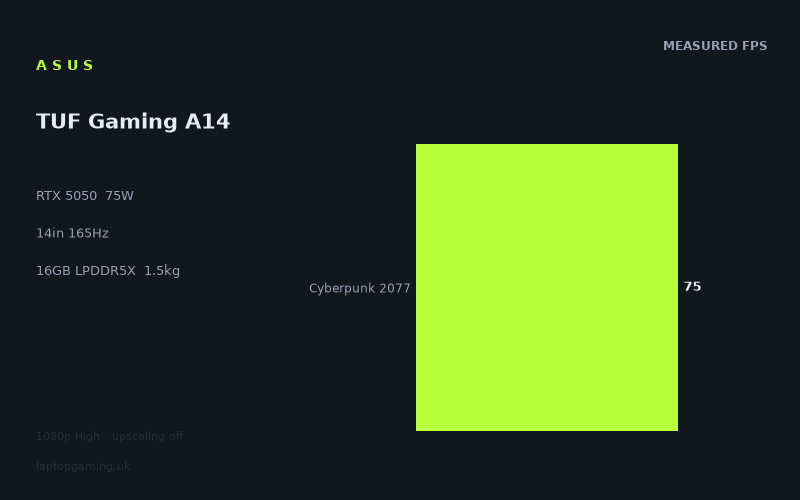
The published frame rates make the shape of the thing clear. At 1920x1080 on High with upscaling off, Counter-Strike 2 runs at 188fps, Forza Horizon 5 at 82fps, Cyberpunk 2077 at 75fps, Red Dead Redemption 2 at 75fps, Hogwarts Legacy at 61fps and Black Myth: Wukong at 47fps. That is a laptop that plays everything, plays competitive titles very well indeed, and plays the heaviest current releases at frame rates you would describe as adequate rather than good — and it does all of that at a resolution well below the one its own screen runs at.
The comparison that matters most is the HP Victus 15. Same GPU, same 75W power limit, £799. Across the six games both machines have measured figures for, the A14 is ahead by an average of 2fps. Two frames per second for £208. If you are buying frames, that is not a purchase you can defend on the numbers. The £208 is buying a 14-inch chassis, 1.46kg, a 2560x1600 165Hz panel and a Ryzen AI 7 260 — and whether that bundle is worth the money depends entirely on whether you carry your laptop.
The comparison that hurts most is the Acer Nitro V 15. It has an RTX 5060 at 115W, it costs £931 — £76 less than the A14 — and across the six shared games it averages 22fps faster. Cheaper and meaningfully quicker. There is no performance argument for the ASUS against it. There is only a portability argument, and it needs to be a strong one.
So: buy the TUF A14 if you actually need a small, light gaming laptop that you will carry several times a week, and you accept that you are paying a real premium in frames per pound to get it. Buy something else if the machine is going to sit on a desk, because at this price the desk-bound alternatives are faster for the same money or less. That is the entire verdict, and the rest of this review is the evidence for it.
Performance
What a 75W RTX 5050 actually is
The single most important number on the spec sheet is not "RTX 5050". It is 75W. Laptop GPUs are sold under names that imply a fixed level of performance and configured by manufacturers at power limits that vary substantially between chassis, and the power limit does more to determine the frame rate than the marketing name does. A thin 14-inch machine cannot dissipate the same heat as a 16-inch one with a bigger fan stack and more surface area, so it gets a lower total graphics power, and the same silicon produces fewer frames.
We have direct evidence of this from our own comparison set. The HP Victus 15 carries the same RTX 5050 at the same 75W, and across six shared games the two machines land within an average of 2fps of one another. That is the expected result when the GPU and its power budget match: the chassis, the cooling design and the CPU shuffle things by a couple of frames, but the power limit sets the ceiling. Conversely, the HP OMEN 16 and the Acer Nitro V16 both use an RTX 5070, at 140W and 115W respectively, and the OMEN averages roughly 12fps further ahead of the A14 than the Nitro does across the same count of shared games. Same GPU name, 25W apart, and a gap you can see in every measurement. Assume the shared game sets are the same six titles, which the counts suggest, and that is a clean demonstration that power limit is not a footnote.
What this means practically for the A14 is that you should think of it as sitting near the entry point of current-generation discrete graphics. It is a genuine gaming GPU — it will run anything you install — but it has no headroom. There is no scenario in which a driver update or a future patch turns this into a 100fps-in-everything machine. The 75W limit is the fixed constraint, and the measured frame rates below are what that constraint produces.
The easy end: Counter-Strike 2 and Forza Horizon 5
Counter-Strike 2 at 188fps is the standout figure in the set, and it is standing out for a reason: it is a comparatively light renderer that leans on the CPU more than on the GPU, and the Ryzen AI 7 260 has enough of a front end to keep the pipeline fed. This is the one measured title that exceeds the panel's 165Hz refresh rate, and it does so with about 23fps of margin. In practice that means CS2 is the game where the screen, not the graphics chip, becomes the limiting factor — you are getting the full benefit of the high-refresh panel and then some.
That matters more than it might appear, because the competitive-shooter case is the strongest single argument for this machine's performance. If your gaming is Counter-Strike, or games built along similar lines, the A14 delivers frame rates that fill a 165Hz screen at 1080p. You would want to check what happens at the panel's native 2560x1600 — a subject I'll come back to, because we do not have measurements at that resolution and I am not going to guess at them — but at the resolution we have data for, this is comfortably a high-refresh esports machine.
Forza Horizon 5 at 82fps is the other comfortable result, and it is comfortable for a different reason. Forza is one of the better-optimised big-budget games of the last several years, with a rendering pipeline that scales gracefully down the hardware stack and an art direction that hides detail reduction well. 82fps in an open-world racer is a genuinely good experience: fast enough that the frame pacing feels smooth at speed, and far enough clear of 60 that dips in dense scenery are unlikely to break the illusion. If you told me you bought this laptop mainly for racing games and competitive shooters, I would tell you the frame rates support the decision.
The middle: Cyberpunk 2077 and Red Dead Redemption 2
Both of these land at 75fps, which is a useful coincidence because they are demanding in quite different ways. Cyberpunk 2077 is a shading-heavy, geometry-heavy urban renderer with expensive lighting even before ray tracing enters the picture; Red Dead Redemption 2 is a wide-open world with heavy volumetrics, long draw distances and a famously punishing set of high presets. That they arrive at the same number tells you the 75W RTX 5050 is being pushed to a similar degree by two different kinds of load.
75fps is a good place to be. It clears 60 with margin, which is the threshold that matters for a single-player game — you want enough headroom that the busy moments, the crowded market squares and the firefights with a dozen light sources, do not drop you into visible stutter. It does not fill the 165Hz panel, but no single-player title on hardware in this class is going to. With variable refresh working, 75fps on a 165Hz screen is a smooth, tear-free experience. This is what most people buying this laptop should expect from most story-driven games they play: something in the seventies at High, at 1080p, without upscaling.
Cyberpunk carries additional weight here because it is part of our five-game scoring suite, and it is the only one of those five we have a figure for. I will address what that means for scoring shortly, but as a data point in isolation it is a reassuring one: Cyberpunk has been the industry's default "can it run modern games" test for years, and 75fps at High is a passing grade by any reasonable standard.
The hard end: Hogwarts Legacy and Black Myth: Wukong
Hogwarts Legacy at 61fps is the first result that requires some care. 61fps is an average, and Hogwarts Legacy is a game with a well-documented gap between its average and its lows — Hogsmeade in particular has historically been rough on mid-range hardware, with traversal stutter and CPU-side hitching that the average frame rate does not capture. A 61fps average means the quiet interiors are running comfortably above that and the busy exteriors are running below. Whether that is acceptable depends on your tolerance; I would call it playable and slightly compromised. It is also the game in this set most likely to be pressing against the 8GB VRAM allocation at High settings, which I'll come to.
Black Myth: Wukong at 47fps is the floor, and it is the number that defines the machine's limits. Wukong is an Unreal Engine 5 title with expensive shading, dense geometry and an appetite for GPU power that has embarrassed a lot of hardware. 47fps is a playable average for a third-person action game with generous timing windows, but it is not a comfortable one, and the lows will be in the low forties or worse. This is the category of game where you will be reaching for the settings menu — dropping to Medium, or enabling upscaling, which the measured figures explicitly do not use.
The honest reading is this: the heaviest current releases are the point at which a 75W RTX 5050 stops being enough at High. Wukong is not an outlier; it is a preview. As more UE5 titles ship with similar rendering costs, the 47fps result is the one that will generalise, not the 82fps Forza result. If your buying decision is being made on the assumption that this machine will handle the next three years of AAA releases at High settings, the Wukong figure is the one to weigh.
Where the spread comes from
188fps to 47fps is a fourfold range across six games, and it is worth understanding why, because it tells you what to expect from titles we have no figures for.
The top of the range is set by games that are not really asking much of the graphics chip. Counter-Strike 2 renders comparatively simple scenes with a rendering budget deliberately kept low so that competitive players can hit high frame rates; the work moves to the CPU, and the CPU here is adequate to the job. Anything built on similar principles — competitive shooters, MOBAs, older engines, games designed to run on a wide install base — will land nearer this end.
The bottom of the range is set by games with expensive per-pixel work: complex lighting, high-cost materials, dense geometry, screen-space effects stacked on top of each other. Wukong is the archetype. These games scale almost directly with available GPU power, which is precisely the resource a 75W part is short of. There is no CPU trick, no memory configuration and no driver update that recovers that; you either turn settings down or accept the frame rate.
The middle is where most games live. Cyberpunk, Red Dead and Forza all cluster between 75 and 82fps, and Hogwarts sits just below at 61. That cluster is the useful predictor: for a typical big-budget release at High and 1080p, expect something in the sixties to low eighties. That is the number to hold in your head when you are looking at a game not in this list.
I would also flag what averaging across these six games would do, which is mislead you. Counter-Strike's 188fps is so far above the rest that any simple mean gets dragged upwards by a title that tells you almost nothing about how the machine handles heavy games. The distribution matters more than its centre. Four of the six measured titles fall between 47 and 82fps, and that band is a far better description of the machine than any single averaged figure would be.
Eight gigabytes of VRAM
The A14 has 8GB of video memory, and in 2026 that is the specification most likely to age badly. Video memory behaves differently from raw shading throughput: it does not degrade gracefully. When a game needs more than is available, it does not run slightly slower — it starts swapping assets across the PCIe bus, and the symptom is texture pop-in, sudden hitches and one-percent lows that collapse while the average frame rate looks fine. This is precisely the failure mode that an average frame rate measurement hides, and it is why 61fps in Hogwarts Legacy deserves more scepticism than 61fps in a lighter game would.
At 1920x1080 with High textures, 8GB is generally workable in the titles measured here. The pressure increases at higher resolutions, with higher texture presets, and with ray tracing enabled — all three of which increase the memory footprint independently of shading cost. That combination is worth spelling out because it interacts badly with this machine's own screen: the native panel resolution is nearly twice the pixel count of the resolution the measurements were taken at, and running native pushes memory use up at the same time as it pushes shading cost up.
The practical consequence is that ray tracing is essentially off the table on this machine for anything demanding. The RTX 5050 has the hardware for it, but the combination of 75W and 8GB means enabling it in a heavy title will take a frame rate that is already at 47 and put it somewhere you would not want to play. If ray-traced lighting is something you specifically want to see, this is not the laptop to buy for it, and no amount of settings tuning changes that conclusion.
Upscaling, and what we don't have figures for
All the measured numbers above have upscaling switched off. That is the right way to benchmark — it isolates the hardware rather than the reconstruction algorithm — but it is not how most people will actually play. NVIDIA's RTX 50-series parts support the current generation of DLSS, including frame generation, and in practice a 47fps Wukong result becomes a much more comfortable experience with upscaling enabled at a sensible quality preset.
I am not going to put a number on that, because we do not have measured upscaled figures and estimating them would be exactly the kind of invented statistic this site exists not to publish. What I will say is directional and defensible: upscaling helps most where the GPU is the bottleneck and the base frame rate is lowest, which is to say it helps most in Wukong and Hogwarts and least in Counter-Strike. If you buy this machine, you will use upscaling in demanding games, and the raw numbers above are therefore a floor rather than a description of your day-to-day experience. They are also the only honest basis for comparing this machine against others, because every machine in our database is compared on the same upscaling-off basis.
Why there's no score on this page
Every laptop we score is averaged over the same five games, so that the comparison between any two machines is like-for-like. For the TUF A14 we have measured figures for only one of those five — Cyberpunk 2077, at 75fps. We have no figures for Baldur's Gate 3, GTA V, X-Plane 11 or Dota 2 on this machine.
That means the A14 cannot be ranked against the scored machines in the database, and rather than average one game and present it as if it were five, we are saying so plainly. The six measured titles we do have are more than enough to characterise how the machine performs — they cover a wide range of rendering loads and they produce a coherent picture — but they are not the standard suite, and a partial set compared against a complete one is not a comparison, it is a category error. The head-to-head figures against the four rivals in this review are calculated only on games both machines have measured results for, which is why those comparisons are valid even though the score is not available.
The screen
The panel is a 14-inch IPS running 2560x1600 at 165Hz. That is a 16:10 aspect ratio, which is worth a moment's attention on a machine this size: the extra vertical space is genuinely useful for anything that scrolls or has toolbars, and on a 14-inch display where vertical room is scarce, 16:10 buys back some of what the small chassis takes away. For a laptop that is plausibly going to spend a lot of its life doing work as well as gaming, that is the right choice.
165Hz against the measured frame rates
Here is the awkward arithmetic. Of the six measured titles, exactly one — Counter-Strike 2, at 188fps — produces enough frames to saturate a 165Hz panel. Everything else falls short, and most of it falls a long way short: Forza at 82fps is running at roughly half the panel's capability, and Black Myth: Wukong at 47fps is running at well under a third.
This is not the criticism it might sound like. High-refresh panels on mid-range gaming laptops are not primarily about hitting the refresh ceiling; they are about variable refresh smoothing out the range below it. A 75fps frame rate on a 165Hz variable-refresh screen looks and feels considerably better than the same 75fps on a fixed 60Hz screen, because the panel matches the render rate instead of forcing frames to wait or tear. Frame-time variance, which is where mid-range machines actually feel rough, is much better hidden by a high-refresh variable panel than by a fixed one.
But it does mean the 165Hz specification is being sold to you at a level the graphics chip cannot generally exploit. If you are the kind of buyer who plays competitive shooters, you will use it, and CS2 at 188fps confirms that. If you play single-player games, the panel is doing valuable work at 60 to 80fps but you would not notice the difference between this and a 120Hz screen. That is worth knowing when you are comparing spec sheets and a rival's lower refresh figure looks like a downgrade.
The resolution gap
The more consequential mismatch is resolution. All the measured frame rates are at 1920x1080. The panel is 2560x1600. That is close to double the pixel count, and running games at native resolution means asking a 75W GPU to do roughly twice the per-frame shading work.
I am not going to extrapolate the frame rates, because performance does not scale linearly with pixel count and publishing a guessed number would be worse than publishing nothing. We do not have native-resolution measurements for this machine. What I can say is structural: a 47fps result at 1080p does not survive a move to 1600p at the same settings, and neither does a 61fps one. The realistic way to use this screen is either to run demanding games at a lower internal resolution — which is what upscaling does, and which is the reason DLSS exists on hardware like this — or to accept a settings drop at native.
Two things soften this. First, a 2560x1600 panel at 14 inches has a high pixel density, and rendering below native on a dense small panel is visually far less damaging than doing the same on a 16-inch 1080p screen; the reconstruction has more real pixels to work with and the artefacts are physically smaller. Second, the resolution is genuinely valuable outside games — text rendering, photo work, having two documents side by side on a 14-inch display — and for a machine positioned as a portable that does double duty, that is a reasonable trade. The panel is not a mistake. It is just a panel specified for the chassis and the buyer rather than for the GPU.
What we don't know about this panel
We have resolution, refresh rate and panel type, and that is all. We do not have measured brightness, colour gamut coverage, colour accuracy, contrast or response time figures for this display, and I am not going to characterise it on the basis of what IPS panels usually do. IPS is a broad family that ranges from excellent to mediocre, and the difference between a bright, wide-gamut IPS panel and a dim one with poor contrast is enormous in daily use — particularly on a machine you are buying precisely because you intend to use it in places other than a dark room.
If you are considering this laptop specifically for colour work, or you expect to use it outdoors or under bright office lighting, that is the specification gap to close before you buy. Look for measured brightness in nits and gamut coverage from a source that publishes them. We do not have those numbers, so we are not going to pretend to a verdict on the panel's quality — only on its resolution, refresh and how they relate to the frame rates we do have.
Build, size and portability
1.46kg in context
This is the number that justifies the machine's existence. 1.46kg with a discrete RTX 5050 inside is a genuinely portable gaming laptop, and it puts the A14 in a different category from the 15- and 16-inch machines it competes with on price. Gaming laptops in the 15-to-16-inch class are structurally larger objects — bigger boards, bigger cooling assemblies, bigger batteries and bigger power bricks — and they weigh accordingly. We do not have the measured weights of the four rivals in our database, so I am not going to quote comparisons, but the class difference is not in dispute.
What 1.46kg means practically: this is a laptop you put in a normal backpack alongside books or a change of clothes and stop thinking about. It is a laptop you take on a train without planning around it. It is a laptop you can work on at a café table or an economy tray table, which most 16-inch gaming machines simply do not fit on. If you are a student who needs one machine for lectures and for games, or someone who commutes with a laptop several days a week, this is the specification that matters, and it is the one you cannot get from the cheaper and faster alternatives at any price.
What it does not mean is that the machine is weightless in a rucksack over a long day, or that the charger is small. A 75W GPU plus a mainstream Ryzen CPU still requires a substantial power adapter, and total carrying weight in the real world is laptop plus brick. We do not have the adapter's weight in our data, so treat 1.46kg as the floor of what you are carrying, not the total.
What a 14-inch chassis has to give up
The physics here are not negotiable. A smaller chassis has less internal volume for heatsinks, less surface area for radiating heat and less room for fan blades. That is precisely why this machine's RTX 5050 is set at 75W while the Nitro V16 and OMEN 16 run their GPUs at 115W and 140W. The A14's size is not incidental to its performance; it is the direct cause of it. You are not buying a laptop that happens to be small and happens to be slower than its rivals — you are buying a laptop that is slower because it is small, and if you would not trade the frames for the size, the whole proposition falls apart.
The related point is thermal behaviour and noise. Putting a 75W GPU and a capable CPU into a 14-inch shell is a dense engineering problem, and it is exactly the situation where fan noise and surface temperatures become part of the buying decision. We do not have measured noise figures or temperature data for this machine, and I am not going to characterise how loud it is or how warm it gets from the specification alone. If you are buying a laptop you intend to use in a shared space — a library, an office, a bedroom next to someone who is asleep — go and find measured decibel figures before you commit. It is a real gap in what we can tell you, and it is a gap that matters more on a small chassis than on a large one.
The same applies to battery life. We have no measured runtime figures for this machine, so we are not publishing an estimate. The specification points in a favourable direction — LPDDR5X is a low-power memory type, and a 14-inch panel draws less than a 16-inch one — but pointing in a favourable direction is not a measurement, and a gaming laptop's battery life depends enormously on what the test workload was. Treat it as unknown.
Memory and storage
16GB of LPDDR5X and a 1TB SSD. The storage is the right amount for 2026 — comfortable for an operating system, a working set of applications and a handful of large modern game installs, though a few 100GB-plus titles will fill it faster than you expect. It is the sort of specification where you will occasionally uninstall something, not the sort where you are managing space constantly.
The memory deserves a firmer note. LPDDR5X is soldered to the board. That is a property of the memory type, not a choice this particular machine made badly, but the consequence is that 16GB is permanent. You cannot add more in two years when 16GB starts feeling tight, which is a real possibility over the lifetime of a machine you are spending a thousand pounds on. Modern games increasingly want more headroom, and if you are the kind of user who keeps a browser with forty tabs open behind a game, 16GB is where you will start to notice.
It is worth checking whether the rivals in this comparison use socketed SO-DIMM memory, because if they do, that is a genuine long-term advantage that does not show up in any frame rate measurement. Our fact sheet does not record the memory type for those machines, so I cannot tell you either way — but it is a question worth asking of any machine you are comparing against this one, and soldered memory is a legitimate reason to buy 32GB up front if a higher-capacity configuration is available.
How it compares
All four comparisons below are calculated only on the games where both machines have measured figures — six shared games in each case. That is the fair way to do it and it means each of these deltas is a like-for-like statement.
HP Victus 15 — same GPU, same power, £208 less
The Victus 15 has an RTX 5050 at 75W. Identical GPU, identical power limit. It costs £799. Across the six shared games, the A14 averages 2fps faster.
Two frames per second. That is inside the range you would expect from chassis and CPU differences on otherwise-matched hardware, and it is the strongest available evidence that the power limit, not the badge, sets the performance. The A14 is not meaningfully faster than a laptop that costs £208 less.
So what does £208 buy? A 14-inch chassis at 1.46kg instead of a 15-inch one. A 2560x1600 165Hz IPS panel. A Ryzen AI 7 260. Our fact sheet does not give us the Victus's screen or weight, so I cannot quantify the gap in either — but the class difference between a 14-inch portable and a 15-inch mainstream gaming laptop is real, and the resolution and refresh on the A14's panel are good specifications by any standard.
The honest framing is that this is a form-factor premium, not a performance premium. If the machine is going to live on a desk, you are paying £208 for nothing you will notice. If you carry it, you are paying £208 for a size and weight class the Victus cannot offer, which is a legitimate thing to buy. What you should not do is talk yourself into believing the ASUS is the faster machine, because on the shared games it essentially is not.
Acer Nitro V 15 — cheaper and faster
This is the comparison that does the most damage. The Nitro V 15 has an RTX 5060 at 115W and costs £931 — £76 less than the A14 — and across six shared games it averages 22fps faster.
Twenty-two frames per second is not a rounding error; it is the difference between playing a demanding game at the low end of comfortable and playing it at the high end. Applied to the shape of the A14's results, it is the difference between a heavy UE5 title being a compromise and being fine. And it comes with a lower price, so there is no trade to argue about on cost. The 5060 at 115W is simply a substantially more capable configuration than a 5050 at 75W, exactly as you would expect from 40W more power and a higher tier of silicon.
There is precisely one axis on which the A14 wins here, and it is size and weight. If that axis does not matter to you, the Nitro V 15 is the better purchase and it is not close. This is the machine I would point most prospective A14 buyers towards first, and only if they came back and said "no, I need it to be 14 inches and 1.46kg" would I return to the ASUS. That is not a criticism of the A14's engineering — it is a good small laptop — but a £76 saving alongside 22 more frames per second is the kind of comparison that a portability argument has to earn its way past.
Acer Nitro V16 — £192 more for a large step up
The Nitro V16 pairs an RTX 5070 at 115W with a £1,199 price. That is £192 above the A14, and across six shared games it averages 36fps faster.
Judged purely on frames per pound, this is a much better deal than the A14. Thirty-six frames per second for under two hundred pounds is a real step up in capability, and it moves you from a machine that struggles at the heavy end to one with genuine headroom — which also means more room for higher settings, higher resolutions and the possibility of ray tracing being worth switching on rather than a curiosity. A 5070 at 115W has the raw throughput to do things the 5050 at 75W cannot approach.
The counter-argument is budget and size. £1,199 is meaningfully more than £1,007, and if £1,007 is your ceiling then the comparison is academic. It is also a 16-inch machine, which puts it two size classes away from the A14 and firmly into desk-and-occasional-transport territory rather than daily-carry. But if you are looking at the A14 at £1,007 and thinking about stretching the budget, the Nitro V16 is what stretching gets you, and it gets you a lot.
HP OMEN 16 — the top of this comparison set
The OMEN 16 runs an RTX 5070 at 140W for £1,375. That is £368 above the A14, and across six shared games it averages 48fps faster.
The most instructive thing about this entry is not the comparison against the A14 but the comparison against the Nitro V16. Same GPU. 140W versus 115W. Twelve frames per second, on average, separating them relative to the ASUS. That is the whole argument about power limits, laid out in one line: a 25W difference on identical silicon produces a visible, repeatable performance gap, and it is why treating "RTX 5070" or "RTX 5050" as a fixed performance level is a mistake that will cost you money.
Against the A14 directly, the OMEN is a different class of machine at a different price. 48fps across six games means the games where the ASUS sits at 47fps are comfortable on the OMEN, and the games where the ASUS sits in the seventies are somewhere the 165Hz-class panel starts to matter. It is also £368 more and a 16-inch chassis. This is not a cross-shop for most A14 buyers; it is here to show you what the top of this price band delivers and to make clear how much of the A14's price is going into its size rather than its speed.
What the four comparisons say together
Line them up and the pattern is unambiguous. Against the machine with an identical GPU configuration, the A14 is 2fps ahead and £208 more expensive. Against every machine with a higher-tier GPU at a higher power limit, it is 22 to 48fps behind — and in the closest of those cases, it is behind while also being more expensive.
That is a machine whose price is not being set by its performance. It is being set by its chassis, its weight and its screen. Which is fine — plenty of good products are priced on things other than raw throughput — but it means the value judgement is entirely about whether you want those things. At £1,007, this is poor value if you are buying frames, and the comparison figures above show exactly how poor. It is defensible value if you are buying a 1.46kg 14-inch gaming laptop with a high-resolution high-refresh screen, because none of the alternatives offer that at any price in this set.
One further caveat on the price: £1,007 is what it costs at the time of writing, and gaming laptop prices move week to week. Every one of these comparisons is a price comparison as much as a performance one, and the conclusions shift if the A14 drops or a rival rises. Check the current figures. A £150 discount would change the Victus comparison substantially and would make the Nitro V 15 comparison merely uncomfortable rather than damning.
Who it's for
Buy it if
You genuinely carry your laptop. This is the case the A14 wins, and it wins it decisively. 1.46kg and a 14-inch footprint mean this machine goes places that a 16-inch gaming laptop does not — daily commutes, lecture halls, trains, small desks, tray tables. If you are moving it several times a week, the size premium is buying you something you will feel every single day, and the 22fps you are giving up against a Nitro V 15 is a fair trade for that. Nobody who has carried a 2.5kg laptop across a campus needs the argument explained.
You play competitive shooters and well-optimised games. 188fps in Counter-Strike 2 is the single most impressive measured figure here, and it means the 165Hz panel is fully exploited in exactly the genre where high refresh matters most. 82fps in Forza Horizon 5 says the same thing about well-built big-budget titles. If your library skews towards games designed to run well rather than games designed to melt hardware, this machine's frame rates are comfortably sufficient.
You want one machine for work and games. The 2560x1600 16:10 panel is a considerably better working display than a 1080p 16:9 one, the chassis is small enough to use in a professional setting without looking like a gaming rig on a desk, and 1TB of storage plus 16GB of memory is a reasonable working configuration. A lot of gaming laptops are bad general-purpose computers. This one, on specification, is not.
You are comfortable using upscaling. All the measured figures have it off. In practice you will turn it on for the heavy titles, and the RTX 5050 supports the current generation of it. If your position is that upscaling is a legitimate tool rather than a compromise, the demanding end of your library will feel better than the raw numbers suggest.
Buy something else if
The machine is going to live on a desk. This is the clearest disqualifier. If the A14 is going to sit in one place, you are paying a substantial premium for portability you will never use — £208 over an identically-specified Victus 15 for 2fps, or £76 more than a Nitro V 15 that is 22fps faster. Buy on frames per pound instead, and buy a 15- or 16-inch machine.
You want to play the heaviest new releases at High. 47fps in Black Myth: Wukong is the warning. It is playable, but it is the bottom of the range and it is the direction the industry is heading. If your buying criterion is that new AAA titles should run comfortably at High settings for the next three years without settings compromises, a 75W RTX 5050 with 8GB of VRAM is not the hardware to do it with. The Nitro V16 exists for £192 more and averages 36fps faster.
You want ray tracing. The hardware supports it; the power limit and the memory capacity mean it is not a realistic option in demanding titles. If ray-traced lighting is something you actively want to see rather than a box on a spec sheet, look higher up the stack.
You intend to play at the panel's native resolution in demanding games. The measured figures are all at 1920x1080,