Performance analysis
Starfield (2023): what it takes to run it
Measured on 4 gaming laptops at 1920×1080, High preset, upscaling off.

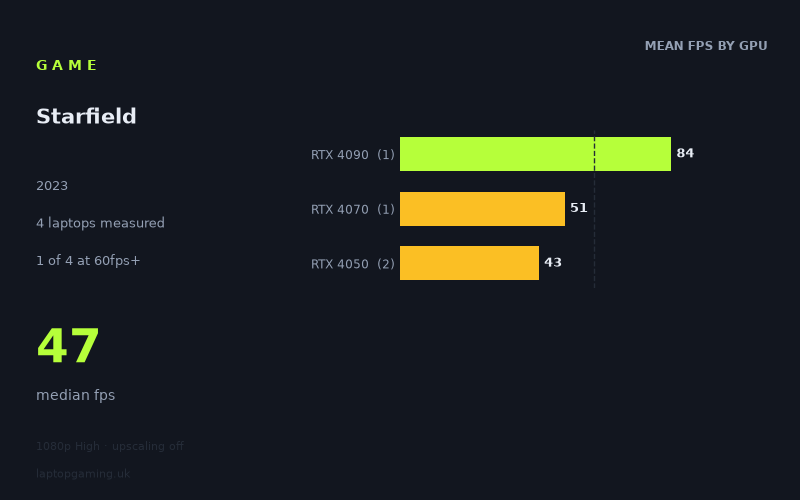
Every laptop we have figures for
Frame rates measured by Notebookcheck.
What it asks of a laptop
Starfield is demanding on the evidence available here. At 1920x1080 using the High preset with upscaling off, Notebookcheck’s measured figures range from 42fps to 84fps across four gaming laptops. That is a sizeable spread, but it is also a very small sample: these are four specific machines, not a complete picture of every laptop configuration using these GPUs.
The median result is 47fps, and only one of the four laptops reached 60fps. None reached 100fps or 144fps. That immediately makes this a game where a high-refresh laptop display is unlikely to be fully exploited at these measured settings, even with the fastest machine in this group.
The GPU-tier separation is clear. The single RTX 4090 laptop achieved 84fps, the RTX 4070 machine reached 51fps, and the two RTX 4050 laptops averaged 43fps. The difference between the RTX 4050 results and the RTX 4070 result is modest in this sample, while the step to the RTX 4090 is much larger.
That does not mean every RTX 4070 laptop will perform like the HP Victus, or that every RTX 4050 laptop will land around the same figure. Laptop GPU performance depends on the specific machine, and the figures cover only four laptops. Still, these numbers suggest that Starfield at 1080p High without upscaling is not especially forgiving of lower GPU tiers. RTX 4050 and RTX 4070 laptops in this small set are below 60fps, while the RTX 4090 machine is the only one comfortably beyond that point.
What runs it
For a measured 60fps result at 1920x1080 High with upscaling disabled, only one laptop in the data clears the line: the Asus ROG Strix Scar 18 G834JYR with an RTX 4090 running at 175W. Notebookcheck’s number for that machine is 84fps.
- RTX 4090: 84fps across one measured laptop, the Asus ROG Strix Scar 18 G834JYR. This is the only result above 60fps, and it has a 24fps margin over that target.
- RTX 4070: 51fps across one measured laptop, the HP Victus 16-r0077ng with a 140W RTX 4070. It falls 9fps short of 60fps in this test.
- RTX 4050: 43fps on average across two measured laptops. The Dell G15 5530 recorded 44fps, while the Schenker XMG Apex 15 recorded 42fps with its 140W RTX 4050. Neither reaches 60fps.
The RTX 4090 result is the only one that supports a straightforward 60fps expectation from the measured machines and settings. It is important not to overstate that conclusion: it is one RTX 4090 laptop, not a wider RTX 4090 average. Likewise, the 51fps RTX 4070 result is one HP Victus configuration, rather than proof that all RTX 4070 laptops will fall below 60fps.
No measured laptop reaches 100fps. The fastest result, 84fps from the RTX 4090 Asus, remains 16fps short. No measured laptop reaches 144fps either; the same 84fps result is 60fps below that level. If maintaining three-figure frame rates or making full use of a 144Hz panel is the priority, these measurements do not identify a laptop that can do so at 1080p High with upscaling off.
The cheapest laptop that handles it
The available pricing is too limited to identify the cheapest laptop overall. Only one machine in the fact sheet has a price: the Asus ROG Strix Scar 18 G834JYR, listed at GBP4,000. It is also the only measured laptop to exceed 60fps, recording 84fps with its 175W RTX 4090.
The HP Victus 16-r0077ng, Dell G15 5530 and Schenker XMG Apex 15 have no prices supplied here. It would therefore be wrong to call the Asus the cheapest option, even though it is the only listed machine that clears 60fps in Notebookcheck’s figures.
If “handles it” means achieving at least 60fps at the tested settings, the Asus is the only named option supported by the available data. If a reader is willing to accept frame rates below 60fps, the measured alternatives are the HP Victus at 51fps and the two RTX 4050 laptops at 42fps and 44fps. Their purchase value cannot be assessed from this data because no GBP pricing is provided for them.
What this means if you’re buying
Buy for the frame-rate level you actually want, rather than assuming that any current gaming laptop will run Starfield at 60fps on High without upscaling. In this four-laptop sample, the RTX 4050 machines sit in the low-40fps range, and the RTX 4070 laptop reaches 51fps. Those are usable measured results for some players, but they are not 60fps results under the stated test conditions.
For the most convincing result in this data set, the RTX 4090 Asus ROG Strix Scar 18 is the clear leader at 84fps. It is also the only laptop with an identified price, at GBP4,000, so it represents a substantial purchase for a result that still does not reach 100fps.
The practical lesson is that Starfield appears to reward more GPU performance, but the current figures do not justify broad guarantees for every GPU model or laptop wattage. There are only four measured systems. Treat the RTX 4090 result as evidence of what that specific 175W Scar 18 achieved, the RTX 4070 result as what that specific 140W Victus achieved, and the RTX 4050 results as what those two named laptops achieved.
For a buyer targeting 60fps at 1080p High with upscaling off, the data points to the tested RTX 4090 laptop rather than the measured RTX 4070 or RTX 4050 machines. For buyers content with around 42fps to 51fps, the lower-tier machines have recorded results, but their prices are not supplied and the sample is too small to turn those figures into a universal buying recommendation.
How these numbers were produced
Frame rates here are not measured by us, and we label how each one was arrived at. A figure marked measured comes from a published run on that exact machine. A figure marked representative is derived from the GPU and its power limit (TGP) and cross-referenced against published reviews - a sound estimate of what that configuration delivers, but not a measurement of that specific laptop. Unless stated otherwise, numbers are 1920x1080, High preset, upscaling off. Where a laptop ships in several power configurations we use the wattage of the exact SKU listed, because a 140W RTX 5070 and a 115W one are not the same product.