Review
Schenker XMG Neo 15 E22 (Early 2022, RTX 3080 Ti) review
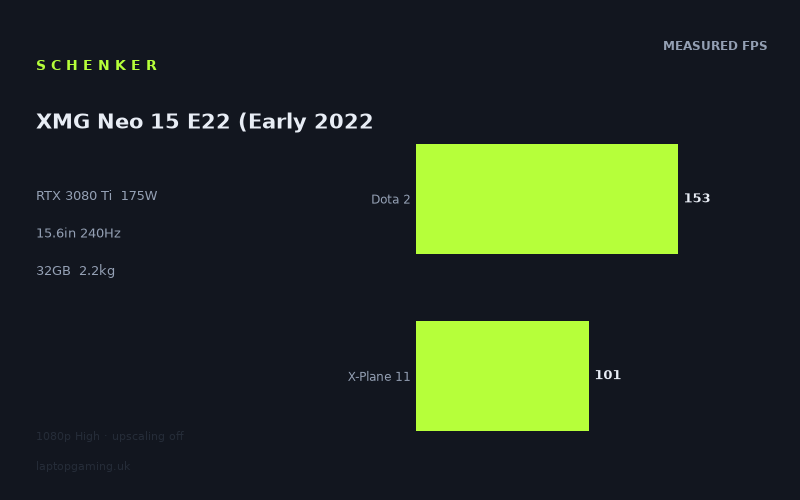
Frame rates
1920×1080, High preset, upscaling off.
Measured on this machine. Source: Notebookcheck, 2022-03-03.
Not scored: incomplete benchmark suite
Every scored laptop on this site is averaged over the same 5 games, and this one is short of Cyberpunk 2077, Baldur's Gate 3, GTA V. A mean over 3 games is not comparable to a mean over 5, so we publish the figures we have and leave the score blank rather than rank it against machines tested on a different set. The numbers below are real - the suite is just incomplete.
How these numbers were produced
Frame rates here are not measured by us, and we label how each one was arrived at. A figure marked measured comes from a published run on that exact machine. A figure marked representative is derived from the GPU and its power limit (TGP) and cross-referenced against published reviews - a sound estimate of what that configuration delivers, but not a measurement of that specific laptop. Unless stated otherwise, numbers are 1920x1080, High preset, upscaling off. Where a laptop ships in several power configurations we use the wattage of the exact SKU listed, because a 140W RTX 5070 and a 115W one are not the same product.
In use
The short version
The Schenker XMG Neo 15 E22 is a serious performance laptop on paper: an RTX 3080 Ti configured to a 175W GPU power limit, a Core i7-12700H, 32GB of memory, a 512GB SSD and a 15.6in 2560x1440 IPS display with a 240Hz refresh rate. Notebookcheck’s published figures show that it is plainly capable of high frame rates at 1920x1080 on the High preset with upscaling switched off. The important qualification is that the display’s native resolution is higher than the benchmark resolution, and there are no supplied 2560x1440 frame rates for this machine. Its 1080p results are encouraging, but they are not evidence that every measured game will run at the same rate on the internal panel at native resolution.
The measured results are strongest in The Witcher 3, where Notebookcheck recorded 212fps. Dota 2 reached 153fps, Far Cry 5 reached 140fps, Final Fantasy XV reached 115fps and X-Plane 11 reached 101fps. Across the three available scoring-suite games, the published mean is 123fps. That is a healthy result for a laptop of this generation, but the spread matters much more than the mean. This is not a machine that turns every game into a 240fps experience simply because it has a 240Hz display. Its measured figures sit below the panel’s maximum refresh rate in every listed title, with The Witcher 3 the closest at 212fps.
The XMG Neo 15 E22 therefore makes sense for somebody who values high-frame-rate gaming but understands that a fast panel is a ceiling rather than a guarantee. The available numbers suggest that it is well suited to games where frame rate matters and where playing at 1920x1080 is acceptable, including users prepared to adjust resolution or settings according to the game. It is less convincing as a straightforward “set everything to native resolution and expect 240fps” purchase, because the supplied benchmark data does not cover 2560x1440 performance at all.
Its 175W GPU power limit is significant because it tells us that Schenker did not configure the RTX 3080 Ti as a low-power implementation. That does not make the name on the GPU sufficient evidence by itself, though. The rival comparisons show why. The XMG Neo 15 E22 is effectively level with an Aorus 17X XES carrying an RTX 3070 Ti and a Lenovo Legion 5 15IAH7H carrying an RTX 3060 at 140W in the shared games, while it trails an MSI Raider GE77 HX with the same RTX 3080 Ti and the same 175W limit. A high GPU power limit is useful context, but it does not remove the need to examine the actual game data.
There is no confirmed UK price in the supplied information. That prevents a responsible value judgement. It would be wrong to call the Neo 15 E22 expensive, cheap, competitive or poor value without knowing what a UK buyer is actually being asked to pay. Performance is clear enough to discuss. Value is not. Anyone considering one should treat the absence of a confirmed price as a practical reason to compare the specific configuration and seller carefully before drawing conclusions from its component list.
There is also no complete scoring-suite result. Figures are not available here for GTA V or Strange Brigade, while scored laptops are averaged over the same five games. The XMG Neo 15 E22 cannot therefore be placed into the site’s normal ranking against fully measured machines. That is not a minor technicality: a partial game set can make a laptop look better or worse than a full five-game average would. The useful conclusion is narrower. On the available Notebookcheck measurements, this is a fast RTX 3080 Ti laptop at 1080p High settings, with excellent results in some titles, lower but still substantial figures in others, and no evidence supplied for native-resolution gaming or for a full five-game ranking.
Performance
What the published numbers show
Notebookcheck measured the Schenker XMG Neo 15 E22 at 1920x1080 using the High preset with upscaling disabled. Those conditions need to stay attached to every result. They are not native 2560x1440 measurements, they are not maximum-detail results, and they are not figures with upscaling helping the GPU. They are nevertheless useful baseline data because they show what this hardware configuration delivered without an upscaling mode changing the comparison.
- The Witcher 3: 212fps
- Dota 2: 153fps
- Far Cry 5: 140fps
- Final Fantasy XV: 115fps
- X-Plane 11: 101fps
- Mean across the available scoring-suite games: 123fps
The Witcher 3 is the standout result. At 212fps, it comes closest to the 240Hz refresh limit of the display. That does not mean the panel is fully fed at its maximum refresh rate by the listed figure: 212fps remains below 240Hz. It does mean that, under the stated 1080p High conditions, the machine is operating in the kind of high-frame-rate territory buyers of a 240Hz laptop reasonably want to see. For a player whose priority is responsiveness and who is happy with the benchmark resolution and preset, this is the result that most strongly supports the specification.
Dota 2 at 153fps is also a strong figure in isolation, but it makes a different point. It is well above the figures commonly associated with merely adequate performance, yet it remains below the panel’s 240Hz ceiling. A 240Hz display can still be useful when the game is not running at its maximum refresh rate; the panel is not made pointless by a result below 240fps. But the specification should not be read as a promise that this laptop will reach 240fps in Dota 2 under the supplied benchmark conditions. Notebookcheck’s number is 153fps, and that is the figure a buyer should use rather than an assumption based on the graphics card name.
Far Cry 5 at 140fps sits in the same broad high-frame-rate category, but it is another step away from the screen’s maximum refresh. It is comfortably above the available scoring-suite mean of 123fps, and it reinforces the point that the Neo 15 E22 can produce high figures in several different games at 1080p High without upscaling. Yet it also contributes to the wider pattern: this is not a universal 240fps machine in the measured set.
Final Fantasy XV records 115fps. That is a notably lower result than The Witcher 3, Dota 2 and Far Cry 5, while still sitting close to the 123fps mean from the available scoring-suite games. The practical reading is not that the laptop suddenly becomes unsuitable. Rather, it demonstrates why a single headline figure is a poor guide to what a gaming laptop will do. A buyer interested mainly in Final Fantasy XV should pay attention to 115fps, not to 212fps in The Witcher 3. The same RTX 3080 Ti configuration produces materially different outcomes according to the title.
X-Plane 11 is the lowest supplied result at 101fps. Again, that is below the display’s 240Hz limit and below the available scoring-suite mean. It remains above 100fps in the published data, which is substantial performance, but it is a reminder that even a high-power RTX 3080 Ti laptop does not remove game-to-game variation. For somebody choosing a laptop specifically for X-Plane 11, the relevant expectation from this data is around the reported 101fps under Notebookcheck’s stated 1080p High conditions, not a general claim of 200fps-class performance because another game reaches 212fps.
The mean is useful, but it is not the verdict
The 123fps mean across Dota 2, Final Fantasy XV and X-Plane 11 is useful as a compact description of the available scoring-suite data. It tells us that the XMG Neo 15 E22 is not relying on one exceptional game result to look quick. Across those three titles, the average remains well into high-frame-rate territory. But it is not a full-site performance result and should not be treated as one.
The scoring suite is incomplete because there are no supplied figures for GTA V or Strange Brigade. Every laptop that receives a complete site ranking is averaged over the same five games. The Neo 15 E22 has only three of those five results available, so it cannot be fairly ranked against machines with complete data. The missing games are not an administrative detail that can be ignored by simply treating the available average as if it represented the full suite. Different laptops can perform differently from game to game, and adding two titles could move a full average in either direction.
For the same reason, buyers should resist the temptation to turn 123fps into a universal expectation. It is an average from Dota 2, Final Fantasy XV and X-Plane 11 under a specific benchmark setup. It does not include The Witcher 3’s much higher 212fps result or Far Cry 5’s 140fps figure, because those are outside the stated scoring-suite mean. It also does not tell us anything directly about games not listed in the fact sheet. The responsible conclusion is simply that the available three-game scoring-suite mean is 123fps, with the individual numbers showing a range from 101fps to 153fps within that subset.
That range is more valuable to a prospective owner than a neat average. It shows that the machine’s measured performance is not flat. The spread between 101fps in X-Plane 11 and 153fps in Dota 2 is large enough that game choice should shape the purchase decision. A buyer whose regular library resembles the faster-running end of this set can reasonably view the Neo 15 E22 as a high-refresh option at the benchmark settings. A buyer whose priorities resemble the lower-running end should see it as a laptop delivering around 100fps-class performance in the available result, not as one that is close to filling its 240Hz panel.
What the 175W GPU limit means, and what it does not
The RTX 3080 Ti in this Schenker is configured with a 175W GPU power limit. That is a specification worth noting because mobile GPUs with the same name are not necessarily configured identically. In this case, the notebook is explicitly listed with a 175W limit, so the performance figures should be understood as the output of an RTX 3080 Ti operating in that stated configuration alongside a Core i7-12700H and 32GB of memory.
It would be too easy, however, to use 175W as a substitute for benchmark analysis. The published rival data directly argues against that shortcut. The MSI Raider GE77 HX also has an RTX 3080 Ti at 175W, yet the Neo 15 E22 averages 20fps behind it across the three shared games. That is a meaningful gap in the shared data despite matching GPU model and stated GPU limit. The specifications alone do not explain every performance difference, and no unsupported explanation should be invented from the figures. What can be said is that the XMG Neo 15 E22’s 175W limit does not guarantee equal results to every other 175W RTX 3080 Ti laptop.
The comparisons with lower-tier GPU names make the other side of the point. Against the MSI Prestige 15 with an RTX 3050 Ti at 105W, the Schenker averages 69fps ahead across three shared games. That is a large measured advantage. Yet against the Aorus 17X XES with an RTX 3070 Ti, the difference is effectively zero across three shared games, and against the Lenovo Legion 5 15IAH7H with an RTX 3060 at 140W, the Schenker is only 1fps behind. This is not evidence that an RTX 3080 Ti is generally no faster than those GPUs. It is evidence that the particular shared games and benchmark conditions can compress differences.
The supplied comparison guidance explains why near-zero gaps should be taken seriously rather than dismissed as an error. At 1080p, lighter titles in the shared set can be CPU-bound, compressing genuine GPU gaps. In other words, a small difference in these shared results does not prove that the GPUs are equivalent. It shows that, in those particular games at that resolution, the GPU may not be the only factor limiting the frame rate. This matters especially for someone shopping from specification names alone. The XMG Neo 15 E22 has a powerful GPU configuration, but its advantage will not necessarily appear in equal measure in every game or at every setting.
High frame rates are not the same as matching the panel
The display refresh rate is 240Hz. Of the published 1080p High results, none reaches 240fps. The Witcher 3 is nearest at 212fps. Dota 2 at 153fps, Far Cry 5 at 140fps, Final Fantasy XV at 115fps and X-Plane 11 at 101fps all sit further below the panel maximum. That should frame expectations accurately.
For a player who simply wants high frame rates, the results remain attractive. All of the supplied figures are above 100fps, and three of the five are above 140fps. But for a buyer choosing specifically because they want the benchmarked games to run at the panel’s full 240Hz limit, the data does not support that claim. The panel has more headroom than the measured results use under these conditions.
That is not automatically a criticism of the screen. A 240Hz panel does not require every game to hit 240fps before it is worthwhile. It does mean that the display specification is more ambitious than the observed output in the listed games. Buyers should think about whether they value the panel’s potential refresh ceiling, or whether they would rather pay attention primarily to the 101fps to 212fps range that the supplied results actually show.
The more important caveat is resolution. The benchmark data is at 1920x1080, while the installed screen is 2560x1440. There are no supplied native-resolution figures, so there is no responsible basis for stating how close the Neo 15 E22 comes to 240fps at 2560x1440 in any of these titles. Nor is there evidence here for claiming a particular frame-rate loss when moving from 1920x1080 to 2560x1440. The only defensible position is that the measured figures belong to 1080p High with upscaling off.
The screen
The XMG Neo 15 E22 has a 15.6in IPS panel with a 2560x1440 resolution and a 240Hz refresh rate. This is a specification aimed at buyers who want both more desktop and game detail than a 1920x1080 display provides and a refresh rate far above the standard baseline. It is also a combination that asks more searching questions of the laptop’s gaming performance than a lower-resolution screen would.
The screen’s 2560x1440 native resolution is not the resolution at which the published frame rates were recorded. Notebookcheck’s measurements are all at 1920x1080 on High settings with upscaling disabled. That distinction should be central to the buying decision, not hidden in small print. A laptop can look excellent at 1080p in benchmark charts yet deliver a different experience when asked to render games at the higher native resolution of its own display. There are no 1440p figures in the fact sheet, so this review cannot quantify that difference.
The strongest available number, 212fps in The Witcher 3, remains below the panel’s 240Hz maximum even at the benchmark resolution. The remaining figures are lower still: 153fps in Dota 2, 140fps in Far Cry 5, 115fps in Final Fantasy XV and 101fps in X-Plane 11. A buyer should therefore see the 240Hz rating as a capability of the display rather than a target that the supplied data shows being met in these games.
There are two sensible ways to interpret that. The optimistic reading is that the screen provides ample refresh headroom for games which can run very quickly, and the available 1080p figures show that this hardware can get close in at least one listed title. The cautious reading is that the panel may be more demanding than the measured data can fully justify for a buyer who expects native-resolution, maximum-refresh gaming without adjustment. Both readings are compatible with the facts. Which matters more depends on the games a buyer actually plays and whether 1920x1080 is an acceptable operating point on a 2560x1440 display.
The IPS panel type is listed, but the supplied information does not include brightness, contrast, colour coverage, response-time measurements, backlight behaviour or any assessment of image quality. It would be wrong to infer those characteristics merely from the IPS label. Likewise, there is no supplied information about whether the panel supports a particular synchronisation technology or how it behaves in motion. The display can be described accurately as a 15.6in, 2560x1440, 240Hz IPS panel. Beyond that, the benchmark data is about game frame rates, not panel quality.
The display and the benchmark setup create an important practical split in the Neo 15 E22’s identity. Its screen suggests a premium preference for resolution and refresh. Its available gaming data demonstrates high frame rates at 1080p High. Those are not contradictory, but they are not the same claim. The laptop is best approached by someone comfortable choosing settings with an eye on the game in front of them, rather than someone looking for a blanket assurance that the internal display’s full resolution and full refresh rate will be reached together in every title.
Build, size and portability
The supplied weight is 2.227kg. That places the XMG Neo 15 E22 firmly in the category of a machine a buyer can carry when needed, but not a configuration that should be evaluated as though weight were irrelevant. The combination of a 15.6in screen, RTX 3080 Ti at a 175W GPU power limit, Core i7-12700H, 32GB of memory and 93Wh battery indicates that this is a performance-led laptop rather than a specification built around minimal mass.
It is important not to overstate what the weight alone tells us. The fact sheet does not provide chassis dimensions, thickness, power-adapter weight, port selection, keyboard layout, construction materials, cooling behaviour, noise figures or surface temperatures. There is no basis here to claim that it is thin, bulky, quiet, loud, cool-running, hot-running, easy to pack or awkward to carry. Those are all matters on which published measurements or specifications would be needed.
What is clear is that 2.227kg is the machine weight provided for a laptop with a 15.6in display and high-end graphics hardware. A buyer intending to move it regularly should treat that number as part of the ownership calculation rather than focusing only on the RTX 3080 Ti label. A buyer expecting it to sit mostly in one place has a different set of priorities, and the available data is more useful there because the machine’s strongest evidence is its gaming output at 1080p.
The battery capacity is 93Wh. No battery-life measurement is supplied, so no conclusion should be drawn about how long the Neo 15 E22 lasts away from mains power. It would be particularly misleading to turn 93Wh into a claimed number of hours, because workload, screen settings and usage conditions are not covered by the fact sheet. The capacity is useful as a specification, but it is not a battery-life result.
Storage is 512GB. That is the listed capacity, but there is no supplied information about drive speed, free capacity, secondary storage provision or upgrade access. Memory is listed at 32GB, with no further information supplied about its arrangement or expandability. These are meaningful omissions for buyers who want to assess the machine as a long-term platform rather than just a benchmark result. The correct conclusion is not that either component is inadequate or excellent; it is that the available evidence establishes the fitted capacity and no more.
There is also no evidence here about build quality. The word “Neo” and the high-spec component list do not substitute for physical assessment or published build measurements. This review can analyse the relationship between its 2.227kg weight and its performance-oriented specification, but it cannot claim how rigid, premium, practical or durable the chassis feels. A buyer who places build, keyboard, trackpad, ports or acoustics ahead of raw frame rate should seek those details before treating this as a complete purchasing case.
How it compares
The available rival data is deliberately a spread rather than a list of machines with nearly identical specifications. It includes a lower-powered RTX 3050 Ti system, RTX 3060 and RTX 3070 Ti systems that are surprisingly close in the shared data, and another RTX 3080 Ti at the same 175W limit that is ahead. The comparisons are based only on games both laptops have results for, with preference given to the scoring suite. They should therefore be read as shared-game comparisons, not as complete all-game rankings.
Against the MSI Prestige 15
The MSI Prestige 15 is listed with an RTX 3050 Ti at 105W. Across three shared games, the Schenker XMG Neo 15 E22 averages 69fps ahead. This is the largest positive gap in the supplied rival list, and it supports the straightforward conclusion that the Schenker has a substantial measured performance advantage over this particular rival in the games compared.
The size of the gap matters more than the GPU branding alone. An average lead of 69fps across the shared set is not the kind of result that needs elaborate interpretation to establish that the XMG Neo 15 E22 is the faster gaming machine in those measurements. For a buyer comparing these two specifically for gaming at the stated benchmark conditions, the Schenker is the much stronger option on the available data.
There is no confirmed UK price for either machine in the supplied information, so the performance lead cannot be converted into a value judgement. It is not possible to say whether the extra measured speed is worth a given premium when no confirmed prices are available. Nor do we have shared information on display quality, battery life, dimensions, noise or other non-performance trade-offs. The correct comparison is consequently narrow but useful: the Neo 15 E22 is well ahead by 69fps across the three shared games.
Against the Aorus 17X XES
The Aorus 17X XES carries an RTX 3070 Ti, yet the XMG Neo 15 E22 averages effectively 0fps difference against it across three shared games. That near-zero result should not be brushed aside simply because the Schenker has an RTX 3080 Ti at a listed 175W GPU power limit. It is a real outcome in the shared data.
The supplied guidance explains the likely reason for this kind of compressed result: at 1080p, lighter titles in the shared set can be CPU-bound, reducing visible differences between GPUs. That does not mean the RTX 3080 Ti and RTX 3070 Ti are identical. It means that the three shared game measurements at this resolution do not expose a meaningful average advantage for the Schenker. Anyone choosing between these two machines should not assume that the higher GPU tier automatically creates a decisive 1080p advantage in every game.
There are no individual shared-game figures supplied for the Aorus comparison, so it would be wrong to claim which title favours which machine. There is also no confirmed UK price for the Aorus 17X XES. The useful conclusion is limited: the measured shared-game average is effectively tied, and the benchmark conditions can explain why genuine GPU differences may be compressed at 1080p.
Against the Lenovo Legion 5 15IAH7H
The Lenovo Legion 5 15IAH7H is listed with an RTX 3060 at 140W. The XMG Neo 15 E22 averages 1fps behind it across three shared games. That is another result that looks surprising if read only through GPU names, but it must be reported as it stands. In the shared measurements, the Schenker is not meaningfully ahead despite having an RTX 3080 Ti at 175W.
A difference of 1fps across three shared games is functionally a tie in the context of these published averages, but it is still useful evidence. It tells a buyer that, under the compared 1080p conditions, the available game set does not show the RTX 3080 Ti laptop delivering a clear lead over this RTX 3060 rival. The supplied explanation about CPU-bound lighter titles at 1080p is relevant here too: those conditions can compress GPU gaps.
This should not be turned into a claim that the Lenovo is generally as fast as the Schenker, nor into a claim that the Schenker is a poor performer. The XMG’s own figures remain high. It is simply a warning against buying on GPU hierarchy alone when the intended games and resolution may not make full use of the apparent graphics advantage. No confirmed UK price is available for the Lenovo, so there is no basis for a price-performance conclusion.
Against the MSI Raider GE77 HX
The MSI Raider GE77 HX is the most important comparison for a buyer who sees the XMG Neo 15 E22 as a high-power RTX 3080 Ti choice. It is also listed with an RTX 3080 Ti at a 175W GPU power limit, but the Schenker averages 20fps behind it across three shared games. This is the largest negative gap in the supplied rival set.
That result makes the central point of this review especially clear: an RTX 3080 Ti at 175W is not a complete performance description. The two machines share both the GPU model and the stated power limit, yet the shared-game data favours the MSI by 20fps on average. The fact sheet does not provide enough information to attribute that gap to a particular design choice, and it would be irresponsible to speculate. What the measurements establish is the outcome, not the precise cause.
For someone shopping specifically for the highest available frame rates among these rivals, the Raider has the stronger shared-game result. For someone considering the XMG Neo 15 E22, this comparison is a reason to check actual game data before assuming it matches every similarly specified RTX 3080 Ti laptop. There is no confirmed UK price for the Raider, so it remains impossible to say whether its lead comes at a justified, unjustified or irrelevant cost.
None of these comparisons creates a complete ranking for the Schenker. The site’s scoring suite is incomplete for this machine because GTA V and Strange Brigade are missing, and the rival comparisons cover only games shared by both systems. Still, the spread is useful. The Neo 15 E22 is far ahead of the RTX 3050 Ti MSI Prestige 15, effectively tied with the RTX 3070 Ti Aorus and the RTX 3060 Lenovo in the available shared data, and behind the similarly configured RTX 3080 Ti MSI Raider. That is a much more honest picture than treating the RTX 3080 Ti badge as a guarantee of a fixed place in the generation.
Who it’s for
The Schenker XMG Neo 15 E22 is for the buyer who wants high 1080p gaming performance from a 15.6in laptop and is willing to judge games individually rather than expecting one component name to answer every question. Notebookcheck’s figures support that use case well. The Witcher 3 at 212fps, Dota 2 at 153fps, Far Cry 5 at 140fps, Final Fantasy XV at 115fps and X-Plane 11 at 101fps show a machine that can produce substantial frame rates across a varied measured set with upscaling disabled.
It also suits someone who values a 240Hz panel as a high-refresh display with headroom rather than as a guarantee of 240fps in all games. The available figures show that the laptop gets closest in The Witcher 3, but none of the listed results reaches the panel’s maximum refresh rate. If the buyer’s goal is broadly high frame rates and smooth-feeling performance rather than a strict requirement to hit 240fps in every title, the specification and results fit together reasonably well.
The Core i7-12700H, 32GB of memory and 175W RTX 3080 Ti configuration make sense for someone looking at this machine as a performance-focused system rather than a minimal-weight laptop. At 2.227kg, it is not a specification that should be chosen solely for portability. It is better viewed as a laptop intended to bring powerful hardware into a format that can be moved when required, with the caveat that no dimensions, adapter weight or battery-life figures are supplied.
It may also suit a buyer who plays at 1920x1080 by choice. That is not an odd use case on a higher-resolution panel if the priority is frame rate, but it should be a deliberate choice. The benchmark data is at 1920x1080, and that is where the evidence exists. Someone content to use that resolution in the games measured has concrete figures to work from. Someone who insists on native 2560x1440 gaming has no equivalent published numbers here and should not make the purchase on assumption.
The Neo 15 E22 is less suitable for the buyer who needs a complete, directly rankable benchmark profile. With no supplied GTA V or Strange Brigade figures, it cannot be placed fairly alongside machines measured across the full five-game scoring suite. If a buyer wants a laptop chosen purely by a complete multi-game comparison, this is not enough evidence on its own.
It is also not the right pick for somebody who expects the RTX 3080 Ti label and 175W power limit to guarantee clear wins over every RTX 3070 Ti or RTX 3060 system. The Aorus 17X XES is effectively level across three shared games, while the Lenovo Legion 5 15IAH7H is only 1fps ahead in the same kind of comparison. At 1080p, lighter shared titles can be CPU-bound and compress genuine GPU gaps. The result is that this Schenker’s graphics specification may offer less visible advantage in some game-and-resolution combinations than the component hierarchy suggests.
Conversely, it is not the obvious choice for a buyer seeking the strongest measured output among the listed RTX 3080 Ti alternatives. The MSI Raider GE77 HX averages 20fps ahead across three shared games despite sharing the RTX 3080 Ti and 175W GPU limit. Without prices, that does not make the Raider automatically the better purchase. It does mean that the Schenker should not be bought on the assumption that its stated GPU configuration is the generation’s final word on performance.
Buy something else if portability is the overriding priority. The only weight supplied is 2.227kg, and there is no evidence here to support calling this a particularly light or compact machine. Buy something else if battery life away from mains power is the deciding factor, because the 93Wh battery capacity is known but no battery-life measurement is available. Buy something else if display image quality, port selection, keyboard feel, noise, temperature or chassis construction are decisive, because none of those areas is covered by the provided data.
Most importantly, buy something else—or wait for fuller information—if native 2560x1440 performance is non-negotiable. The screen is 2560x1440, but every supplied game measurement is at 1920x1080 High with upscaling off. There is no honest way to fill that gap with guessed frame rates. The available evidence supports a strong 1080p High gaming case. It does not establish how this exact configuration performs at the display’s native resolution.
For the right buyer, the XMG Neo 15 E22 remains compelling as a high-performance early-2022 machine with a powerful stated GPU configuration, 32GB of memory, a fast 15.6in IPS display and published 1080p results that range from 101fps to 212fps. The sensible buying case is not “RTX 3080 Ti equals automatic 240Hz gaming”. It is “this particular 175W RTX 3080 Ti laptop has strong attributable results in the games measured, but its performance varies by title, its native-resolution output is unconfirmed, its full benchmark ranking is unavailable, and its value cannot be judged without a confirmed UK price.”