Review
Alienware m17 R3 review
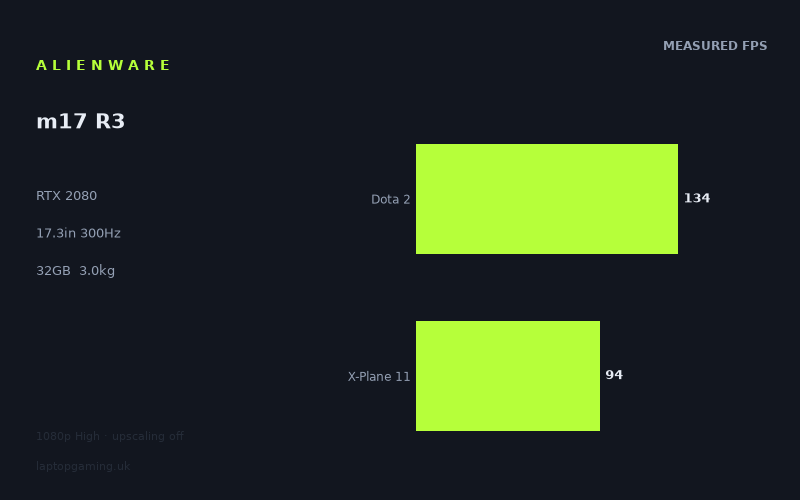
Frame rates
1920×1080, High preset, upscaling off.
Measured on this machine. Source: Notebookcheck, 2020-09-04.
Not scored: incomplete benchmark suite
Every scored laptop on this site is averaged over the same 5 games, and this one is short of Cyberpunk 2077, Baldur's Gate 3, GTA V. A mean over 3 games is not comparable to a mean over 5, so we publish the figures we have and leave the score blank rather than rank it against machines tested on a different set. The numbers below are real - the suite is just incomplete.
How these numbers were produced
Frame rates here are not measured by us, and we label how each one was arrived at. A figure marked measured comes from a published run on that exact machine. A figure marked representative is derived from the GPU and its power limit (TGP) and cross-referenced against published reviews - a sound estimate of what that configuration delivers, but not a measurement of that specific laptop. Unless stated otherwise, numbers are 1920x1080, High preset, upscaling off. Where a laptop ships in several power configurations we use the wattage of the exact SKU listed, because a 140W RTX 5070 and a 115W one are not the same product.
In use
The short version
The Alienware m17 R3 is a large, high-specification gaming laptop built around an RTX 2080, a Core i9-10980HK, 32GB of memory and a 17.3in 1920x1080 IPS display with a 300Hz refresh rate. Notebookcheck’s measured figures show that it is plainly fast at its native resolution, but they also show an important limitation: the screen’s 300Hz ceiling is much higher than the measured results in the games available here.
At 1920x1080 on the High preset with upscaling off, Notebookcheck recorded 186fps in The Witcher 3, 134fps in Dota 2, 103fps in Final Fantasy XV and 94fps in X-Plane 11. Across the three scoring-suite games for which figures are available, the mean is 110fps. That is strong performance for a 1080p gaming machine, especially for someone who values high and consistent-looking frame rates over a move to a higher-resolution panel. It is not evidence that this laptop can make full use of a 300Hz display in every game, or even in the measured games.
The m17 R3 makes the most sense for a buyer who wants a physically large 17.3in laptop, prefers 1080p gaming, and values a panel with plenty of refresh-rate headroom for less demanding games or settings below the High preset. The RTX 2080 gives it a substantial lead over the RTX 2060 Schenker XMG Core 15 in the shared benchmark set, and it remains ahead of the RTX 2070 MSI GE66 Raider. Those are meaningful advantages, even though the gap to another RTX 2080 laptop is much smaller.
It is less convincing as a straightforward “buy the biggest specification” choice. The 300Hz panel is a premium feature, but the benchmark data does not show the laptop reaching 300fps in any of the measured titles at the stated settings. The m17 R3 is also not a light machine at 2.988kg, and the available information does not include a confirmed UK price. Without that price, there is no honest way to judge whether the specification is good value against current alternatives.
There is also no complete Laptop Gaming score for this machine. The scoring suite is incomplete because there are no figures for GTA V or Strange Brigade. Every ranked laptop is averaged across the same five games, so it would be misleading to position the Alienware in that ranking using only the available results. The figures that do exist are useful, but they must be read as a partial performance picture rather than a directly comparable full-suite result.
Buy it if the appeal is specifically a 17.3in, 1080p, high-refresh Alienware with strong measured results in the games listed, and if its eventual UK price makes sense against the machines available at the time. Look elsewhere if portability matters, if you are buying mainly for a panel that can be fed at its maximum refresh rate in demanding games, or if you want a laptop whose value can be assessed immediately from a confirmed UK price.
Performance
The measured figures
The available benchmark data comes from Notebookcheck and uses a clear, useful test condition: 1920x1080, High preset, with upscaling off. That matters. These are native-resolution figures for the laptop’s own panel resolution, without relying on an upscaling mode to push the frame rate higher. They are therefore a reasonable indication of what the RTX 2080 can deliver when the m17 R3 is used as a conventional 1080p gaming laptop rather than as a machine set up around aggressive image-scaling compromises.
- The Witcher 3: 186fps
- Dota 2: 134fps
- Final Fantasy XV: 103fps
- X-Plane 11: 94fps
- Mean across the available scoring-suite games: 110fps
The Witcher 3 is the standout result at 186fps. It is the only measured title here that gets near enough to the upper reaches of the panel’s capabilities to make the 300Hz specification feel less abstract, but it still does not reach the display’s maximum refresh rate at the tested settings. That distinction matters. A 300Hz panel can refresh at 300Hz, but the game needs to produce frames at a similarly high rate for the system to make full use of that ceiling. The measured Witcher 3 result is fast, but it remains below the panel’s stated refresh rate.
Dota 2 at 134fps is also comfortably above the frame rates associated with ordinary 60Hz play. It should make the case for a high-refresh screen far better than a result near 60fps would. Yet it also underlines the same point as The Witcher 3: there is a substantial difference between “high refresh is useful” and “the panel’s maximum refresh rate is being fully exploited”. The m17 R3’s screen gives the hardware room to run at higher frame rates, but this measurement does not show it saturating the panel.
Final Fantasy XV at 103fps is still a strong 1080p High result. It is above the available scoring-suite mean of 110fps only by a small margin in the opposite direction, and it demonstrates that the m17 R3 is not dependent on one especially favourable title to look fast. At the same time, it is much closer to the region where the panel’s very high refresh rate becomes less central to the experience. A game running at 103fps can benefit from a high-refresh display, but it is not a 300fps gaming experience simply because the screen is capable of 300Hz.
X-Plane 11 is the lowest measured result at 94fps. That is not poor performance in isolation: 94fps at 1920x1080 on the High preset with upscaling off is a capable outcome. It does, however, show why it would be wrong to describe this laptop as universally suited to a 300Hz target at high settings. The available data covers a broad enough range to make the point clearly. The RTX 2080 can produce very high frame rates in some titles, but game engine behaviour and workload matter greatly.
The 110fps mean across Dota 2, Final Fantasy XV and X-Plane 11 is a useful summary, but it should not be overused. A mean makes the machine easier to place in broad terms, yet the individual figures are more useful to a buyer. Someone playing Dota 2 will care more about the 134fps result than the mean. Someone whose time is spent in X-Plane 11 should focus on the 94fps result. A laptop does not deliver an average frame rate to every game; it delivers different results according to the demands of each title.
The Witcher 3 result should also be considered separately because it is not part of the stated scoring-suite mean. It is an important measurement because 186fps is the highest figure available for the m17 R3, but it should not be folded casually into the 110fps figure or used to imply a higher full-suite result. The benchmark record available here is deliberately incomplete, and the responsible conclusion is that the machine is fast rather than that it can be assigned a complete all-games ranking.
What the spread between games tells us
The m17 R3’s results range from a very high 186fps in The Witcher 3 to 94fps in X-Plane 11. The important point is not simply that one number is higher than the other. It is that the laptop’s performance profile is shaped by the game being played, not just by the presence of an RTX 2080 and a Core i9-10980HK in the specification.
That is normal for gaming laptops, but it is particularly relevant when the display is advertised around a very high refresh rate. A 300Hz panel invites the expectation that frame rate will be the main story. The measurements show a more nuanced reality. In the available games, the m17 R3 is always well beyond a basic 60fps target, but its results do not cluster around 300fps. Instead, they sit at levels where high refresh can still be valuable while the maximum refresh rate remains largely unused at the tested High setting.
The difference between 186fps in The Witcher 3 and 94fps in X-Plane 11 is also a reminder that it is unhelpful to discuss a laptop as though it has one fixed gaming speed. Buyers sometimes see an RTX 2080 label and a 300Hz screen label and assume that those two specifications alone describe the experience. The figures do not support that simplification. The machine is capable of very strong results, but the actual result depends on the title and settings.
For a buyer choosing between a high-refresh 1080p display and a higher-resolution display, the m17 R3’s data supports the case for 1080p. The laptop is producing frame rates that can make a fast panel worthwhile. If it were limited to figures close to a basic 60Hz target, the 300Hz screen would look like a specification-sheet flourish. Here, there is enough performance to justify a high-refresh panel in principle. The caveat is that the specific 300Hz maximum remains aspirational in the available measurements rather than something demonstrated at the High preset.
The lower result in X-Plane 11 is particularly useful because it stops the review becoming a simple celebration of the highest figure. It gives a more realistic view of what a buyer should expect from the laptop: high frame rates are available, but not every game will behave like a lightweight competitive title, and not every game will allow the m17 R3 to approach its panel’s maximum refresh rate without changes to settings. The fact sheet does not provide alternative-preset measurements, so it would be wrong to claim what would happen at lower settings. It is enough to say that the tested High preset does not produce 300fps in the measured games.
The missing GPU power-limit information
The m17 R3 uses an RTX 2080, but the fact sheet does not provide a GPU power limit. That missing detail matters because laptop GPUs with the same name can perform differently depending on their configured power, cooling arrangement and overall system design. It would be easy to assume a particular power figure from the size of the chassis or from the Alienware branding, but that would be speculation rather than analysis.
As a result, the sensible way to judge this implementation is through the available benchmark data rather than through an assumed power limit. The measured results show a laptop that is quick at 1920x1080 High settings. They do not reveal exactly how much electrical power the GPU is configured to use, nor do they allow a precise claim about whether this RTX 2080 is operating at a higher or lower power level than every other RTX 2080 laptop.
This is especially relevant when looking at the comparison with the Asus Strix Scar 17 and MSI GT76 Titan DT. Both are also RTX 2080 machines, yet the Alienware is effectively level with the Asus across the shared games and behind the MSI across the shared games. Those outcomes could reflect a mixture of GPU configuration, cooling, processor behaviour, memory configuration and the particular games included in the shared comparison. Without the power-limit figure and without full per-game data for every machine in this review, it would be irresponsible to reduce the difference to one cause.
What can be said with confidence is that the RTX 2080 in this Alienware is not automatically the fastest result among the listed RTX 2080 laptops merely because it shares the same GPU designation. The GT76 Titan DT holds an advantage across the shared games, while the Strix Scar 17 produces no average difference in that same shared comparison. The m17 R3 is competitive within that group, but the designation on the GPU is not enough to establish a hierarchy by itself.
That is why buyers should treat the benchmark figures as more useful than the badge. “RTX 2080” tells you the general class of hardware. The Notebookcheck figures tell you what this particular Alienware delivered in the measured games and settings. For the m17 R3, that means excellent 1080p results, but not evidence of 300fps performance at High settings across the tested selection.
What the performance means in practice
The measured figures point to a machine that should be considered a high-frame-rate 1080p laptop rather than a laptop defined solely by its 300Hz display. That might sound like a subtle distinction, but it affects the buying decision. A person who wants a fast screen for smoother movement, lower persistence and the ability to benefit from frame rates above a basic 60Hz target has a clear reason to consider the m17 R3. A person who wants the display’s maximum refresh rate to be a routinely achievable target in demanding games has less support from the available data.
The Witcher 3 result is strong enough to make the panel’s speed feel relevant. Dota 2 at 134fps also makes a high-refresh display an appropriate pairing. Final Fantasy XV and X-Plane 11 show a different kind of benefit: the screen is still capable of displaying the frame rate the laptop produces without being restricted to a lower-refresh ceiling, but the jump from a conventional high-refresh panel to 300Hz is harder to justify from those figures alone.
There is no need to pretend that a 300Hz panel becomes useless below 300fps. That would be an equally unhelpful simplification. The issue is not whether the display can offer an advantage below its maximum refresh rate; it can. The issue is whether the benchmark data supports paying extra for the specific 300Hz headline. Without a confirmed UK price, that value judgement cannot be settled here. The performance data says the panel has useful headroom. It does not say that every buyer will realise the full benefit of that headroom.
The 32GB of memory and 1TB SSD are substantial supporting specifications for a gaming laptop, but there are no storage-speed, memory-performance or application-workload measurements in the fact sheet. It is reasonable to note that the machine is configured with 32GB and 1TB, but not to claim a particular loading-time benefit, multitasking result or content-creation performance level from those specifications alone.
Similarly, the Core i9-10980HK is a high-end processor in the stated configuration, but there are no processor benchmark results in the supplied data. The gaming figures demonstrate the performance of the complete laptop in the listed titles, not a separate CPU result. That distinction matters because buyers should not assume that the processor specification alone explains the m17 R3’s results, particularly where lighter titles can become CPU-bound at 1080p.
The screen
A 17.3in 1080p IPS panel
The Alienware m17 R3 has a 17.3in IPS display with a 1920x1080 resolution and a 300Hz refresh rate. This is a deliberately performance-led display specification. The 1080p resolution keeps the pixel load lower than a higher-resolution panel would, while the 300Hz refresh rate prioritises motion clarity and responsiveness for games capable of producing very high frame rates.
The IPS panel type is worth noting because it identifies the display technology, but the fact sheet does not provide measurements for brightness, contrast, colour coverage, response times or backlight behaviour. Those are all important parts of screen quality, especially for a premium gaming laptop, and they should not be guessed from the IPS label alone. The available information supports a discussion of size, resolution, refresh rate and panel type, not a definitive judgement on image quality beyond those specifications.
At 17.3in, 1920x1080 is a straightforward fit for the m17 R3’s gaming focus. The benchmark data shows why. The RTX 2080 is able to generate frame rates well above a basic 60fps target in every measured title at native resolution and High settings. A higher-resolution panel could have offered more desktop space or pixel density, but the available measurements are for 1080p and should be judged on that basis. The m17 R3’s configuration is aimed at pushing frames rather than at pursuing resolution for its own sake.
That makes sense for the laptop’s 300Hz positioning. A high-refresh display needs high frame rates to show what it can do, and 1080p makes that more achievable than a more demanding resolution would. The m17 R3’s results demonstrate that the approach has merit: 186fps, 134fps, 103fps and 94fps are all much more naturally paired with a high-refresh screen than with a panel limited to a conventional basic refresh rate.
Can the RTX 2080 drive 300Hz?
The direct answer from the available data is no, not at the tested 1920x1080 High preset with upscaling off in any of the measured games. The highest result, 186fps in The Witcher 3, remains below 300fps. Dota 2 reaches 134fps, Final Fantasy XV reaches 103fps and X-Plane 11 reaches 94fps. The 300Hz display is therefore not being driven to its maximum refresh rate in the published figures.
This should not be framed as a failure of the laptop. A 300Hz screen is an unusually high target, and the m17 R3’s results remain strong. The important point is that buyers should understand what they are getting. They are buying a laptop with a very fast panel and the potential to benefit from high frame rates. They are not buying evidence that demanding games will always run at the panel’s maximum refresh rate at High settings.
The panel makes most immediate sense for games that are less demanding than the ones represented by the lower results here, or for owners who are prepared to alter settings where that is appropriate. However, the fact sheet provides no lower-preset measurements and no results for additional competitive games. It would be wrong to claim a specific frame rate for those scenarios. The safe conclusion is simply that the 300Hz panel provides headroom beyond the results currently documented.
For The Witcher 3, the 186fps measurement is a particularly good fit for a high-refresh display even though it is below 300Hz. For Dota 2, 134fps also gives the screen meaningful work to do. Final Fantasy XV at 103fps and X-Plane 11 at 94fps remain above the level where a high-refresh panel becomes pointless, but they are further from the display’s defining specification. Buyers who play games closer to those results should value the 17.3in IPS panel and its native 1080p resolution at least as much as the 300Hz headline.
There is another practical consideration. A 300Hz display does not require a game to hit 300fps to be usable, but it does mean the buyer is paying for capability that the available benchmark set does not fully demonstrate. That is acceptable if the screen is part of a broader preference for fast-refresh gaming, but less persuasive if the purchase is being made solely because “300Hz” sounds categorically better than lower refresh rates.
Build, size and portability
The m17 R3 weighs 2.988kg. That immediately places it on the large-laptop side of the market rather than in the category of machines chosen for effortless daily carrying. The 17.3in screen already signals that this is designed to provide a more expansive gaming setup than a smaller laptop. The weight reinforces that impression.
A 2.988kg laptop can still be transported, but it is not the sort of machine to choose if the main requirement is minimum bag weight. Its likely role is better understood as a laptop that can move between rooms, desks, homes or occasional travel locations while still prioritising a large screen and high gaming performance. It is portable in the literal sense, but the specification does not suggest a portability-first design.
The fact sheet does not provide chassis dimensions, so there is no basis for claims about how thin, deep or wide the m17 R3 is. It also does not provide information about the power adaptor, ports, keyboard, trackpad, speakers, webcam, materials, upgrade access or cooling noise. Those omissions matter because they are the details that often determine whether a large gaming laptop is pleasant to use outside a benchmark chart.
It would be misleading to fill those gaps with general assumptions about Alienware laptops or about 17.3in gaming machines. Large gaming laptops can differ significantly in their practical footprint, cooling requirements and desk presence. Here, the information available supports a narrow but useful conclusion: the m17 R3 is a 17.3in laptop weighing 2.988kg, so it is better suited to buyers comfortable with a substantial machine than to buyers who need something genuinely light.
The 86Wh battery is another specification that requires careful handling. Battery capacity is not battery life. There are no runtime measurements in the fact sheet, so there is no basis for claiming how long the m17 R3 lasts away from mains power in gaming, browsing, video playback or any other use. Gaming laptops can vary substantially in battery behaviour depending on settings and workload, and the 86Wh figure alone does not settle the question.
For prospective owners, the practical implication is straightforward. Treat the 86Wh battery as a capacity specification, not as a promised duration. If mobile use away from a plug socket is central to the purchase, more battery-life evidence is needed before making a decision. If the laptop will mainly be used on a desk or in locations with power available, the lack of runtime data is less critical, though it remains a gap in the published picture.
The same caution applies to thermals and noise. The m17 R3 contains an RTX 2080 and Core i9-10980HK in a 17.3in chassis, but the supplied information contains no temperature or noise figures. There is no basis for declaring it cool, hot, quiet or loud. The benchmark figures show its performance, not the acoustic or thermal trade-offs involved in producing that performance.
That limitation is especially relevant to a buyer comparing it with the MSI GT76 Titan DT, another RTX 2080 laptop that is ahead in the shared games. It would be tempting to explain the MSI’s lead through cooling or size, but no such supporting data is supplied here. The correct reading is only that the MSI produces the better shared-game average, while the reasons for that difference are not established by the fact sheet.
How it compares
Important limits on the comparison
The rival figures are shared-game comparisons rather than complete five-game scores. That is the right approach because the Alienware’s available scoring suite is incomplete. There are no m17 R3 figures for GTA V or Strange Brigade, so a full-suite ranking would not be fair. Comparing only the games that both machines hold avoids pretending that missing results do not matter.
The shared-game results also need to be read with some context. At 1080p, lighter titles in the shared set can be CPU-bound, which compresses genuine GPU gaps. That is why a very small average difference is still a meaningful result. It does not necessarily mean two GPUs are identical in every condition; it can mean that the games and resolution are limiting the ability of the faster graphics hardware to pull away.
For the m17 R3, the comparison pattern is clear. It has a major advantage over the RTX 2060 machine listed here, a smaller but still positive advantage over the RTX 2070 laptop, no average difference against one RTX 2080 rival, and a deficit against another RTX 2080 rival. That is more useful than treating the RTX 2080 label as an automatic guarantee of a fixed position.
Against the Schenker XMG Core 15
Against the Schenker XMG Core 15 with an RTX 2060, the Alienware averages 50fps more across the three shared games. This is the m17 R3’s largest advantage among the listed comparisons, and it is substantial enough to matter without qualification. The m17 R3 is not merely edging ahead of the RTX 2060 rival; it is operating in a clearly higher performance bracket in the shared data.
For a buyer choosing between these two types of machine, the Alienware’s benchmark advantage is the strongest performance argument in its favour. Its 17.3in 300Hz screen is also more naturally matched to the higher frame rates suggested by this gap. A laptop that is ahead by 50fps across shared games has much more scope to make use of a high-refresh display than one with lower graphics performance.
There is no confirmed UK price for either the Alienware m17 R3 or the Schenker XMG Core 15 in the supplied information. That prevents a proper value comparison. A 50fps advantage is compelling as a performance result, but performance alone is not the whole buying decision. If the Alienware were available at a much different price from the Schenker, that would materially affect the recommendation. The current information does not establish that part of the comparison.
The difference in GPU class is relevant, but the shared benchmark outcome matters more than the label. The m17 R3’s RTX 2080 delivers a sizable gain over the RTX 2060 XMG Core 15 in the games both machines hold. If the priority is maximum frame rate at 1080p, the Alienware has the stronger case. If portability, price or a smaller chassis matters more, the fact sheet does not provide enough information to decide between them on those grounds.
Against the MSI GE66 Raider
The MSI GE66 Raider uses an RTX 2070, and the Alienware averages 7fps more across the three shared games. This is a much narrower win than the one over the RTX 2060 Schenker. It still matters, because the m17 R3 is ahead in the available shared comparison, but it is not the kind of result that should automatically override every other consideration.
A 7fps average advantage is the sort of gap that needs to be interpreted rather than advertised loudly. It supports the conclusion that the Alienware is faster in the games both machines hold, but it does not establish a vast divide in real-world gaming capability. At 1080p, lighter titles in the shared set can be CPU-bound, compressing genuine GPU gaps. That context is particularly important when comparing an RTX 2080 laptop with an RTX 2070 laptop and finding a relatively modest average difference.
The practical message is that the m17 R3 has the performance lead, but the lead is not large enough in this data to make the MSI irrelevant. Buyers should consider the Alienware’s larger 17.3in 300Hz display and 2.988kg weight as part of the package rather than focusing only on the RTX badge. The GE66 may appeal to a different kind of buyer depending on its price and physical design, but no confirmed UK price is available here for either machine.
The Alienware’s advantage becomes more meaningful if the buyer specifically wants the largest screen and the high-refresh positioning. It becomes less decisive if the buyer simply wants strong 1080p performance and is willing to compare the wider machine characteristics. The shared figures establish that the Alienware is ahead, but they do not support an argument that it is in a completely different league from the MSI GE66 Raider.
Against the Asus Strix Scar 17
The Asus Strix Scar 17 also uses an RTX 2080. Across the three shared games, the Alienware averages no difference against it. This is one of the most useful results in the comparison section because it demonstrates how little the GPU name alone tells a buyer once two machines occupy the same broad class.
An average difference of effectively nothing should not be dismissed as unhelpful. It is a real outcome. At 1080p, lighter titles in the shared set can be CPU-bound, which compresses genuine GPU gaps. When that happens, two laptops with similar high-end graphics hardware can produce extremely close results even if their internal configurations are not identical.
The right conclusion is not that the m17 R3 and Strix Scar 17 are necessarily identical in every game or every setting. The shared benchmark set is limited, and the comparison only covers the games both machines hold. The correct conclusion is narrower and more valuable: there is no average performance reason in these shared results to prefer one of these RTX 2080 laptops over the other.
That shifts the buying decision towards factors not fully documented in the fact sheet. The Alienware offers a 17.3in 1920x1080 300Hz IPS display and weighs 2.988kg. The information supplied here does not provide equivalent physical, screen, battery, acoustic or price data for the Asus. Therefore, the m17 R3 cannot be declared the better purchase overall. It can only be said to be effectively level with the Strix Scar 17 in the available shared-game comparison.
This is exactly where a buyer should resist the urge to choose based on brand reputation or a processor-and-GPU headline. The benchmark data says performance is a draw in the shared games. If both were available, the deciding factors would need to be confirmed price, screen preferences, portability and the other practical details that are not established here.
Against the MSI GT76 Titan DT
The MSI GT76 Titan DT is the listed machine that beats the Alienware by the largest margin. It also uses an RTX 2080, and it averages 11fps more than the m17 R3 across the three shared games. This is not an enormous gulf, but it is a consistent enough shared average to put the MSI ahead in the data available.
The GT76’s advantage is important because it prevents the Alienware from being described as the definitive RTX 2080 result among these rivals. It is not. The m17 R3 is effectively level with the Asus Strix Scar 17, but the MSI GT76 Titan DT delivers the stronger shared-game average. A buyer focused only on extracting the highest available performance from this comparison group should therefore look closely at the MSI.
However, the figures do not explain why the MSI is ahead. The fact sheet does not provide GPU power limits, thermal results, acoustic measurements, dimensions, battery-life figures or complete game-by-game breakdowns for the comparison. Any attempt to attribute the 11fps margin to a particular cooling system or power configuration would be unsupported.
The measured outcome is enough to establish the performance order in the shared games: the MSI is ahead. It is not enough to establish whether that lead is worth any difference in size, weight, price or usability. No confirmed UK price is available for either machine in the supplied information, so there is no responsible way to turn the performance lead into a value verdict.
For the Alienware, this comparison is a reminder that a large 17.3in machine with an RTX 2080 is not automatically the fastest option in its generation. The m17 R3 is a strong performer, but buyers with access to an MSI GT76 Titan DT should not assume the Alienware’s specification is superior simply because the core GPU class is the same.
Who it’s for
The Alienware m17 R3 is for the buyer who wants a large-screen gaming laptop and is comfortable treating it as a substantial portable system rather than a lightweight everyday machine. The 17.3in display, 2.988kg weight, RTX 2080 and Core i9-10980HK point towards a laptop intended to prioritise gaming performance and screen speed over minimal mass.
It is a good fit for someone playing at 1920x1080 who wants frame rates well beyond a basic 60fps target. The available Notebookcheck data is clear on that point. The Witcher 3 at 186fps, Dota 2 at 134fps, Final Fantasy XV at 103fps and X-Plane 11 at 94fps are all strong native-resolution High-preset results with upscaling off.
It also suits the buyer who values refresh-rate headroom rather than demanding that every game hit 300fps. The 300Hz IPS panel is not fully driven by any of the measured figures, but the laptop does produce high enough frame rates for a fast screen to be more than a decorative specification. The key is to buy it for high-refresh 1080p gaming generally, not on the assumption that the number printed beside the panel will be reached in every demanding title.
The m17 R3 has the clearest performance case against lower-tier graphics hardware. Its 50fps shared-game advantage over the RTX 2060 Schenker XMG Core 15 is large. Its 7fps advantage over the RTX 2070 MSI GE66 Raider is smaller, but it remains an advantage. A buyer choosing primarily on measured frame rate should recognise that the Alienware belongs above those machines in the available comparison data.
It is also for someone who understands that the 32GB memory and 1TB SSD are part of a generous configuration, while recognising that no storage or wider productivity measurements are provided here. The specifications are substantial, but the gaming data remains the main basis for recommendation.
Who should buy something else
Buy something else if low weight is a priority. At 2.988kg, the Alienware is not the obvious choice for someone who carries a laptop daily and wants the least burdensome option. The fact sheet does not provide dimensions, so its precise footprint cannot be assessed, but the combination of a 17.3in screen and this weight is enough to identify it as a large machine.
Buy something else if your main reason for choosing it is the promise of 300Hz gaming at High settings. The available measurements do not show 300fps in any tested title. The m17 R3 is fast, but its documented results are 186fps at the high end and 94fps at the low end. Those figures support a high-refresh experience; they do not demonstrate full use of the panel’s maximum refresh rate.
Buy something else, or at least wait for more information, if value is the deciding factor. The UK price is not confirmed. Without a price, there is no honest way to say whether the Alienware is good value, poor value or fairly priced against the Schenker XMG Core 15, MSI GE66 Raider, Asus Strix Scar 17 or MSI GT76 Titan DT. A performance result is not a value conclusion without the cost of entry.
Buy something else if you need a complete five-game benchmark ranking. The m17 R3 has no available figures for GTA V or Strange Brigade, so it cannot be placed fairly alongside laptops averaged across the complete scoring suite. The three-game mean of 110fps is useful as a partial summary, but it is not a substitute for a complete shared methodology.
Buy something else if you need confirmed battery-life, noise, thermal, display-quality or physical-dimension information before committing. The m17 R3 has an 86Wh battery, but no battery runtime figures are supplied. It has an IPS panel, but there are no brightness, contrast, colour or response-time measurements. It has high-end components, but there are no temperature or noise figures. Those gaps do not make the laptop bad; they simply mean those aspects cannot be responsibly judged from the available evidence.
The final view is therefore positive but conditional. The Alienware m17 R3 is a capable 1080p gaming laptop with genuinely strong Notebookcheck frame-rate figures, a large 17.3in IPS display and a 300Hz refresh rate that provides considerable headroom. It convincingly outperforms the RTX 2060 Schenker XMG Core 15 in the shared games, stays ahead of the RTX 2070 MSI GE66 Raider, matches the RTX 2080 Asus Strix Scar 17 on average, and trails the RTX 2080 MSI GT76 Titan DT.
Its weaknesses are not exposed as poor gaming performance. They are uncertainty and fit. There is no confirmed UK price, no complete scoring-suite result, no stated GPU power limit, no battery-life measurement, no thermal or noise data, and no chassis dimensions. For the right buyer, the documented performance is enough to make the m17 R3 worth serious consideration. For anyone who needs portability, confirmed value or proof of sustained 300Hz gaming in demanding titles, the published data gives good reasons to be more cautious.