Performance analysis
ARC Raiders (2025): what it takes to run it
Measured on 6 gaming laptops at 1920×1080, High preset, upscaling off.

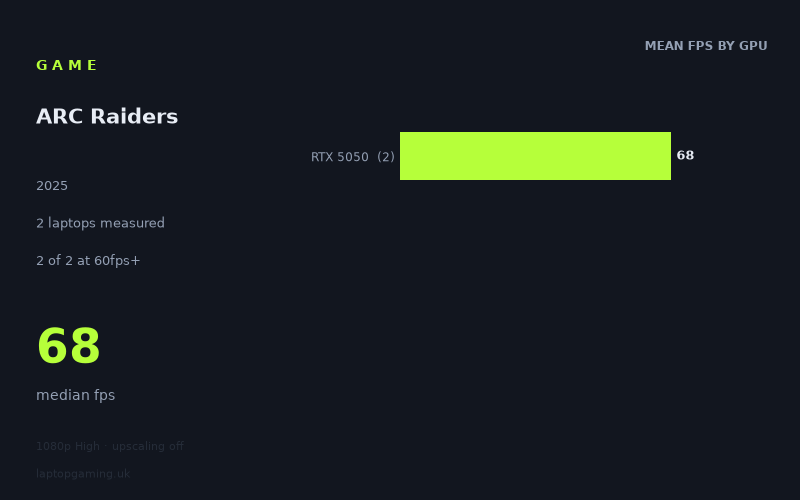
Every laptop we have figures for
Frame rates measured by Notebookcheck.
The sample: two laptops, one GPU tier
Before anything else, the caveat that shapes this entire piece: Notebookcheck's figures for ARC Raiders cover exactly two laptops, and both of them use the same GPU — the RTX 5050. That is not enough data to build a settings guide on, and it is nowhere near enough to draw a curve across the mobile GPU stack. There are no measured numbers here for the 5060, 5070, 5080 or 5090, nor for anything from the previous generation.
So this is not "here is how ARC Raiders scales on gaming laptops". This is "here are two machines, here is exactly what they did, and here is the narrow set of conclusions those two results can actually support". Anything beyond that would be guesswork dressed up as analysis.
What it asks of a laptop
The measured configuration is 1920x1080, High preset, with upscaling switched off. That last detail matters more than it might sound: these are native-resolution numbers with no reconstruction propping them up, which makes them a clean read on the raw rendering cost rather than a read on how good the upscaler is.
The two results:
- 72fps — Acer Nitro V14 AI (RTX 5050)
- 64fps — MSI Cyborg 15 (RTX 5050, £984)
Median 68fps. Both machines clear 60fps. Neither reaches 100fps, let alone 144fps.
The honest reading of that is: at 1080p High with no upscaling, ARC Raiders is a real load — but not an unreasonable one. The entry-level current-generation GPU in the sample produces playable frame rates without any assistance from the settings menu or from reconstruction. That puts it in a different bracket to the genuinely punishing releases, where a 5050 at native 1080p High would be scraping along in the thirties and forties.
What we can't tell you from two data points is where the difficulty comes from. With only one GPU tier represented, there is no way to see whether the game scales cleanly with more raster horsepower, whether it starts leaning on the CPU further up the stack, or whether VRAM becomes the pinch point at higher resolutions. Any claim about how a 5070 or 5080 behaves here would be invention. We don't have those numbers.
The gap between two identical GPUs
The more interesting thing in this tiny dataset is the eight-frame spread between two laptops with the same GPU. That is roughly a 12% difference from the same silicon, which tells you that on this game, at this preset, the specific chassis matters. Power delivery and cooling headroom vary substantially between designs — a thicker 15in machine and a compact 14in machine with nominally identical GPUs routinely land in different places, and here the 14in Acer is the faster of the two.
The practical takeaway is not "buy the Acer". It is that "RTX 5050" on a spec sheet is not a frame rate prediction. Two machines wearing the same badge landed at 72fps and 64fps. A third one you're looking at could sit either side of that range, and we have no figures for it.
What runs it
Working through the tiers with only the measured numbers available:
- Clears 60fps: 2 of 2. Both RTX 5050 laptops in the sample, at 1080p High, native. Mean for the tier is 68fps.
- Clears 100fps: 0 of 2. Neither machine gets close — the fastest result is 72fps, some 28 frames short.
- Clears 144fps: 0 of 2. Not remotely, on this hardware at these settings.
That is the complete picture the data supports. For anything above the 5050, we have no measured figures at all, and we're not going to extrapolate a number for you. What you can reasonably infer is directional rather than numerical: a game that already runs at 64-72fps on entry-level current-gen hardware at native 1080p High is not going to be a wall for the tiers above it. But whether a 5060 lands at 85fps or 105fps, and whether a 5070 gets you to a stable 144, are questions this dataset cannot answer.
If you want high frame rates
Neither measured laptop reaches 100fps at these settings, so if you're running a 144Hz or 165Hz panel — which most gaming laptops in this bracket have — a 5050 at native 1080p High is not going to feed it. Turning on upscaling would obviously change that, and lowering the preset would too, but there are no measured figures here for either scenario, so we can't tell you how much you'd gain. What we can say is that the gap between 72fps and 144fps is large enough that it would take more than a nudge.
The cheapest laptop that handles it
Of the two machines with figures, the MSI Cyborg 15 at £984 is the only one with a price attached, and it returned 64fps at 1080p High native. That is a playable result and, on the evidence available, the cheapest confirmed way to get one — a sub-£1,000 machine holding above 60fps at native resolution on the High preset with no upscaling crutch.
The Acer Nitro V14 AI was the faster of the pair at 72fps, but no price is given in the measured data, so we can't tell you whether it represents better value.
Two machines is not a value survey. Treat the £984 Cyborg as a proof point — "this class of laptop, at this price, produced this number" — rather than as a recommendation that any £984 laptop will match it.
What this means if you're buying
If you already own an RTX 5050 laptop, the measured evidence says you are very likely fine at 1080p High, and you should expect something in the 60-75fps region depending on how well your particular chassis is cooled and powered. That's the one solid conclusion here.
If you're buying and you want a locked 100fps or more, the honest answer is that we don't have the data to tell you which GPU gets you there. The two-laptop sample stops at 72fps. Spending up from a 5050 will clearly help — the question is how much, and there are no measured figures to quantify it.
And if you're weighing two laptops with the same GPU, note the 12% gap between the Acer and the MSI. On this game, chassis quality was worth roughly the difference between comfortable and merely adequate.
How these numbers were produced
Frame rates here are not measured by us, and we label how each one was arrived at. A figure marked measured comes from a published run on that exact machine. A figure marked representative is derived from the GPU and its power limit (TGP) and cross-referenced against published reviews - a sound estimate of what that configuration delivers, but not a measurement of that specific laptop. Unless stated otherwise, numbers are 1920x1080, High preset, upscaling off. Where a laptop ships in several power configurations we use the wattage of the exact SKU listed, because a 140W RTX 5070 and a 115W one are not the same product.