Review
MSI GP76 Leopard review
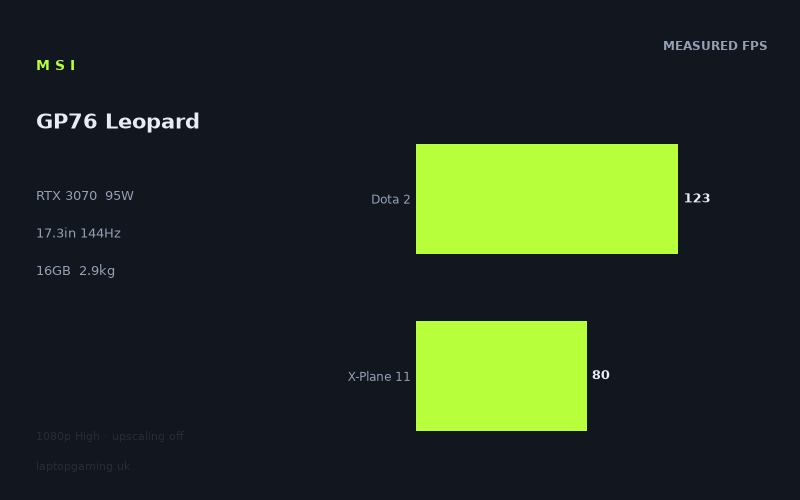
Frame rates
1920×1080, High preset, upscaling off.
Measured on this machine. Source: Notebookcheck, 2021-03-06.
Not scored: incomplete benchmark suite
Every scored laptop on this site is averaged over the same 5 games, and this one is short of Cyberpunk 2077, Baldur's Gate 3, GTA V. A mean over 3 games is not comparable to a mean over 5, so we publish the figures we have and leave the score blank rather than rank it against machines tested on a different set. The numbers below are real - the suite is just incomplete.
How these numbers were produced
Frame rates here are not measured by us, and we label how each one was arrived at. A figure marked measured comes from a published run on that exact machine. A figure marked representative is derived from the GPU and its power limit (TGP) and cross-referenced against published reviews - a sound estimate of what that configuration delivers, but not a measurement of that specific laptop. Unless stated otherwise, numbers are 1920x1080, High preset, upscaling off. Where a laptop ships in several power configurations we use the wattage of the exact SKU listed, because a 140W RTX 5070 and a 115W one are not the same product.
In use
The short version
The MSI GP76 Leopard is a large-screen gaming laptop built around a Core i7-10750H and an RTX 3070 running at a 95W GPU power limit. The published benchmark data shows a machine that can deliver genuinely strong Full HD performance in several demanding games, but it should not be treated as a universal 144fps laptop simply because it has a 144Hz screen. Notebookcheck’s measured figures range from 123fps in Dota 2 down to 34fps in Anno 1800 at 1920x1080, High settings and with upscaling disabled. That is a wide spread, and it is more useful than a single headline average.
The good news is that the GP76’s RTX 3070 is far from wasted at its native resolution. Dota 2 runs close to the display’s refresh limit, Final Fantasy XV reaches 90fps, and X-Plane 11 reaches 80fps. Those are healthy results for a 1920x1080 gaming laptop, particularly with High settings rather than a reduced preset. The less flattering result is Anno 1800. At 34fps, it is the clear outlier in the figures available, and it shows why buying on GPU name alone is a poor shortcut. This laptop has an RTX 3070, but particular game engines, simulation workloads and CPU-heavy scenes can still stop it from delivering the kind of smoothness implied by a 144Hz panel.
There is also an important limitation to be clear about. We have figures for Dota 2, Final Fantasy XV and X-Plane 11 from the site’s scoring suite, but no results for GTA V or Strange Brigade. That means the available scoring-suite set is incomplete. Every fully scored laptop is averaged across the same five games, so this GP76 cannot honestly be placed into the wider ranked table from only the published partial set. The mean across its three available scoring-suite games is 98fps, which is useful context for the laptop’s performance level, but it is not a substitute for a full like-for-like ranking.
The GP76 Leopard makes most sense for someone who wants a 17.3in IPS gaming screen, plays primarily at 1920x1080, and values a substantial desktop-replacement style machine more than low carry weight. At 2.9kg before considering the charger, it is not the model to choose for regular commuting, all-day university use or frequent travel. It is better understood as a laptop that can be moved when necessary, rather than a machine designed to disappear into a bag.
It is also a machine that needs to be judged without a confirmed UK price. That matters. A 95W RTX 3070 can be an attractive proposition if it is priced sensibly against other large gaming laptops, but the GP76’s performance alone cannot establish value without knowing what UK buyers are asked to pay. The specification is credible: 16GB of memory, a 512GB SSD, a 17.3in 144Hz IPS screen and an RTX 3070 are all appropriate components for Full HD gaming. But the final buying case depends heavily on price, and there is no confirmed UK figure here.
Buy it if you want a big-screen Full HD machine, accept that performance will vary sharply by game, and can use the extra screen size and 144Hz panel in the titles where the RTX 3070 gets close to that refresh ceiling. Look elsewhere if portability is central, if you need evidence of consistently high-refresh performance in demanding strategy and simulation games, or if the eventual UK price puts it close to better-powered alternatives.
Performance
The benchmark picture is strong, but not uniform
Notebookcheck’s measurements were taken at 1920x1080 using the High preset, with upscaling disabled. That is the right context in which to read every result here. These are not low-detail figures designed to make a gaming laptop look faster than it will in normal use, and they are not assisted by upscaling. They show what the MSI GP76 Leopard can do at the native resolution of its own display while using a reasonably demanding graphics setting.
Across the three scoring-suite games for which figures are available, the mean is 98fps. That is a strong general indicator for Full HD gaming, but the individual game results matter more than the mean. The available data is not tightly clustered around one result. Instead, it includes a very high figure, two solid but clearly sub-144fps results, and one much lower result outside the scoring suite. A buyer looking only at the 98fps mean could easily form the wrong expectation: the GP76 is capable of high frame rates, but it is not producing the same experience in every game.
Dota 2 is the most favourable result. The measured figure is 123fps. On a 144Hz display, that is close enough to the panel’s ceiling to make the high-refresh screen meaningful. It does not fully reach 144fps in the published measurement, so it should not be described as a locked 144fps result, but it is much nearer the panel’s intended operating range than the other figures. For players whose main interest is Dota 2, the combination of 123fps and a 144Hz IPS display is persuasive. The screen’s extra refresh headroom is not merely decorative in that game.
Final Fantasy XV lands at 90fps. That remains a good result for a High preset at 1920x1080 with upscaling off. It should support a visibly smoother experience than a conventional 60Hz target, while still leaving clear unused capacity on the 144Hz panel. The important practical point is that this is not a result that fully justifies buying the GP76 specifically for constant maximum-refresh play in demanding games. It is, however, an indication that the 95W RTX 3070 has enough performance to make a 144Hz screen more useful than it would be with a lower-tier GPU.
X-Plane 11 reaches 80fps. That is another respectable Full HD result, especially for a title whose workload is not simply a question of graphics hardware. Flight simulation performance can be affected by processing demands as well as graphics settings, and the published figure illustrates why an RTX 3070 badge cannot be read as a guarantee of identical frame rates across genres. At 80fps, the GP76 is well beyond a basic 60fps target, but it is still nowhere near filling the 144Hz panel. For flight-simulation buyers, that distinction is worth taking seriously. The screen will still offer a smoother presentation than a 60Hz display when the game runs at this level, but the measured figure does not suggest a machine built around consistently maximising a 144Hz display in this kind of workload.
Anno 1800 is the result that demands the most caution. Notebookcheck’s measured figure is 34fps. This is not a marginal shortfall from the display refresh rate; it is a fundamentally different performance class from Dota 2, Final Fantasy XV and X-Plane 11. It means the GP76 should not be bought on the assumption that its RTX 3070 will make every current strategy game run at a high frame rate at High settings. In the data available, Anno 1800 is the game that most clearly exposes the limits of relying on a single hardware label.
That does not make the GP76 a weak gaming laptop. It means that the laptop’s strengths are conditional. There is a large difference between having enough performance for strong Full HD results in a broad sense and having enough performance to force every game towards a 144fps target. The GP76 achieves the former in the available figures. The latter is not supported by the measurements.
What the 95W RTX 3070 means in practice
The RTX 3070 name tells only part of the story. This GP76 runs its GPU at a 95W power limit, and that power limit is a central part of the specification rather than a minor footnote. Gaming laptop GPUs with the same name can operate with different power limits, and that can affect their real-world performance. A buyer comparing only “RTX 3070” against “RTX 3070” is therefore not comparing the full machines.
In the GP76, the 95W limit should be read alongside the benchmark results rather than in isolation. The machine produces 123fps in Dota 2, 90fps in Final Fantasy XV and 80fps in X-Plane 11 at its native Full HD resolution and High settings without upscaling. Those figures show that the configuration is capable of strong performance. At the same time, the 34fps Anno 1800 result is a reminder that power limit, processor behaviour and game engine demands all matter. The RTX 3070 is not a magic pass to a fixed level of performance.
The most useful way to interpret this 95W configuration is as a Full HD-focused RTX 3070. It has enough performance to run the published games well in many cases, but the available evidence does not support treating it as an overpowered GPU with unlimited spare capacity at 1920x1080. There is room for the display’s 144Hz refresh rate to matter in lighter or more favourable titles, particularly Dota 2. There is less evidence that it will routinely drive that refresh rate in graphically demanding games or games that lean heavily on the CPU.
That distinction matters especially because the GP76 uses a 17.3in 1920x1080 panel rather than a higher-resolution screen. A lower native resolution reduces the graphics workload compared with a higher-resolution laptop display, which is favourable for frame rate. Yet even at Full HD, the available results do not all converge around 144fps. That tells buyers something useful: the obstacle is not simply resolution. Some games are demanding in ways that a reduction in pixel count cannot completely solve.
It also explains why turning on upscaling, if a particular game offers it, should be seen as a tool rather than an assumption. The benchmark data here was collected with upscaling off, so the figures are clean native-resolution comparisons. We do not have measured upscaling results for this machine, and should not invent them. Buyers who expect to use upscaling may see a different outcome in supported games, but the attributable data for the GP76 is the native 1920x1080 High-preset set shown here.
Why the frame-rate spread matters more than a single average
The 98fps mean across Dota 2, Final Fantasy XV and X-Plane 11 is useful because it summarises three measured results. It is not useful if it is allowed to hide the gap between those games. A laptop averaging 98fps can mean very different things depending on whether every game sits near that figure or whether one game is much faster than the rest. The GP76 belongs to the latter category. Dota 2 at 123fps pulls the average upward, while Final Fantasy XV at 90fps and X-Plane 11 at 80fps show a more restrained level of performance in the other measured scoring-suite titles.
For a buyer, this means game choice should drive the decision. Someone spending most of their time in Dota 2 can reasonably care about the 123fps figure and the proximity to the 144Hz screen limit. Someone whose priority is Final Fantasy XV should focus on 90fps instead. A flight-simulation buyer should pay attention to the 80fps X-Plane 11 result. An Anno 1800 player should not be reassured by the average at all: the directly relevant result is 34fps.
This is precisely why Laptop Gaming does not treat an isolated claimed frame rate as sufficient evidence. The useful question is not whether a laptop can post one impressive number. It is how it behaves across different workloads under stated settings. The GP76’s available figures show a capable Full HD gaming platform with a pronounced title-by-title spread. That is a more accurate and more useful conclusion than simply calling it “fast”.
The older Core i7-10750H should also be considered as part of the platform, especially in games where frame rate is not limited solely by the GPU. The shared-game comparison data provides a good example. The GP76 matches both the Lenovo Legion 5 Pro 16ACH6H and Alienware m15 R4 at an average difference of +0fps across three shared games, despite all the usual reasons to expect laptop configurations to differ. At 1920x1080, lighter titles in the shared set can become CPU-bound, compressing genuine GPU differences. A near-zero result is therefore informative, not meaningless: it shows that the GP76 can keep up in those particular shared games, but it does not prove every RTX 3070 laptop is interchangeable across every workload.
What the numbers do and do not establish
The published figures establish that the GP76 can deliver high frame rates in some games at Full HD High settings without upscaling. They establish that Dota 2 is close to the 144Hz panel’s intended range, that Final Fantasy XV and X-Plane 11 are comfortably above a basic 60fps expectation, and that Anno 1800 is much more demanding on this system at the measured settings.
They do not establish performance in every game. We do not have figures here for GTA V or Strange Brigade, which are part of the wider scoring suite. We also do not have a complete five-game set, so it would be misleading to turn the available partial mean into a full ranking claim. The GP76 should not be described as definitively ahead of, behind or level with every scored laptop in a complete table because the underlying suite is incomplete for this model.
We also do not have figures for other graphics presets, other resolutions, upscaling modes, ray tracing settings, frame pacing, noise, temperatures or battery gaming. None should be guessed at. The evidence supports a focused verdict: this is a capable 1920x1080 High-preset machine, but its frame rates depend substantially on the game, and it has not demonstrated universal 144fps performance.
The screen
The GP76 Leopard has a 17.3in IPS display with a 1920x1080 resolution and a 144Hz refresh rate. On paper, that is a sensible pairing for this class of gaming laptop. Full HD is a more achievable target for a 95W RTX 3070 than a higher-resolution panel would be, and 144Hz gives the display enough headroom to show more than the conventional 60fps experience when a game can produce it.
The panel’s size is a major part of the appeal. A 17.3in screen gives games, interfaces, strategy maps and simulation controls more physical room than a smaller laptop display at the same resolution. The benefit is not that the resolution changes; it remains 1920x1080. Rather, the larger panel changes how that resolution is presented. For buyers who use a laptop as their main gaming machine and do not plan to travel constantly with it, the larger screen is a legitimate advantage.
The 144Hz refresh rate is worthwhile, but only in proportion to the game. Dota 2 at 123fps is the clearest fit. The measured frame rate is close to the display ceiling, so the panel can show considerably more motion updates than a 60Hz screen can. It is not a measured 144fps result, and buyers seeking a strict maximum-refresh lock should not overstate it, but it is close enough for the high-refresh specification to be meaningful.
Final Fantasy XV at 90fps is also a good match for a 144Hz panel, although not a complete one. At that frame rate, the screen has more refresh capacity than the game is delivering. Still, 90fps makes a higher-refresh panel relevant; the machine is not limited to a 60fps class of experience in the published result. The same applies to X-Plane 11 at 80fps. The screen’s 144Hz ceiling is not filled, but the measured performance is well suited to a panel that can present more than 60 updates per second.
Anno 1800 at 34fps is the opposite case. A 144Hz screen does not solve a 34fps result. Refresh rate describes how often the panel can update; it does not create frames that the system has not rendered. For Anno 1800 at the tested settings, buyers should think about graphics-setting changes rather than assuming that the display specification will deliver smooth high-refresh behaviour on its own. We do not have measured lower-setting results for this machine, so there is no basis for claiming what frame rate those changes would achieve.
The IPS panel type is a positive specification for a gaming laptop, but the information available does not include measured brightness, contrast, colour coverage, response times or backlight behaviour. Those details are important for a full display judgement, especially for buyers who also edit photos, watch films in darker rooms or care about competitive-motion clarity. We should not attach claims to the panel that the fact sheet does not support. What can be said is that it is a 17.3in IPS, 1920x1080, 144Hz screen whose refresh target is partially but not universally supported by the measured gaming data.
There is a practical advantage to this balance. A 144Hz Full HD screen gives the GP76 flexibility. In lighter games, the laptop can approach the panel limit. In more demanding games, the screen can still display frame rates such as 90fps or 80fps without reducing the experience to a 60Hz ceiling. The panel is therefore not mismatched with the GPU. It is simply more ambitious than the laptop can fully exploit in every title.
Build, size and portability
The most important physical figure is the 2.9kg weight. That immediately places the MSI GP76 Leopard in the large-laptop category. A 17.3in display already signals a machine aimed more at desk use, home use or occasional relocation than at daily mobility, and the weight reinforces that impression.
At 2.9kg, this is not the kind of gaming laptop to choose if it will be carried between lectures, offices or trains every day. It can certainly be transported, as any laptop can, but the question is whether you want to transport it often. For many buyers, a 17.3in screen is valuable precisely because the machine will spend most of its life in one place: on a desk, at a home setup or in a regular work area. In that role, the GP76’s size is less of a compromise and more of the point.
We do not have dimensions in the available fact sheet, so there is no basis for making claims about its footprint, thickness or how easily it fits into a particular bag. The 2.9kg figure is enough to make the broad portability judgement, but not enough to pretend we know more precise carrying details. Buyers for whom bag fit is critical should check the exact dimensions before buying.
The same caution applies to battery use. The GP76 has a 65Wh battery, but capacity is not battery-life evidence. We do not have measured runtime figures for web use, video playback, office work or gaming. It would be irresponsible to turn 65Wh into a claimed number of hours. What can be said is that a 65Wh battery is the battery specification available for this configuration, while its actual unplugged endurance remains unconfirmed in the supplied data.
That absence matters because the machine’s 2.9kg weight makes battery use more relevant, not less. A large laptop is easier to recommend as a desktop replacement when it can stay near power for most of its working life. Buyers who need long sessions away from a socket should seek measured battery-life data rather than assuming that a 65Wh battery will meet a particular routine.
The internal configuration is also straightforward: 16GB of memory and a 512GB SSD. For gaming, 16GB is a sensible baseline specification, and the 512GB SSD provides solid-state storage rather than a slower mechanical drive. The capacity may require some planning for buyers with large game libraries, but we do not have usable-capacity figures, upgrade information or storage performance measurements. The appropriate conclusion is simply that the GP76 arrives with 16GB of memory and a 512GB SSD, not that it has a particular amount of room after system files or that it can be upgraded in a particular way.
This is a machine for someone comfortable with a substantial laptop. The 17.3in display, 2.9kg weight and 65Wh battery form a profile that favours stationary gaming with occasional transport. That is not a criticism. Many buyers specifically want a larger screen without committing to a separate desktop tower and monitor. It is only a poor fit for buyers who need the portability normally associated with smaller laptops.
How it compares
The rival comparisons are useful because they cover a spread rather than only one nearby alternative. They include a lower-tier RTX 3050 Ti machine, two RTX 3070 rivals that effectively match the GP76 in the shared data, and a much more powerful RTX 3080 Ti configuration. All of these comparisons use only games both machines hold, preferring scoring-suite games. That makes them more meaningful than comparing isolated results from different games.
Against the MSI Prestige 15
Against the MSI Prestige 15 with an RTX 3050 Ti running at 105W, the GP76 averages +44fps across three shared games. That is the clearest demonstration of the advantage provided by the GP76’s RTX 3070-class graphics hardware in the available comparisons. The Prestige 15’s GPU has a higher stated power limit at 105W, but it is a different GPU tier. The GP76’s average lead is substantial enough that buyers choosing between these machines should not regard them as performance equivalents.
For someone whose priority is gaming performance at 1920x1080, the GP76 is the obvious choice from the frame-rate evidence. Its 17.3in 144Hz screen also makes more sense alongside the stronger GPU. The Prestige comparison does not tell us everything about either laptop, and no confirmed UK price is available for the Prestige 15 here, but the shared-game frame-rate gap is clear. If gaming is the main job, the GP76 has a material advantage.
Against the Lenovo Legion 5 Pro 16ACH6H
The Lenovo Legion 5 Pro 16ACH6H is also an RTX 3070 laptop, and the GP76 averages +0fps against it across three shared games. It is tempting to dismiss a near-zero difference as unhelpful, but it is a real result. It shows that in the shared titles, under the comparison method used, the GP76 is not falling behind the Lenovo despite the GP76’s 95W GPU power limit.
The explanation is important. At 1920x1080, lighter titles in the shared set can become CPU-bound. When that happens, genuine GPU differences are compressed because the graphics hardware is not the only limit on frame rate. The +0fps average therefore should not be read as proof that all RTX 3070 laptops perform identically, nor that their power limits are irrelevant. It says that in these particular shared games, the measured outcomes are effectively level.
For a buyer, that means the decision between the GP76 and the Lenovo cannot be settled by this small shared-game set alone. The GP76 has its 17.3in 1920x1080 144Hz IPS screen and 2.9kg weight. Beyond that, the available comparison data does not establish a performance winner. There is also no confirmed UK price for the Lenovo in the fact sheet, so there is no responsible value conclusion to make between them.
Against the Alienware m15 R4
The Alienware m15 R4 also produces an average difference of +0fps against the GP76 across three shared games. The same caution applies. This is not evidence that the two laptops are the same in every respect. It is evidence that, where both have measured results in the shared comparison set, the frame-rate outcome is effectively tied.
Again, the compression effect at 1920x1080 matters. In lighter titles, CPU limits can reduce the visible separation between GPUs and laptop configurations. That is why a near-zero difference should be explained rather than repeated as if it settles the entire comparison. The GP76’s 95W RTX 3070 is not automatically equivalent to every other RTX 3070 implementation; the shared-game figures simply show that it can match the Alienware in the data available.
No confirmed UK price is available for the Alienware m15 R4 here either. Without price, the sensible conclusion is performance parity in the limited common benchmark set, not a blanket recommendation of one over the other. Buyers should consider screen size, carry weight, battery information from measured sources and the exact price available at the time of purchase.
Against the MSI Raider GE77 HX
The MSI Raider GE77 HX is the machine that beats the GP76 by the largest margin in the listed comparison set. It uses an RTX 3080 Ti at 175W, and the GP76 averages -45fps across three shared games. That is a large gap, and unlike the near-zero comparisons against the Lenovo and Alienware, it cannot be explained away as trivial variation.
The Raider’s RTX 3080 Ti is a higher GPU tier than the GP76’s RTX 3070, and its 175W power limit is far above the GP76’s 95W figure. The frame-rate difference is therefore consistent with the expectation that more GPU resource and a much higher power limit can matter substantially when the workload allows them to matter. The comparison is useful because it sets an upper reference point for buyers considering whether the GP76 is enough or whether they need significantly more gaming performance.
The practical reading is simple. The GP76 is capable, but it is not a substitute for a much higher-powered RTX 3080 Ti machine. If the goal is to maximise frame rate in demanding games, the Raider’s shared-game lead shows what a higher class of hardware can deliver. If the goal is strong Full HD gaming rather than chasing the highest possible figures, the GP76 remains viable. No confirmed UK price is available for the Raider, however, so the performance advantage cannot automatically be translated into a value recommendation.
Who it’s for
The MSI GP76 Leopard is for the buyer who wants a large 17.3in gaming laptop with a Full HD 144Hz IPS screen and who is prepared to use it primarily as a desk-based machine. Its 2.9kg weight makes most sense in a home setup, a regular work location or a room where the laptop can spend long periods in one place. It is well suited to someone who values screen size and does not need a compact machine for daily carrying.
It is particularly suitable for players whose games resemble the more favourable published results. Dota 2 at 123fps is close to the 144Hz panel target, making this a sensible option for someone who wants a high-refresh experience in that title. Final Fantasy XV at 90fps and X-Plane 11 at 80fps show that the GP76 can also provide strong Full HD performance in more demanding games without upscaling. Those results do not fill the 144Hz display, but they are still comfortably above a basic 60fps expectation.
It is also for buyers who understand what a 95W RTX 3070 is and is not. This is not a machine that needs excuses for its performance; the available figures are good. But it is a Full HD-focused implementation, and it should be bought as such. The screen specification gives it useful high-refresh headroom, while the benchmark data shows that the laptop can only fully exploit that headroom in some games.
The GP76 is not the right choice for someone who wants a truly portable gaming laptop. At 2.9kg, it is too substantial to recommend unreservedly for frequent carrying. Buyers who move between locations every day should put weight high on their list and should not assume that a large 17.3in machine will fit their routine simply because it is technically a laptop.
It is also not the right choice for buyers who play Anno 1800 at High settings and expect a high-refresh experience without compromise. The measured 34fps figure is the relevant evidence. There may be ways to change settings, but there are no attributable alternative-setting figures in the fact sheet, so no promised outcome can be made. Anno 1800 players should either seek more performance headroom or look for directly measured results at the settings they actually plan to use.
Buyers who want consistently maximum-refresh performance in demanding games should also consider something stronger. The GP76’s 144Hz panel is a good feature, but the laptop does not demonstrate 144fps-class results across the available benchmark set. The MSI Raider GE77 HX comparison is especially revealing here: the GP76 trails the RTX 3080 Ti at 175W machine by an average of -45fps across three shared games. That is the sort of gap that matters to someone buying specifically for frame-rate headroom.
Finally, buyers who are highly price-sensitive should wait for a confirmed UK price before making a decision. There is no confirmed price for the GP76 in the available information, and there are no confirmed UK prices for the listed rivals either. Performance evidence can establish what the machine does; it cannot establish whether it is good value without knowing the actual asking price. If the GP76 is priced competitively, its 17.3in 144Hz screen and strong Full HD results make a coherent package. If it is priced too close to more powerful machines, the 95W RTX 3070 and the uneven benchmark spread become harder to overlook.
The final verdict is therefore conditional but clear. The MSI GP76 Leopard is a credible large-screen Full HD gaming laptop with strong measured results in Dota 2, Final Fantasy XV and X-Plane 11, and with a display that can make use of those frame rates. It is not a universal 144fps machine, it is not especially portable, and its Anno 1800 result shows that some games demand more than its configuration can deliver at High settings. For the right buyer, that is an acceptable and understandable set of compromises. For anyone expecting maximum-refresh gaming in every title or easy daily mobility, it is the wrong shape of laptop.