Review
HP Omen Max 16 ah000 review
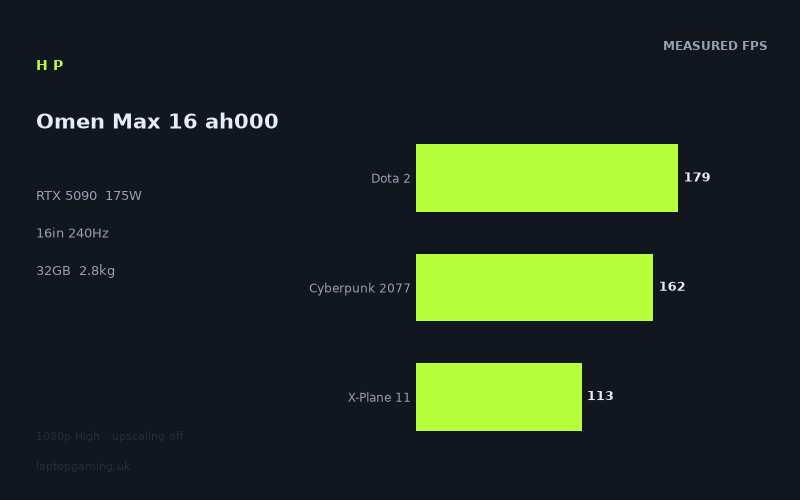
Frame rates
1920×1080, High preset, upscaling off.
Measured on this machine. Source: Notebookcheck, 2025-05-04.
Not scored: incomplete benchmark suite
Every scored laptop on this site is averaged over the same 5 games, and this one is short of Baldur's Gate 3, GTA V. A mean over 3 games is not comparable to a mean over 5, so we publish the figures we have and leave the score blank rather than rank it against machines tested on a different set. The numbers below are real - the suite is just incomplete.
How these numbers were produced
Frame rates here are not measured by us, and we label how each one was arrived at. A figure marked measured comes from a published run on that exact machine. A figure marked representative is derived from the GPU and its power limit (TGP) and cross-referenced against published reviews - a sound estimate of what that configuration delivers, but not a measurement of that specific laptop. Unless stated otherwise, numbers are 1920x1080, High preset, upscaling off. Where a laptop ships in several power configurations we use the wattage of the exact SKU listed, because a 140W RTX 5070 and a 115W one are not the same product.
In use
The short version
The HP Omen Max 16 ah000 is HP's attempt at a no-excuses 16in gaming laptop: an RTX 5090 allowed to draw 175W, 24GB of video memory, a Core Ultra 9 275HX, 32GB of system memory, a 2TB solid-state drive and a 16in 2560x1600 OLED panel running at 240Hz. It weighs 2.807kg and carries an 83Wh battery. There is no confirmed UK price for this exact configuration at the time of writing, and we will not guess at one.
The published frame rates come from Notebookcheck, dated 4 May 2025, all recorded at 1920x1080 on the High preset with upscaling switched off. Four titles are covered: Final Fantasy XV at 203fps, Dota 2 at 179fps, Cyberpunk 2077 at 162fps and X-Plane 11 at 113fps. Across the three of those that belong to our fixed scoring suite, the mean is 151fps.
Those are good numbers, and they are also a thinner data set than a machine of this specification deserves. Three of the four titles measured are old, lightly threaded or both. Only Cyberpunk 2077 asks the graphics card a difficult question at this resolution, and even that is a High-preset run with no ray tracing and no upscaling. So what you are looking at is a snapshot of a very powerful graphics card being given, for the most part, undemanding work.
There is no ranked score on this page. Our leaderboard averages every laptop across the same five games so the comparison is like for like, and for the Omen Max 16 we are missing two of them: Baldur's Gate 3 and GTA V. Publishing a three-game mean next to five-game means would produce a number that looks precise and is not. We would rather leave a gap in the table than fill it with something misleading. That is a hole in the data, not a criticism of the machine.
The comparison data is more revealing than the raw frame rates. Against the MSI Cyborg 15, an RTX 5050 machine at GBP 984, the Omen Max is 80fps clear across three shared games — an enormous, unambiguous gap that shows the benchmark set is perfectly capable of separating hardware. Against the Schenker XMG APEX 16 MAX, which carries an RTX 5070 Ti, the Omen Max is 1fps behind. Against the Asus ROG Strix Scar 16, another RTX 5090 laptop, it is 3fps behind. And against the Schenker XMG Neo 16 A25, a third RTX 5090 machine, it is 45fps behind. A flagship that cannot separate itself from a 5070 Ti on this test, and that loses by a wide margin to a differently engineered machine with the same graphics chip, is telling you something important — partly about the test, and partly about how much of an RTX 5090's capability a given chassis actually converts into frames.
Buy it if you want a 16in machine with the top mobile graphics part, a genuinely excellent panel specification, and enough graphics memory to stop worrying about texture budgets for years — and if you accept that the headline case for it rests on workloads nobody has published numbers for here. Buy something else if what you want is high frame rates at 1080p on the High preset, because that is the single job where an RTX 5090 is least efficiently deployed and where far cheaper machines close most of the gap.
Performance
What a 175W power limit actually decides
The graphics power limit is the most consequential number on a gaming laptop spec sheet and the one most often skipped over. Nvidia licenses the same graphics silicon to manufacturers across a wide band of sustained power budgets, and the chassis, the cooling design and the firmware decide where in that band a particular laptop settles. Two laptops can both print RTX 5090 on the lid and behave like meaningfully different products once the heat has built up. The Omen Max 16's figure is 175W, which sits at the upper end of what a 16in chassis is normally asked to sustain.
That is a genuinely important specification, and it deserves to be understood precisely. A power limit governs the clock speed a graphics card can hold once it is actually saturated — high native resolution, heavy shader loads, ray tracing, large texture working sets, long sessions where the cooling system has stopped being able to bank heat in the metal and has to settle into a steady state. Under those conditions the difference between a 175W implementation and a substantially more restrained one is large and repeatable.
What a power limit decides very little about is a graphics card that spends much of each frame idle, waiting for the processor to hand it the next batch of work. And that second situation describes most of what was measured here, because every number in the set was recorded at 1920x1080. At that resolution, on the High preset, with no ray tracing, an RTX 5090 is comfortably ahead of the workload in three of the four games listed. The bottleneck moves elsewhere: single-thread processor throughput, driver overhead, engine architecture, memory latency, how well a given title spreads work across cores.
This matters for how you read the rest of this review. The 175W figure is real, it is relevant, and it is the number that would separate this machine from a lower-powered RTX 5090 at the panel's native 2560x1600 or with ray tracing switched on. It is simply not the number doing the work in the results below. Anyone treating a 1080p High sweep as a verdict on a power limit has misread the test.
The four games we have, and what each of them is actually measuring
Final Fantasy XV at 203fps is the top result and the least informative one. It is a DirectX 11 title with a rendering path from an earlier era of engine design, and it has served as a benchmark staple for years precisely because it scales cleanly and runs fast on anything modern. At 1080p High it is not asking an RTX 5090 for anything difficult. A number like that is best read as a diagnostic: it confirms the memory subsystem is not choking, the drivers are behaving normally, and nothing odd is happening in power management. It is not a performance claim about the graphics card. If you buy this laptop because of a 203fps Final Fantasy XV figure, you have bought it on the strength of a nine-year-old game running at a frame rate the panel cannot fully display.
Dota 2 at 179fps sits in the same category for different reasons. Dota 2 is an esports title engineered from the outset to run acceptably on modest hardware, and its performance profile leans heavily on single-thread processor speed rather than graphics throughput. An RTX 5090 rendering Dota 2 at 1080p High is nowhere near being the constraint. The figure is a statement about the Core Ultra 9 275HX and the memory subsystem attached to it, far more than it is about the graphics card.
Cyberpunk 2077 at 162fps is the most useful number in the set and the one to hold onto. It remains the most demanding conventional rasterisation workload in wide benchmark circulation, and at 1080p on High with upscaling off it is one of the very few titles here where the graphics card is meaningfully engaged. 162fps in that game, under those settings, is a strong result in absolute terms. Read the settings carefully, though: High preset, no ray tracing, no upscaling. There are no ray-traced or path-traced figures for this machine in the data we have, and those are exactly the workloads where a 175W RTX 5090 with 24GB attached is supposed to justify its existence. That absence is a real gap.
X-Plane 11 at 113fps is the lowest result and, paradoxically, the one least dependent on the graphics card. Flight simulators of that generation lean extraordinarily hard on single-thread processor performance and on the geometry and draw-call pipeline. A laptop reaching 113fps in X-Plane 11 has told you a great deal about its processor, its memory latency and its driver overhead, and almost nothing about whether the graphics card has 16GB or 24GB of memory bolted to it. It sits at the bottom of a list topped by 203fps, giving a spread of a little under two to one across four titles measured on the same hardware on the same day — and essentially all of that spread comes from engine architecture rather than from anything a buyer can influence.
Where the spread across titles comes from
It is worth spelling this out because it governs how much weight any single number deserves. The gap between the fastest and slowest results here — 203fps down to 113fps — is not a story about graphics settings or thermal behaviour. All four runs used the same preset, the same resolution and the same machine on the same day. The difference is entirely in how the four game engines distribute work.
Final Fantasy XV and Dota 2 sit at the top because they were built for hardware generations that no longer exist in this form; their per-frame graphics cost is low, so the platform runs out of processor before it runs out of graphics card. X-Plane 11 sits at the bottom for a related but distinct reason: it is not graphically heavy either, but its per-frame cost is concentrated in exactly the serial, latency-sensitive work that modern processors cannot parallelise away. Cyberpunk 2077 sits in the middle, and it is the only one of the four where the graphics card is being asked to do something substantial per frame.
The practical consequence is that a laptop's position in a 1080p High table is decided as much by its processor, its memory configuration and its software stack as by the graphics part its marketing leads with. That is not a flaw in the measurements — they are honest measurements of real games — but it is a constraint on what you can infer from them, and it directly explains the comparison results discussed further down.
The 151fps mean, and why we are not ranking it
Our scoring suite is fixed at five titles: Dota 2, GTA V, Cyberpunk 2077, X-Plane 11 and Baldur's Gate 3. Every machine on our frame rate leaderboard is averaged across those same five games, which is what makes the leaderboard worth reading at all. For the Omen Max 16 ah000 we have three of them — Dota 2, Cyberpunk 2077 and X-Plane 11 — averaging 151fps. GTA V and Baldur's Gate 3 are missing.
Publishing that three-game mean alongside five-game means would quietly hand this machine a different exam from every other laptop in the table, and in a direction that is impossible to predict from the outside. GTA V is a heavily processor-limited title at 1080p on fast hardware; Baldur's Gate 3 behaves differently again, with a substantially more modern renderer but a punishing third act. Adding either could move a mean by a wide margin in either direction. The composition of a benchmark set is not a neutral background detail — it is a major input to the result.
So there is no score on this page, and there will not be one until the missing figures exist from a source we are willing to stand behind. That is an honest gap rather than a judgement on the laptop. It also, incidentally, cuts the other way: nobody should read the absence of a rank as evidence that the machine underperforms. On the three suite games we do have, it is a fast laptop.
What these numbers cannot tell you
On a machine at this tier the unmeasured territory is precisely the territory that would justify the money. We do not have ray-traced figures, path-traced figures, or any results with DLSS or frame generation enabled — and on an RTX 5090 those are not side dishes, they are a large part of the argument for buying the top part rather than the one below it. We have no measurements at the panel's native 2560x1600, which is the resolution anyone buying this screen will actually play at. We have no data on noise under sustained load, no surface temperature figures, no measured battery life, and nothing on how the machine behaves once the cooling system has been running flat out for an hour.
That last point is not a small one for a 175W graphics implementation in a 16in chassis. The whole promise of a high power limit is that it can be held, not just reached, and a benchmark sweep of four titles at 1080p is a mild workload by the standards of what this hardware is designed for. We would want to see sustained-load behaviour before making confident claims about it, and we do not have it. Where we do not have data, we will not manufacture an impression.
The screen
The panel specification is the most straightforwardly attractive thing about this laptop: 16in, 2560x1600, 240Hz, OLED. Each of those three elements is worth something specific, and together they describe a display that is genuinely ahead of the machine's benchmark data.
The resolution first. 2560x1600 in a 16in panel gives a pixel density that makes text crisp and removes the softness that a 1920x1080 panel of the same size shows on desktop work. It is also the sensible middle ground for a gaming laptop: it asks a great deal more of the graphics card than 1080p without going to the extremes of a 4K panel that no mobile graphics card can drive at high frame rates in demanding titles. The 16:10 aspect ratio gives extra vertical space, which is worth having for anything that is not a game.
The refresh rate is 240Hz, and this is where the measured data becomes awkward. Every published figure we have was recorded at 1920x1080, and not one of them reaches 240fps. Final Fantasy XV, the fastest title in the set, tops out at 203fps. Dota 2 manages 179fps, Cyberpunk 2077 162fps and X-Plane 11 113fps. So even at a resolution well below the panel's native one, none of the four measured games saturates the display.
At native resolution the picture is harder still, and it is worth doing the arithmetic explicitly. 2560x1600 is 4,096,000 pixels; 1920x1080 is 2,073,600. The native panel is very close to double the pixel count of the benchmark resolution. We have no measurements at 2560x1600 and will not invent any, but the direction is not in question: frame rates at native resolution will be materially lower than the figures above. Exactly how much lower depends on how graphics-bound each title is — Cyberpunk 2077 would give up the most, X-Plane 11 relatively little, because its constraint was never the pixel count in the first place.
None of which makes the 240Hz specification pointless. It is genuinely useful in the older and lighter titles this machine will run far above 120fps, it reduces perceived motion blur even when frame rates sit below the refresh ceiling, and it gives the panel headroom for competitive shooters played at reduced settings. But if you are choosing this machine because a 240Hz OLED sounds like a promise of 240fps gaming, the data does not support that reading in any of the four titles we have numbers for.
The OLED part deserves its own note. OLED gives per-pixel illumination, which means genuine black rather than a dimly lit approximation of it, and a contrast performance that no conventional backlit panel can match. In practice that is the single biggest visible upgrade available on a laptop display, more noticeable in normal use than a resolution bump. It also brings the usual OLED trade-offs, which are worth being honest about: static interface elements left on screen for very long periods carry a wear risk that conventional panels do not have, and OLED panels typically behave differently from mini LED under bright ambient light. We have no brightness measurements for this specific panel, so we cannot tell you how it copes near a window, and we are not going to pretend otherwise.
The overall assessment of the display is straightforward. As a specification it is excellent, and it is arguably the strongest single reason to want this machine over a rival with a similar graphics part. But it is a display that the measured benchmark data does not fully exercise, and a buyer should understand that the panel is running ahead of the numbers we can show them.
Build, size and portability
At 2.807kg the Omen Max 16 is heavy for a 16in laptop and unremarkable for a 16in laptop carrying a 175W graphics implementation. Those two statements are both true, and which one matters depends entirely on what you plan to do with it.
The physics here are not negotiable. Sustaining 175W of graphics power plus a Core Ultra 9 275HX under load requires a substantial vapour chamber or heat-pipe array, a lot of fin area, fans large enough to move air through it, and a chassis rigid enough to hold the whole assembly without flexing. That mass has to go somewhere. A 16in machine with a meaningfully lower power limit can be built considerably lighter, and machines that do so exist — but they give up exactly the sustained performance that is the point of this configuration.
What 2.807kg means in practice is that this is a laptop that moves rather than travels. It will go from a desk to a bag and out again at the other end without much complaint. Carried on foot for half an hour, or slid into an already-full backpack for a commute, it will be noticed every time. And the machine's real travelling weight is higher than 2.807kg, because a 175W graphics part plus a high-end processor demands a power supply substantially larger than the ones shipped with thin-and-light machines. We do not have the adapter's weight in our data, so we will not put a figure on the total, but nobody should budget for 2.807kg and be surprised by what actually goes in the bag.
The battery is 83Wh. That is a large battery in absolute terms and a modest one relative to this class, where 99Wh — the largest capacity permitted in aircraft cabin baggage under standard rules — is the usual target for a flagship. We have no measured battery life figure for this machine and will not estimate one. What can be said with confidence is structural rather than numerical: a laptop of this specification does not run its graphics card anywhere near 175W on battery, because no 83Wh cell could sustain that draw for a useful length of time. Gaming unplugged on any machine in this class means accepting substantially reduced performance, and the smaller-than-maximum battery here does not help.
The 16in form factor is, for most buyers, the right compromise in the current market. It gives enough screen area to work on properly and enough internal volume for serious cooling, without the desk footprint and awkwardness of an 18in machine. If you want the top mobile graphics part in something you can realistically carry, 16in is where that request stops being unreasonable. The Omen Max 16 is squarely in that category: portable in the sense that it has a battery and a lid, not portable in the sense that you will forget it is in the bag.
One further note on the configuration. 32GB of system memory and a 2TB solid-state drive are a sensible, generous pairing for gaming and for most creative work. 32GB is comfortably beyond what any current game needs and enough headroom for heavy multitasking, streaming while playing, or moderate content work. 2TB holds a meaningful game library without constant management, which matters when modern installs routinely exceed 100GB. And 24GB of video memory is a genuine long-term asset: it is far more than any current title requires at the resolutions this machine will run, which means it is insurance against future texture budgets and immediately useful for local machine-learning work, large scenes in 3D applications and high-resolution video timelines.
How it compares
Four machines from the same graphics generation give a useful spread here — the two nearest, the one this laptop beats by the widest margin, and the one that beats it by the widest margin. All comparisons are drawn only from games both machines have figures for, and all of them come from the same 1080p High measurement conditions.
MSI Cyborg 15 — RTX 5050, GBP 984
Across three shared games the Omen Max 16 averages 80fps more than the Cyborg 15. That is by far the largest margin in this comparison set, and it is the single most important number in the whole section, because it establishes that the benchmark is not broken. When two machines genuinely differ in graphics capability, this test set shows it, and it shows it emphatically. An 80fps average gap across three titles is not a rounding error or a run-to-run variance; it is the difference between a budget graphics part and a flagship one, clearly rendered.
It is also a comparison that a buyer should think about carefully rather than dismiss. The Cyborg 15 is a GBP 984 machine. The Omen Max 16's price is not confirmed, but a laptop with a 175W RTX 5090, 24GB of video memory, a Core Ultra 9 275HX and a 240Hz OLED panel will not be sold anywhere near GBP 984 — it will be a multiple of it. The question that matters is not whether the Omen Max is faster; it plainly is. The question is whether 80fps on top of the Cyborg's figures, in games where the Omen Max is already well past the point of diminishing returns, is worth what it costs. For a buyer whose games are the lighter titles at the top of this table, the honest answer is often no. For a buyer who plays modern, graphically demanding releases at the panel's native resolution with ray tracing on — the workloads this data set does not cover — the answer is very likely yes, but the evidence for it is not in these numbers.
Schenker XMG APEX 16 MAX — RTX 5070 Ti, no confirmed UK price
Across three shared games the Omen Max 16 averages 1fps behind the APEX 16 MAX, which carries an RTX 5070 Ti — two full tiers down the graphics stack. Taken at face value that looks like an indictment of the Omen Max. It is not, and it is worth explaining exactly why rather than waving it away.
The three shared games are drawn from a set dominated by titles that do not load a modern flagship graphics card at 1080p. When a game is limited by processor throughput rather than by the graphics card, adding graphics capability produces no additional frames — the card simply finishes its work earlier and waits longer. Under those conditions an RTX 5070 Ti and an RTX 5090 will land in the same place, not because they are equivalent, but because neither is the thing being measured. What separates them is what happens when the pixel count doubles, when ray tracing is enabled, or when texture working sets grow past 16GB. None of those conditions appears in this data.
There is a second factor, and it is not one to dismiss. The APEX 16 MAX is a machine built around cooling headroom, and a well-cooled 5070 Ti running at its full power budget with a fast processor behind it will hold high clocks in exactly the lightly loaded scenarios these benchmarks describe. Parity here is a real result. It just is not a result about graphics tier.
The practical advice follows directly. If your gaming is competitive shooters, older titles and 1080p-class workloads, an RTX 5070 Ti machine will get you the same experience for less money, and this data is the evidence. If your gaming is the heaviest current releases at 2560x1600 with ray tracing, this data has not measured the thing you are buying, and the graphics tier will matter a great deal more than it appears to here.
Asus ROG Strix Scar 16 — RTX 5090, no confirmed UK price
Across three shared games the Omen Max 16 averages 3fps behind the Strix Scar 16, another RTX 5090 laptop. This is the comparison most likely to be over-interpreted, and it deserves a plain reading: a 3fps average difference between two machines with the same graphics chip, measured on titles that mostly do not stress that chip, is not a meaningful separation. Two identically specified graphics parts in different chassis, running mostly processor-limited games, land in the same place. That is what the data says and it is all it says.
What this comparison does usefully establish is that the Omen Max is not an outlier among 5090 implementations. It performs the way a 5090 machine of this class performs on this test. Where the two machines might genuinely diverge is in the areas the data does not cover — sustained clocks over long sessions, cooling noise, native-resolution and ray-traced performance, and the panels, which differ in kind rather than degree. The Omen Max's OLED display is a real differentiator on specification, and for many buyers it would be the deciding factor between two otherwise-similar machines.
Schenker XMG Neo 16 A25 — RTX 5090, no confirmed UK price
This is the result that makes the whole section coherent. Across three shared games the Omen Max 16 averages 45fps behind the XMG Neo 16 A25 — a third laptop with the same RTX 5090 graphics part.
Put that next to the 1fps gap against a 5070 Ti and the 3fps gap against another 5090, and the picture sharpens considerably. The benchmark set clearly can separate machines: it separates the Omen Max from the Cyborg 15 by 80fps and from the XMG Neo by 45fps in the other direction. So when it fails to separate the Omen Max from a 5070 Ti, that is not the test collapsing under its own weight. It is the test correctly reporting that in those particular titles, at that particular resolution, the graphics tier is not what decides the outcome.
What decides it instead is everything else: processor performance and how aggressively it is allowed to boost, memory speed and latency, how the firmware balances power between processor and graphics card when neither is fully loaded, and how quickly the whole platform can sustain that balance. A 45fps average gap between two RTX 5090 machines on games that are mostly processor-limited is very strong evidence that the XMG Neo's platform feeds its graphics card better under exactly these conditions. That is a legitimate advantage and a legitimate reason to prefer it if this kind of workload is your workload.
It is also a reason for caution about how much weight to put on any single comparison. Neither machine has a confirmed UK price in our data, so the value question — which is where these arguments usually resolve — cannot be answered here at all. What we can say is that buying the Omen Max 16 purely on the strength of "it has a 5090" would be a mistake. Two other laptops in this comparison have the same chip and land 3fps and 45fps ahead of it. The chip is a necessary condition for top-tier performance, not a sufficient one, and the Omen Max's case has to rest on the whole package: the panel, the memory and storage configuration, the 175W power budget in workloads this data does not reach, and whatever price it eventually lands at.
Reading the comparison set as a whole
Lay the four results side by side — plus 80, minus 1, minus 3, minus 45 — and a shape emerges that is more useful than any individual figure. The gap to a genuinely lower-tier machine is vast. The gaps to machines in the same broad performance class, whether they carry a 5070 Ti or a 5090, are either negligible or in the wrong direction. In other words, on this test, the Omen Max 16 sits comfortably in the top group and nowhere near the top of it.
That is a coherent and defensible position for a laptop to occupy, provided the price reflects it. Without a confirmed UK price we cannot make that judgement, and we are not going to imply one. What we can say is what a buyer should be looking for: if this machine is priced as a flagship, the case for it has to be made on the OLED panel, the 24GB of video memory and the 175W sustained power budget in workloads beyond this data set — because on the measured frame rates alone, it is not pulling away from cheaper hardware.
Who it's for
The Omen Max 16 ah000 makes most sense for a specific buyer: someone who wants one 16in machine that plays current games at the panel's native 2560x1600 with the settings turned up, who values display quality highly enough that an OLED is a genuine deciding factor, and who has workloads beyond gaming — local machine-learning experiments, 3D scenes, high-resolution video work — where 24GB of video memory and 32GB of system memory stop being a specification and start being the reason a task completes at all. For that person the 175W power limit is not marketing; it is the difference between a graphics card that holds its clocks through a long session and one that quietly settles lower.
It also suits someone who wants a top-tier machine but has a hard ceiling on how much bulk they will carry. At 2.807kg it is heavy, but it is a 16in laptop rather than an 18in one, and the difference in daily practicality between those two categories is larger than the weight difference alone suggests. If you have decided that 18in is too much machine but you still want the top graphics part, the field narrows quickly and this is in it.
Who should buy something else
If you mainly play competitive shooters, esports titles or older games at 1080p, buy something considerably cheaper. The evidence is right here in the comparison data: an RTX 5070 Ti machine matched this laptop across three shared games. In those workloads the graphics card is not the limiting factor, and paying for the top tier buys you frames you will not see. Put the difference towards a better monitor or a faster processor instead.
If your priority is the highest measured frame rate in this class regardless of anything else, buy the XMG Neo 16 A25. It averages 45fps ahead across three shared games with the same graphics chip. That is a decisive result on this test and the honest recommendation for anyone whose only criterion is the number.
If you need to carry a laptop every day, on foot or on public transport, look at something lighter. 2.807kg plus a substantial power adapter is a meaningful daily load, and there are capable gaming laptops built around lower power limits that weigh considerably less. You will give up sustained performance under heavy load; whether that trade is worth it depends on how often you are actually under heavy load versus how often you are carrying the thing.
If you need long battery life, this is not the category. An 83Wh cell in a machine with this power budget is not a recipe for an all-day unplugged laptop, and while we have no measured runtime figure for it, the physics of the configuration are not in doubt. Nobody buys a 175W graphics laptop for battery life, but it is worth stating plainly rather than leaving as an assumption.
And if value is your primary criterion, you cannot make that judgement from this page, because we have no confirmed UK price. That is the honest position. When a price appears, the questions to ask are simple ones: what is the premium over an RTX 5070 Ti machine that matched it on these three games, and are the workloads where a 175W RTX 5090 genuinely pulls ahead — native-resolution rendering, ray tracing, large-memory tasks — the workloads you actually run? If yes, the machine justifies itself. If no, the measured data in front of you is already telling you to spend less.
The bottom line
The HP Omen Max 16 ah000 is a strong, conventionally excellent 16in flagship with a display specification that is better than most of its rivals and a benchmark record that does not, on its own, make the case for it. The 151fps average across the three scoring-suite games we have is a fast result. The 80fps margin over an RTX 5050 machine is emphatic. But the 1fps deficit to a 5070 Ti laptop and the 45fps deficit to another 5090 laptop are the numbers a prospective buyer should sit with, because they show that the graphics tier on the box is not what determined the outcome in these particular games.
The right way to read this machine is as a package rather than as a graphics card. The 240Hz OLED panel at 2560x1600, the 24GB of video memory, the 2TB drive and the 175W power budget together describe a laptop built for demanding work at the panel's native resolution — and that is precisely the workload the published 1080p figures do not measure. If those are your workloads, this is a serious machine. If they are not, the comparison table is quietly recommending you spend less, and it is worth listening to.