Review
Asus Zephyrus S17 review
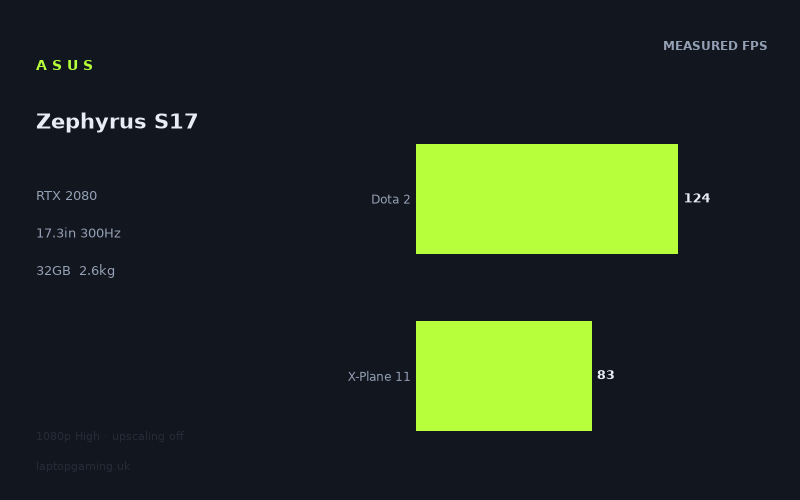
Frame rates
1920×1080, High preset, upscaling off.
Measured on this machine. Source: Notebookcheck, 2020-08-17.
Not scored: incomplete benchmark suite
Every scored laptop on this site is averaged over the same 5 games, and this one is short of Cyberpunk 2077, Baldur's Gate 3, GTA V. A mean over 3 games is not comparable to a mean over 5, so we publish the figures we have and leave the score blank rather than rank it against machines tested on a different set. The numbers below are real - the suite is just incomplete.
How these numbers were produced
Frame rates here are not measured by us, and we label how each one was arrived at. A figure marked measured comes from a published run on that exact machine. A figure marked representative is derived from the GPU and its power limit (TGP) and cross-referenced against published reviews - a sound estimate of what that configuration delivers, but not a measurement of that specific laptop. Unless stated otherwise, numbers are 1920x1080, High preset, upscaling off. Where a laptop ships in several power configurations we use the wattage of the exact SKU listed, because a 140W RTX 5070 and a 115W one are not the same product.
In use
The short version
The Asus Zephyrus S17 (GX701LXS) is an unusual proposition: a large-format gaming laptop with a 17.3in Full HD IPS display capable of refreshing at 300Hz, paired with an RTX 2080, a Core i7-10875H, 32GB of memory and a 1TB SSD. On paper, that is a high-end specification for its generation. The benchmark data, however, makes the important point clear: the 300Hz panel is far more ambitious than the measured performance in the games available here.
Notebookcheck measured 124fps in Dota 2, 83fps in X-Plane 11 and 67fps in Final Fantasy XV at 1920x1080 using the High preset with upscaling disabled. The mean across those three scoring-suite games is 91fps. That is still useful 1080p gaming performance, and it is especially encouraging that Dota 2 reaches well into triple-digit territory. But none of the published results reaches the display’s 300Hz maximum. This is not a laptop whose measured results justify buying it on the assumption that modern games will routinely run at the screen’s full refresh rate.
The right buyer is someone who values the combination of a 17.3in screen, a fast-refresh IPS panel and a strong period-correct component list, while understanding that the headline refresh rate is a ceiling rather than a performance guarantee. The Zephyrus S17 looks best for a buyer who plays a mixture of lighter competitive games and more demanding titles, and who is content with the latter running well below 300fps. The published Dota 2 result shows that lighter games can make meaningful use of a fast panel. The X-Plane 11 and Final Fantasy XV results show the other side of the machine: in heavier work, the RTX 2080 does not turn this into a 300fps laptop.
It is also a machine that needs to be judged with more caution than usual on value. No confirmed UK price is supplied for this configuration. That means there is no responsible way to say whether it is a bargain, fairly priced or poor value in the UK. The specification is substantial, but specification alone is not value. The measured frame rates establish what it can do; the missing price prevents a proper conclusion about whether what it can do is worth the asking price.
There is a second limitation to be clear about. The scoring suite is incomplete for this laptop. We have no figures for GTA V or Strange Brigade. Every scored laptop is averaged over the same five games, so this partial set cannot be ranked against machines with a complete scoring suite. The 91fps figure is a useful description of these three measured games, not a complete performance ranking and not a substitute for one.
As a practical recommendation, the Zephyrus S17 makes sense if the large 300Hz screen matters to you, if its measured performance is sufficient for the games you actually play, and if the eventual UK price is sensible. It makes less sense if you are shopping specifically for the highest measured gaming performance in this group, because the MSI GT76 Titan DT is materially faster across the shared games. It also makes less sense if you assume that an RTX 2080 badge automatically produces a major advantage over every lower-tier GPU in a 1080p laptop. The comparison data does not support that assumption.
Performance
What the measured figures say
The available results come from Notebookcheck and use a consistent setup: 1920x1080, the High preset and upscaling switched off. That matters because it removes one common source of confusion. These are not frame rates achieved by lowering the resolution below the panel’s native 1920x1080 resolution, and they are not frame rates inflated by an upscaling mode. They are directly relevant to the Zephyrus S17’s own Full HD display.
- Dota 2: 124fps
- X-Plane 11: 83fps
- Final Fantasy XV: 67fps
- Mean across the available scoring-suite games: 91fps
The spread is the first thing to notice. Dota 2 is comfortably the strongest published result at 124fps. X-Plane 11 sits in the middle at 83fps. Final Fantasy XV is the lowest measured result at 67fps. Those are not minor fluctuations around one fixed level of performance. They describe a laptop whose experience will depend heavily on the game being played.
Dota 2 is the clearest case for the Zephyrus S17’s fast display having practical value. A measured 124fps is nowhere near 300fps, but it is still a high frame rate in its own right. The screen can present frames at a much higher cadence than a standard 60Hz display, so the Dota 2 result is meaningfully aligned with the character of the panel even if it does not fully exploit the panel’s maximum refresh capability. Someone who spends most of their gaming time in Dota 2 should see the Zephyrus S17 as much more convincing than someone buying primarily for Final Fantasy XV.
X-Plane 11 tells a more restrained story. At 83fps, it is above the mean only in the sense that Final Fantasy XV is lower; it is not remotely close to the screen’s 300Hz ceiling. The important conclusion is not that 83fps is inadequate. It is that this is an example of a game where the display specification runs well ahead of the measured performance. The panel remains a high-refresh panel, but the published result suggests that the game is the limiting factor rather than the screen.
Final Fantasy XV, at 67fps, is the most demanding result available for this machine. It is still a frame rate that supports conventional smooth play at the stated settings, but it is far removed from the kind of output associated with a 300Hz gaming display. This is the figure that should temper expectations. Buyers should not look at the RTX 2080 and the 300Hz label, then assume that demanding games at High settings will inhabit the same performance range as Dota 2. Notebookcheck’s numbers show that they do not.
The 91fps mean is useful as a quick summary, but it should not become the whole review. A mean conceals the difference between 124fps and 67fps, and that difference is exactly what determines whether the 300Hz screen is an active benefit or simply a high-spec panel with performance headroom left unused. A buyer choosing the machine for a particular game should place more weight on that game’s closest published result than on the mean.
There is also no basis in the supplied information for extrapolating beyond these results with invented confidence. We do not have measured figures for GTA V or Strange Brigade, and there are no measured figures here for other titles. The fact that Dota 2 reaches 124fps cannot be turned into a claim that every lighter game will do the same. Equally, the fact that Final Fantasy XV reaches 67fps cannot be turned into a claim that every visually demanding game will sit at that level. The defensible position is narrower: these are the published outcomes in these three games, using these settings.
The RTX 2080 needs context
The Zephyrus S17 uses an RTX 2080, which places it above the RTX 2070, RTX 2060 and RTX 2050 machines in the comparison group by name. That hierarchy is useful, but it is not the same thing as a guarantee of a proportionate performance gap in every laptop. The benchmark comparisons show why. Against the Aorus 5 KB with an RTX 2060, the Zephyrus S17 is only 3fps ahead on average across three shared games. Against the Asus Zephyrus S15 with an RTX 2070, it is only 2fps ahead on average across three shared games.
Those small gaps are real results, not a reason to dismiss the comparison. The supplied comparison notes explain that, at 1080p, lighter titles in the shared set are CPU-bound and compress genuine GPU gaps. In other words, a stronger GPU does not always receive enough graphics work at this resolution for its theoretical advantage to show up as a large frame-rate lead. The processor and the rest of the system can become the limiting factors instead.
That matters particularly for this laptop because its display encourages buyers to focus on very high frame rates. Once a game is operating in a range where the CPU is a limiting factor, moving to a higher-tier GPU may not deliver the large uplift expected from the GPU name alone. The Zephyrus S17’s Core i7-10875H is part of the machine’s stated specification, but the available data does not isolate processor performance. What it does show is the practical result: the RTX 2080 does not create a wide shared-game lead over the RTX 2060 Aorus 5 KB or the RTX 2070 Zephyrus S15.
The comparison with the MSI GT76 Titan DT is the counterpoint. That machine also has an RTX 2080, yet the Zephyrus S17 averages 30fps behind it across three shared games. This is a major difference, especially compared with the tiny margins against the RTX 2060 and RTX 2070 rivals. It demonstrates that the GPU label is not enough to predict laptop performance. Two laptops with the same GPU can still produce very different results in the same games.
GPU power limits are central to this kind of discussion, but the supplied fact sheet does not provide the Zephyrus S17’s RTX 2080 power limit. It would therefore be wrong to assign it a wattage, to describe it as a particular power class, or to claim that a stated power limit explains its position against the GT76 Titan DT. The benchmark gap is established by the shared-game data; the exact technical reason for that gap is not established by the information available here.
That uncertainty is important rather than inconvenient. A review should not turn a plausible explanation into a stated fact. Laptop GPU performance can vary by implementation, but this fact sheet does not provide the power-limit specification needed to quantify that aspect of the Zephyrus S17. The safe conclusion is that its measured performance is materially behind the GT76 Titan DT despite both machines being listed with RTX 2080 graphics. Anyone considering the S17 because they expect all RTX 2080 laptops to perform similarly should treat that comparison as a warning.
What 1080p means for this result set
The 17.3in panel runs at 1920x1080, and all the available gaming figures are measured at that same resolution. This is useful because it avoids the mismatch that can occur when a laptop is benchmarked at a resolution different from its own panel. The published results tell us how the system behaves at the resolution it is actually designed to display.
They also illustrate why resolution cannot be considered in isolation. Full HD is often associated with high frame rates, and Dota 2 supports that association here with 124fps. But Full HD does not make every game a 300fps proposition. X-Plane 11 at 83fps and Final Fantasy XV at 67fps make that plain. The same 1920x1080 resolution produces markedly different outcomes across the available titles.
For a buyer, this means settings decisions remain part of ownership. The stated figures are at High with upscaling off. If those exact conditions are important, the listed frame rates are the relevant expectations. There are no supplied results at lower presets, higher presets, altered resolutions or with upscaling enabled, so no specific claims should be made about how much headroom exists outside the measured configuration. The review can say that the panel supports 300Hz; it cannot honestly promise a particular performance gain from changing settings when no such data is provided.
The best way to read the numbers is therefore game by game. At one end, Dota 2 delivers a frame rate that makes strong practical use of the panel’s high-refresh capability. At the other, Final Fantasy XV is a reminder that an RTX 2080 system at 1080p can still sit far below the display maximum in demanding work. X-Plane 11 reinforces the middle ground: above a conventional 60fps target, but nowhere near the point at which a 300Hz panel is fully fed.
A partial benchmark picture, not a league-table position
The measured suite is incomplete. Dota 2, X-Plane 11 and Final Fantasy XV are available; GTA V and Strange Brigade are not. This is more than a missing pair of extra charts. The site’s comparative scoring system depends on every scored laptop being averaged over the same five games. Since the Zephyrus S17 has only three results in that suite, it cannot be fairly ranked against machines with full five-game coverage.
That does not make the three figures worthless. They are measured, attributable data from Notebookcheck, and they establish useful facts about the laptop’s behaviour at 1080p High with no upscaling. What they cannot do is support a claim that the S17 is definitively ahead of, behind, or level with another machine across the complete scoring suite. The shared-game comparisons supplied for the rivals are the right evidence for direct comparison; a full-suite ranking is not available.
This distinction matters most where margins are narrow. The S17’s average lead over the Aorus 5 KB is 3fps across three shared games, and its lead over the Zephyrus S15 is 2fps across three shared games. Those are already small differences in the available common data. It would be especially misleading to inflate them into a broader all-games ranking when two scoring-suite results are absent for the S17.
The screen
A large Full HD, 300Hz IPS panel
The Zephyrus S17’s display is a 17.3in IPS panel at 1920x1080 with a 300Hz refresh rate. This is a very specific combination. The physical screen is large by laptop standards, the resolution is Full HD rather than a higher-resolution option, and the refresh ceiling is extremely high. The panel specification is aimed at speed rather than at increasing pixel count beyond 1920x1080.
The IPS panel type is worth noting because it is part of the stated screen specification, but there are no supplied measurements for brightness, colour coverage, contrast, response behaviour or viewing characteristics. It would be inappropriate to claim a particular image-quality standard from the IPS label alone. What can be said is that this is an IPS panel with a 300Hz refresh rate, not a panel type or screen configuration left unspecified.
The main question is whether the graphics hardware can actually drive it. The answer from the measured data is mixed. No measured game reaches 300fps. Dota 2 is the closest at 124fps, while X-Plane 11 records 83fps and Final Fantasy XV records 67fps. The display can refresh much faster than any of the published frame rates, but that does not mean the screen is wasted. It means the degree to which it is exploited varies considerably by title.
For Dota 2, the case for the 300Hz panel is reasonably persuasive. A measured 124fps is high enough that the difference between this kind of panel and a lower-refresh display is relevant in principle, even though the panel maximum remains out of reach in the published result. The S17 is not delivering the full headline figure, but it is producing a frame rate that belongs on a fast gaming screen.
For X-Plane 11, the relationship is less direct. At 83fps, the game is running comfortably above the level associated with a basic 60Hz display, but it is not approaching 300fps. The panel’s refresh headroom is there, but the GPU and system output shown in the benchmark data are the limiting factor. Buyers focused on this type of result should treat the screen as a high-quality-capacity feature rather than an indication of the frame rate they should expect.
For Final Fantasy XV, the mismatch is strongest. At 67fps, the benchmark result is only modestly beyond 60fps and far below the screen ceiling. That does not undermine the usefulness of a 17.3in Full HD panel, but it does undermine any simplistic argument that a 300Hz specification automatically makes the laptop a 300fps gaming machine. It plainly does not in this published result.
Do not buy the panel on the promise of universal 300fps gaming
A 300Hz label is easy to over-read. It tells you the maximum refresh capability of the display. It does not tell you what frame rate the laptop will produce in a given game. The Zephyrus S17 is an especially clear example because the panel maximum is much higher than the available measured results. The fact sheet gives no 300fps result in the scoring-suite data.
This does not make the display specification a mistake. It makes it selective in value. It is most appealing to a buyer whose gaming includes titles that can run at very high frame rates, with Dota 2 being the concrete published example. It is less compelling to a buyer whose primary interest is in more demanding games like the measured Final Fantasy XV result, where the system output is much lower.
The practical buying advice is to separate the screen’s capability from the laptop’s demonstrated output. The panel can refresh at 300Hz. Notebookcheck’s measured figures show 124fps, 83fps and 67fps in the available games. Both statements can be true without contradiction. The display is prepared for exceptionally high frame rates; the measured GPU performance does not consistently provide them at 1080p High with upscaling off.
There is no supplied evidence on whether the panel offers any adaptive-refresh technology, and none should be assumed. There is also no supplied evidence on response times or image-quality measurements. The sound conclusion is narrower but useful: the screen is a 17.3in, 1920x1080, 300Hz IPS panel, and the available game data shows that its high refresh rate is most relevant in lighter titles rather than consistently achieved across this benchmark selection.
Build, size and portability
The Zephyrus S17 weighs 2.62kg. That is the most important portability fact supplied, and it places this machine firmly in the large-laptop category in practical terms. A 17.3in display already signals that the S17 is designed around screen space and a full-size gaming-laptop format rather than minimum mass. The stated weight reinforces that reading.
It would be wrong to claim exact dimensions because none are supplied. There is no basis here for statements about its footprint, thickness, bag fit or desk depth. The weight and screen size do, however, provide enough information for a realistic buying judgement. At 2.62kg, this is not a machine to select primarily because you want the lightest possible laptop. The 17.3in screen and 300Hz panel are the kinds of features that prioritise a larger gaming setup over the smallest possible package.
That does not mean the S17 cannot be moved. It means portability should be considered in relative, practical terms. A buyer who intends to keep the laptop mainly in one place, or move it between a limited number of regular locations, has a clearer case for accepting 2.62kg. A buyer who expects the laptop to be a constant companion should treat the stated weight as a meaningful part of the decision rather than an afterthought.
The 76Wh battery is another specification that needs careful handling. It tells us the battery capacity, but it does not tell us battery life in any workload. There are no supplied battery-runtime measurements for gaming, browsing, video playback, office work or idle use. The review therefore cannot promise how long the Zephyrus S17 will last away from mains power, and it cannot compare that endurance with a rival.
For a gaming buyer, that lack of measured battery data matters. The laptop’s published gaming figures are not battery-life figures, and the fact that it has a 76Wh battery cannot be converted into a runtime estimate. If battery operation is a major purchasing criterion, the correct response is caution: the available information confirms the capacity but does not establish endurance.
The rest of the configuration is substantial. The system is listed with 32GB of memory and a 1TB SSD. For buyers comparing configurations rather than just GPUs, that means the Zephyrus S17 is not presented here as a stripped-back RTX 2080 laptop with minimal memory or storage. But there are no supplied details on memory speed, storage performance, drive arrangement, upgrade access or spare slots. The sensible conclusion is simply that the stated configuration includes 32GB of memory and 1TB of SSD storage.
No thermal measurements or noise figures are supplied. That means there is no responsible basis for claiming that the S17 runs cool, runs hot, stays quiet or becomes loud. This absence is especially relevant because the MSI GT76 Titan DT demonstrates that another RTX 2080 laptop can be substantially faster in the shared games. It may be tempting to speculate about cooling, size or power behaviour as an explanation, but the fact sheet does not provide the evidence required to do that. The performance difference should be reported as a measured outcome, not dressed up as an unmeasured thermal conclusion.
In usage terms, the strongest case for the S17’s form factor is the buyer who wants a laptop that behaves primarily as a larger-screen gaming system and only secondarily as something to carry frequently. The weakest case is the buyer prioritising low weight, compact dimensions or proven battery endurance. The first group can weigh the 17.3in display, 300Hz refresh rate and 2.62kg mass as a sensible trade. The second group lacks the data needed to be reassured on the things they care about most.
How it compares
The direct comparison data is deliberately limited to games both machines hold, with preference given to scoring-suite titles. That is the right method here because the Zephyrus S17 does not have a complete five-game scoring suite. The comparison averages are therefore useful shared-game evidence, not full-suite rankings.
Against the Acer Aspire 17 with RTX 2050 at 35W
The Zephyrus S17 averages 21fps ahead of the Acer Aspire 17 across three shared games. The Acer is listed with an RTX 2050 at 35W, while the S17 has an RTX 2080. This is the largest positive comparison margin supplied for the S17, and it is the clearest evidence that the Asus delivers a meaningful performance step over the lower-end Acer in the shared selection.
The Acer has no confirmed UK price in the supplied information, so there is no price-performance judgement to make between the two. The comparison should stay focused on what the benchmark data says: across the shared games, the S17 is ahead by 21fps on average. That is a substantial enough margin to matter more than a minor benchmark variation.
For someone choosing solely between these two machines on gaming output, the S17 has the stronger measured case. It also brings a 17.3in 300Hz IPS display, 32GB of memory and a 1TB SSD in the stated configuration. But the price question remains open for both machines in the available UK information. Without confirmed prices, the performance lead cannot be turned into a value verdict.
Against the Aorus 5 KB with RTX 2060
The comparison with the Aorus 5 KB is much more revealing than the GPU names suggest. The Zephyrus S17 averages only 3fps ahead across three shared games, despite the S17 being listed with an RTX 2080 and the Aorus with an RTX 2060. That does not mean the RTX 2080 and RTX 2060 are interchangeable. It means that, in these particular shared 1080p results, the measured gap is small.
The supplied comparison guidance gives the important context: lighter shared titles at 1080p can be CPU-bound, compressing genuine GPU differences. This is precisely the situation where buyers should resist buying by GPU tier alone. If your own games resemble the lighter titles driving this shared result set, the RTX 2080 label does not guarantee that the Zephyrus S17 will feel dramatically faster than the RTX 2060 Aorus.
The 3fps lead is still a lead. It should not be written off simply because it is small. But it is too small to support a claim that the S17 decisively outclasses the Aorus 5 KB in the available shared-game evidence. The more useful distinction is feature and format: the S17 has a 17.3in, 300Hz IPS screen and a stated 2.62kg weight, while the fact sheet does not provide equivalent screen or weight information for the Aorus. No confirmed UK price is supplied for the Aorus either, so there is no valid way to decide which is better value.
Against the Asus Zephyrus S15 with RTX 2070
The Zephyrus S17 averages 2fps ahead of the Zephyrus S15 across three shared games. This is the closest result in the supplied comparison set. The S15 has an RTX 2070 and is listed at £2,000. The S17 has an RTX 2080, but no confirmed UK price is supplied for it.
Again, the narrow gap is meaningful because it is measured. A 2fps average advantage is not the kind of margin that supports a strong performance-led upgrade argument on the shared data. The S17 is ahead, but only just. At 1080p, CPU-bound behaviour in lighter shared titles can compress GPU gaps, and that supplied explanation is directly relevant to a comparison where RTX 2080 and RTX 2070 systems finish so closely.
The screen is likely to be the more distinctive part of the S17’s appeal in this comparison, because its stated display is a 17.3in 1920x1080 300Hz IPS panel. However, the supplied facts do not give the S15’s screen specification, weight, memory or storage, so no broader configuration judgement should be invented. Nor can the S17 be called better or worse value than the £2,000 S15 because the S17’s UK price is not confirmed.
A buyer considering the S17 instead of the S15 should therefore be cautious about paying a large premium purely for the RTX 2080 name. The available shared-game performance margin is only 2fps. A large premium might still be justified by features outside the supplied data, but it cannot be justified by these shared benchmark figures alone.
Against the MSI GT76 Titan DT with RTX 2080
The MSI GT76 Titan DT is the most important warning against simplistic GPU-based buying. It also uses an RTX 2080, yet the Zephyrus S17 averages 30fps behind it across three shared games. This is the largest deficit in the supplied comparison set and a decisive one in performance terms.
The key fact is not merely that the GT76 Titan DT is faster. It is that the difference is large despite the two machines sharing the same listed GPU model. This is why laptop buyers need attributable measured data rather than relying only on specification labels. The S17’s RTX 2080 tells you something important about its position in the product stack, but the GT76 result proves it does not tell you everything about the frame rates it will produce.
No confirmed UK price is supplied for the GT76 Titan DT, so this cannot become a value comparison. We also do not have the GT76 Titan DT’s dimensions, weight, battery capacity, display details, GPU power limit, thermal results or noise figures in the supplied facts. It would be wrong to explain the 30fps gap through those factors without evidence. What can be said plainly is that the MSI is the stronger gaming performer in the shared measured games, by a margin large enough to matter.
For the buyer whose first priority is the best possible performance among these named rivals, the GT76 Titan DT has the superior shared-game evidence. For the buyer drawn to the S17’s 17.3in 300Hz IPS screen, the decision is less straightforward, but the performance compromise must be acknowledged rather than hidden. The S17’s panel is faster on paper than its measured output in every available game, while the MSI’s shared-game lead shows that the S17 is not extracting the highest performance available from an RTX 2080-labelled laptop.
Who it’s for
The Asus Zephyrus S17 is for the buyer who wants a large 17.3in gaming display, values a 300Hz IPS panel, and understands that the panel’s maximum refresh rate is not the same as a guaranteed game frame rate. The strongest evidence in its favour is the Dota 2 result of 124fps, which gives the fast screen a practical role. The machine also has a generous stated configuration of 32GB of memory and a 1TB SSD, alongside the RTX 2080 and Core i7-10875H.
It is particularly suited to someone whose game library includes lighter titles where high frame rates are realistic, and who also wants the space of a 17.3in panel. The published Dota 2 result is the concrete example. Such a buyer should still avoid assuming the system reaches 300fps, because the available figure is 124fps, but they have a credible reason to value the high-refresh display.
It can also suit a buyer who considers 67fps to 83fps satisfactory in demanding games at 1920x1080 High with upscaling off. X-Plane 11 and Final Fantasy XV establish that the S17 can deliver those results under the published test conditions. The machine is not being presented by the evidence as a universal 300fps platform; it is being presented as a capable Full HD gaming laptop whose output varies substantially by title.
The S17 is less suitable for a buyer who wants the highest measured performance available from the listed comparison group. The MSI GT76 Titan DT is 30fps ahead on average across three shared games, despite both machines using RTX 2080 graphics. That is too large a result to ignore. If maximum shared-game frame rate is the priority, the GT76 Titan DT has the stronger case based on the evidence available.
It is also not the obvious choice for someone expecting an RTX 2080 to deliver a dramatic gain over every RTX 2060 or RTX 2070 laptop. The S17 is only 3fps ahead of the RTX 2060 Aorus 5 KB and only 2fps ahead of the RTX 2070 Zephyrus S15 across three shared games. At 1080p, CPU-bound lighter titles can compress real GPU differences. That explanation does not erase the S17’s lead, but it makes the lead too small to justify a confident performance-first buying recommendation over those machines without considering price and the rest of each configuration.
Buy something else if portability is the central requirement. At 2.62kg with a 17.3in screen, the S17 is a large gaming laptop rather than a lightweight option. There are no dimensions in the supplied information, so its exact physical footprint cannot be assessed, but the stated mass alone is enough to say that frequent carrying should be considered carefully.
Buy something else, or wait for more evidence, if battery endurance is a deciding factor. The Zephyrus S17 has a 76Wh battery, but there are no runtime measurements. Capacity is not endurance. Without measured battery-life data, there is no honest basis for promising how it will behave away from mains power.
Finally, do not buy this laptop until the UK price is known if value is your primary concern. No confirmed UK price is supplied. The S17 may prove competitively priced, or it may not; the fact sheet does not permit a conclusion. The only responsible verdict is performance-led: its measured results are good in the available games, uneven across titles, well below the panel’s 300Hz maximum, narrowly ahead of the RTX 2060 and RTX 2070 rivals in shared data, clearly ahead of the RTX 2050 Acer, and substantially behind the RTX 2080 MSI GT76 Titan DT.
That leaves the Zephyrus S17 with a clear but conditional identity. It is a large 1080p gaming laptop with a genuinely fast 300Hz IPS display, a strong stated component list and useful measured performance. It is not proven to be a value buy without a UK price, not proven to have strong battery endurance without runtime data, and not a universal match for its own display refresh ceiling. Buy it for the 17.3in fast-panel format and for the games where its published frame rates fit your expectations. Do not buy it purely for the RTX 2080 badge or the promise implied by 300Hz.