Review
Aorus 5 KB review
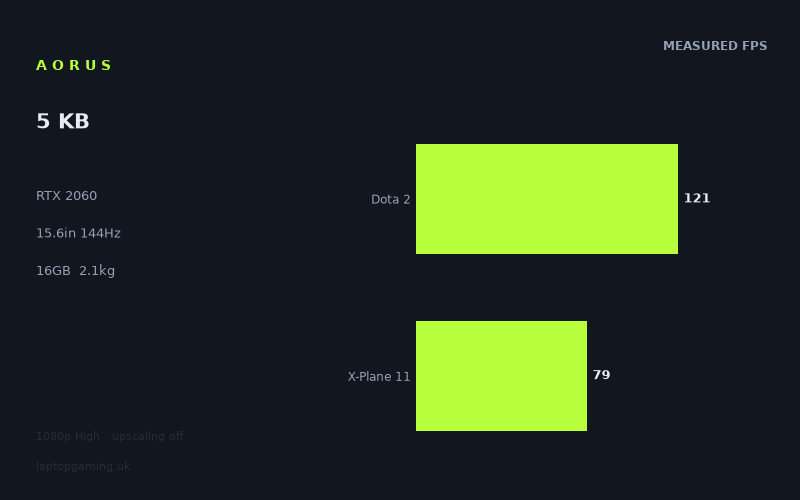
Frame rates
1920×1080, High preset, upscaling off.
Measured on this machine. Source: Notebookcheck, 2020-10-10.
Not scored: incomplete benchmark suite
Every scored laptop on this site is averaged over the same 5 games, and this one is short of Cyberpunk 2077, Baldur's Gate 3, GTA V. A mean over 3 games is not comparable to a mean over 5, so we publish the figures we have and leave the score blank rather than rank it against machines tested on a different set. The numbers below are real - the suite is just incomplete.
How these numbers were produced
Frame rates here are not measured by us, and we label how each one was arrived at. A figure marked measured comes from a published run on that exact machine. A figure marked representative is derived from the GPU and its power limit (TGP) and cross-referenced against published reviews - a sound estimate of what that configuration delivers, but not a measurement of that specific laptop. Unless stated otherwise, numbers are 1920x1080, High preset, upscaling off. Where a laptop ships in several power configurations we use the wattage of the exact SKU listed, because a 140W RTX 5070 and a 115W one are not the same product.
In use
The short version
The Aorus 5 KB is a 15.6in Full HD gaming laptop built around an RTX 2060, Core i7-10750H, 16GB of memory and a 512GB SSD. The published Notebookcheck figures show a machine with credible 1080p High-preset performance, but not one that can be assumed to make full use of its 144Hz panel in every game. Dota 2 is the clear success story at 121fps, while X-Plane 11 reaches 79fps and Final Fantasy XV manages 66fps. Those are useful results, but they describe a laptop best suited to conventional 60fps-class gaming with extra headroom in lighter or more CPU-limited titles, rather than a machine that consistently turns its 144Hz display into a competitive advantage.
There is an important qualification before treating the Aorus 5 KB as a neatly ranked product. The available scoring-suite data covers Dota 2, X-Plane 11 and Final Fantasy XV, but there are no figures for GTA V or Strange Brigade. That means the available set is incomplete and cannot be fairly averaged against fully measured laptops. Every scored laptop needs to be averaged across the same five games, so this Aorus cannot be given a comparable overall performance position from the published numbers alone. The three available results are still useful, especially because they show how widely performance changes from title to title, but they are not enough to turn the machine into a simple league-table entry.
That matters because the Aorus 5 KB is not an obvious specification-sheet winner on its published frame rates. An RTX 2060 sounds comfortably ahead of entry-level RTX 2050 systems, and the Aorus does indeed hold a sizeable shared-game advantage over the Acer Aspire 17 with its 35W RTX 2050. Yet the more surprising finding is how closely it runs to two Asus systems listed with nominally higher-tier GPUs: the RTX 2070-equipped Zephyrus S15 and RTX 2080-equipped Zephyrus S17. The Aorus is only 1fps behind the S15 and 3fps behind the S17 across their respective three-game shared sets.
That does not mean an RTX 2060 has somehow become interchangeable with every RTX 2070 or RTX 2080 laptop. It means the particular 1080p games shared in these comparisons compress the difference between GPUs. Lighter titles can become limited elsewhere in the system, especially at Full HD, so a larger GPU specification does not always create a proportionally larger frame-rate lead. The opposite result is visible against the MSI GT76 Titan DT: its RTX 2080 is 32fps ahead across three shared games. The Aorus can look surprisingly close to some higher-labelled rivals, but it can also be decisively outpaced by a more performance-focused RTX 2080 machine.
Buy the Aorus 5 KB only if its actual UK price makes sense against the performance shown here, because no confirmed UK price is available. It makes most sense for someone who wants an RTX 2060 laptop with a 144Hz IPS screen, plays esports-style or less graphically punishing games where higher frame rates are plausible, and accepts that demanding games will be closer to 60fps than 144fps at the tested 1920x1080 High preset. It is also a reasonable fit for someone who values a 2.122kg gaming laptop rather than a much larger desktop-replacement design.
It is a weaker choice for a buyer who expects the RTX 2060 label alone to guarantee high-refresh gaming across modern demanding titles. Final Fantasy XV at 66fps is the most useful corrective to that expectation. It is playable at the tested settings, but it leaves much of a 144Hz panel unused. X-Plane 11 at 79fps is similarly well above 60fps without being remotely close to 144fps. The Aorus 5 KB is therefore best understood as a competent Full HD gaming machine whose display has more potential than the published figures consistently demonstrate.
Performance
The available benchmark picture
Notebookcheck’s measured figures were recorded at 1920x1080, using the High preset with upscaling off. That test setup is especially relevant for this laptop because it matches the native resolution of its 15.6in display. There is no need to make assumptions about lower-resolution performance, image-scaling modes or aggressive preset reductions before assessing the core result. The numbers show what the Aorus 5 KB can do when asked to render games at the panel’s intended resolution and at a visually substantial setting.
- Dota 2: 121fps
- X-Plane 11: 79fps
- Final Fantasy XV: 66fps
- Mean across those three scoring-suite games: 89fps
The 89fps mean is useful as a description of this particular three-game sample, but it should not be mistaken for a universal gaming expectation. It is an average made from a 121fps result, a 79fps result and a 66fps result. The spread is substantial. Dota 2 sits 55fps above Final Fantasy XV, while X-Plane 11 sits between them. That tells a more useful story than the mean alone: the Aorus 5 KB can deliver a notably different experience depending on the game, even when the resolution, preset category and upscaling setting are held constant.
Dota 2 at 121fps is the closest the measured data gets to explaining the purpose of the 144Hz panel. At that level, gameplay has considerably more frame-rate headroom than a conventional 60Hz screen requires. It does not reach the panel’s maximum refresh rate in the published test, but 121fps is still high enough to make a high-refresh display meaningful. It is the result that makes the Aorus appealing to players whose regular games have similarly light graphical demands or whose performance is constrained by factors other than raw GPU throughput.
The other figures are more restrained. X-Plane 11 at 79fps is clearly beyond a 60fps target, and that extra margin can be valuable where frame rate varies during play. But it is not a result that suggests the laptop is driving a 144Hz display close to its limits. The same applies more strongly to Final Fantasy XV at 66fps. That is only modestly beyond 60fps at the measured settings. There is no basis in the available data to describe Final Fantasy XV as a high-refresh experience on this system at 1920x1080 High with upscaling disabled.
The difference between those outcomes is why buyers should resist treating an average as a promise. An 89fps three-game mean sounds comfortably high, but the screen refresh rate is 144Hz, not 89Hz. The Aorus is not being held back by a 60Hz panel that makes all additional performance irrelevant; it has a display capable of showing more frames. The limitation is that the published game results only deliver enough frames to approach that capability in Dota 2. In the more demanding measured titles, the machine is operating in a useful middle ground: above basic 60fps gaming, but below the frame rates associated with fully exploiting the display.
What the RTX 2060 result does and does not tell us
The Aorus 5 KB uses an RTX 2060, but the fact sheet does not provide its GPU power limit. That is a significant omission for anyone trying to compare this laptop with another RTX 2060 system purely by GPU name. Laptop GPUs with the same name can be configured differently, and the available information does not allow the Aorus 5 KB’s RTX 2060 to be described as a low-power, high-power or otherwise specifically configured version. It would be wrong to infer a wattage from the frame rates or to present an assumed power figure as specification.
What can be said is narrower and more useful: the measured performance belongs to this exact combination of RTX 2060, Core i7-10750H, 16GB memory, 512GB SSD and 1920x1080 display. The published figures are therefore more valuable than a generic GPU expectation. They show the result a buyer can actually use when considering the Aorus 5 KB, rather than asking them to guess where it might sit among other RTX 2060 laptops.
The comparisons against Asus models illustrate why GPU labels need context. Across three shared games, the Aorus averages only 1fps behind the Asus Zephyrus S15 with RTX 2070 graphics. It is also only 3fps behind the Asus Zephyrus S17 with RTX 2080 graphics across three shared games. On paper, those graphics names imply clear progression, but the shared 1080p data does not produce large gaps in those particular tests.
The likely explanation offered by the comparison notes is important: at 1080p, lighter titles in the shared set can be CPU-bound and compress genuine GPU differences. That does not erase the differences between GPUs. It explains why the available shared-game average should not be read as proof that every RTX 2060 laptop matches every RTX 2070 or RTX 2080 laptop. When a game’s performance is limited elsewhere, adding graphical capability may not transform the frame rate. The Aorus can therefore look unusually close to more highly specified systems in the games represented here without making those systems redundant in broader gaming use.
The MSI GT76 Titan DT supplies the necessary counterweight. Its RTX 2080 leads the Aorus by 32fps across three shared games. That is not a marginal difference and not one that can be dismissed as measurement noise. It shows that the higher GPU tier can translate into a decisive real-world advantage when the system and shared workloads allow it to do so. The Aorus 5 KB should not be bought on the assumption that its close result against the Zephyrus models means all RTX 2080 laptops are effectively equivalent. The Titan comparison says exactly the opposite: system design and the games being measured matter enormously.
How to read the frame-rate spread
The best way to use the Aorus 5 KB’s benchmark data is to start with the game closest to what you actually play. Dota 2 at 121fps supports a different buying decision from Final Fantasy XV at 66fps. Someone who spends most of their gaming time in titles with similar demands to Dota 2 can reasonably see the Aorus as a high-frame-rate Full HD machine, even if it does not quite reach 144fps in the published result. Someone primarily interested in graphically demanding games represented more closely by Final Fantasy XV should see it as a laptop intended for smooth 60fps-class gaming at High settings, not as a no-compromise 144Hz machine.
X-Plane 11 at 79fps adds a useful middle case. It suggests there is a sizeable zone between the extremes where the Aorus delivers more than basic 60fps performance but not enough to turn every game into a high-refresh showcase. That matters more than a simplistic “can it run games?” judgement. The available numbers say yes, but the quality of the experience depends on what frame-rate target the buyer has in mind. A player content with results above 60fps has a much stronger case for the Aorus than a player who considers 120fps or more a requirement.
The test settings also rule out an easy escape route in the interpretation. Upscaling was off. The results are not being boosted by an upscaling mode, but neither do they tell us what performance might be possible with one. The High preset was used, but there are no published figures here for lower presets. It would be reasonable in general to expect settings choices to affect performance, but there is no measured basis in this fact sheet for stating how far the Aorus might move from 66fps, 79fps or 121fps after changing those options. Buyers should not treat imagined lower-setting results as published evidence.
Similarly, there are no figures for ray-traced modes, no figures for other resolutions and no measurements for the missing scoring-suite games. The performance evidence is solid within its stated boundaries and incomplete outside them. That is not a reason to disregard the results; it is a reason to keep the conclusion proportionate. The Aorus 5 KB has demonstrated respectable 1080p High-preset performance in three games. It has not demonstrated a full five-game scoring-suite result, universal 144Hz gaming, or a specific ranking against every rival.
The screen
The Aorus 5 KB has a 15.6in IPS display with a 1920x1080 resolution and a 144Hz refresh rate. For its measured gaming performance, Full HD is the sensible pairing. The RTX 2060 is being asked to render at the screen’s native resolution, and the published results show why that matters. A higher-resolution panel would demand more from the graphics hardware, while the existing 1920x1080 panel gives the machine a realistic chance of moving beyond 60fps in the measured games.
The IPS panel type and 144Hz refresh rate are the key display specifications available, but the fact sheet does not provide measurements for brightness, colour coverage, contrast, response times or adaptive-sync behaviour. Those omissions matter for buyers who need a laptop for colour-critical work, outdoor use, dark-room viewing or serious competitive play. It would be overconfident to call this panel colour-accurate, exceptionally fast or particularly bright without published measurements. The display can be assessed here only as a 15.6in Full HD 144Hz IPS panel, and in relation to the supplied gaming results.
In that context, the refresh rate is both an advantage and a reminder of the laptop’s limits. A 144Hz screen has room for substantially more than 60fps, so Dota 2 at 121fps has somewhere useful to go. The panel is not wasted in that result. A player is receiving far more frames than they would on a 60Hz display, even though the benchmark does not reach 144fps. This is the Aorus 5 KB at its most convincing: a Full HD game running at a high enough frame rate to make the display specification feel relevant.
For X-Plane 11 at 79fps, the argument changes. The display still has a higher refresh ceiling than the measured output, but the gap is much larger. The experience should be considered smoother than a strict 60fps target on the evidence available, but it is not reasonable to present 79fps as making full practical use of a 144Hz display. The screen provides headroom, rather than a performance level the Aorus has demonstrated it can fill in this game.
Final Fantasy XV at 66fps is more straightforward. At the tested 1920x1080 High preset with upscaling off, the Aorus has not shown a result that aligns closely with a 144Hz target. The panel remains a good specification to have, particularly because it does not cap the laptop at 60Hz in lighter games, but the GPU performance here is closer to a conventional 60fps proposition. Buyers whose preferred games resemble Final Fantasy XV should regard the 144Hz screen as flexibility for other titles rather than as a guarantee of high-refresh operation in their main games.
This is not a criticism of the resolution. Full HD is arguably the right resolution for the benchmark evidence available. The issue is not that the panel asks too much of the RTX 2060; it is that 144Hz sets a demanding frame-rate aspiration. The laptop can approach it in Dota 2, but the more demanding published results show that the panel’s maximum refresh rate should not be confused with the frame rate the system will always produce.
There is also a practical benefit to the 1920x1080 specification beyond the benchmark figures: it keeps the screen and the testing resolution aligned. Buyers do not need to choose between gaming at native resolution and reducing resolution to chase frame rate in the evidence presented here. Notebookcheck’s results already describe native-resolution gaming. That makes the 121fps, 79fps and 66fps figures more immediately relevant than results measured at a resolution the screen does not natively display.
Build, size and portability
The Aorus 5 KB weighs 2.122kg. That places it in a more portable category than a large desktop-replacement machine, but it should not be described as an ultra-light laptop. The figure is light enough for a buyer who needs to move the machine between rooms, take it to work or study locations, or travel with a gaming-capable system, provided they accept that it is still a dedicated 15.6in gaming laptop rather than a minimal carry-everywhere notebook.
There are no dimensions in the fact sheet, so it is not possible to make a reliable statement about footprint, thickness or how easily the Aorus 5 KB fits into a particular bag. Weight alone is not the full portability picture. A laptop can weigh 2.122kg yet have a different practical shape from another 15.6in machine, and the available information does not support a claim about the Aorus’s chassis volume. Likewise, there are no figures for the power adaptor, so total travel weight cannot be calculated.
The 15.6in screen size gives the Aorus a familiar gaming-laptop format: large enough to make the Full HD display and 144Hz refresh rate useful without moving to the larger format associated with the 17in rival named here. That does not automatically make it more portable than the Acer Aspire 17, Zephyrus S17 or MSI GT76 Titan DT, because no rival weights or dimensions are provided. It does mean the Aorus is aimed at a different balance from a 17in laptop: a gaming screen large enough for regular use, packaged in a smaller display class.
No build-material information, keyboard details, port list, webcam specification, battery figure, thermal measurements or noise figures are provided. Those are major buying considerations for a gaming laptop, particularly when the available performance data shows a machine designed to operate above 60fps in some games. Sustained gaming performance, fan behaviour and battery use cannot be responsibly inferred from the RTX 2060 name, the Core i7-10750H name or the laptop’s weight. A buyer who needs quiet operation, long unplugged use or a specific connection should seek confirmed measurements and specifications before deciding.
The storage and memory configuration is clearer. This model is listed with 16GB of memory and a 512GB SSD. That is the configuration attached to the published gaming figures, so there is no ambiguity about whether the results came from a lower-memory model or from a machine with different storage capacity. However, the fact sheet does not state memory speed, memory upgrade options, storage expansion options or SSD performance. It would be wrong to assume the upgrade path simply because the laptop is a gaming model.
For the buyer, the useful conclusion is modest. At 2.122kg and with a 15.6in display, the Aorus 5 KB has a portability argument that a large performance-focused system may not. It is best seen as a transportable gaming laptop rather than a lightweight everyday machine. If your priority is moving an RTX 2060 system regularly while retaining a 144Hz Full HD screen, its stated weight is encouraging. If your priority is detailed knowledge of chassis quality, acoustics, thermals, battery endurance or physical dimensions, the available data does not establish a case either way.
How it compares
Against the Acer Aspire 17 with RTX 2050
The Aorus 5 KB holds its clearest measured advantage over the Acer Aspire 17 with an RTX 2050 configured at 35W. Across three shared games, the Aorus averages 18fps more. That is a meaningful gap, not a cosmetic one. It supports the expectation that the Aorus is the stronger gaming option in this comparison, and it is the most straightforward argument for choosing the RTX 2060 machine over the lower-tier RTX 2050 rival.
The Acer has no confirmed UK price in the supplied information, so there is no value conclusion to draw from the performance gap alone. If the Acer were much cheaper, its lower performance might be acceptable for a buyer with modest frame-rate aims. If the prices were close, the Aorus’s 18fps shared-game lead would become more compelling. Without confirmed prices for either the Aorus or the Acer, the correct conclusion is simply that the Aorus has the stronger published gaming result, not that it is automatically the better purchase.
Against the Asus Zephyrus S15 with RTX 2070
The Asus Zephyrus S15 is listed with an RTX 2070 and a UK price of £2,000. Across three shared games, the Aorus is only 1fps behind it. This is one of the most revealing comparisons in the available data, because a 1fps average difference is effectively a near-tie in these shared tests. It should not be repeated as though it establishes a meaningful performance hierarchy. The important point is that the Aorus’s measured result is extremely close despite the Zephyrus carrying a higher-tier GPU name.
The comparison notes explain that at 1080p, lighter titles in the shared set can be CPU-bound and compress genuine GPU gaps. That explanation is more useful than declaring the Aorus equal to an RTX 2070 laptop in all circumstances. The shared data says the two systems are extremely close in these particular tests. It does not say that the RTX 2070 provides no benefit in games that place greater demand on the GPU.
The £2,000 price of the Zephyrus S15 makes the absence of an Aorus price particularly important. If the Aorus is available well below that figure, the close shared-game performance would give it a strong value argument. If it is priced similarly, the buyer would need more information about the machines beyond these three-game results. Since the Aorus has no confirmed UK price, the evidence does not support declaring it a bargain or calling the Zephyrus overpriced. It supports a narrower point: do not pay a premium for the RTX 2070 label without checking the actual games and the actual price.
Against the Asus Zephyrus S17 with RTX 2080
The Asus Zephyrus S17 has an RTX 2080, yet the Aorus averages only 3fps behind it across three shared games. Again, this is a close result rather than a dramatic deficit. It reinforces the warning against using GPU naming alone as a proxy for frame rate. In the specific shared 1080p data, the Aorus’s RTX 2060 is much closer to the Zephyrus S17 than the specification labels might suggest.
There is no confirmed UK price for the Zephyrus S17, so the comparison remains about measured performance rather than value. It would be tempting to treat the 3fps gap as proof that the Aorus is the sensible option, but that would go beyond the evidence. The same CPU-bound explanation applies: lighter titles at 1080p can reduce the visible separation between GPUs. A buyer considering the S17 may have reasons beyond these three games, and the data here does not establish how the machines compare in a complete five-game suite.
Against the MSI GT76 Titan DT with RTX 2080
The MSI GT76 Titan DT is the rival that beats the Aorus by the largest margin in the supplied comparison set. Its RTX 2080 leads by 32fps across three shared games. This result prevents the close Zephyrus comparisons from becoming misleading. Aorus performance is not universally close to RTX 2080 performance. In the right system and games, the more powerful graphics tier can produce a major advantage.
The GT76 has no confirmed UK price in the available information, so the size of the performance lead cannot be converted into a value judgement. Nor are its weight and dimensions given, so there is no sourced basis for describing its portability relative to the Aorus. What the benchmark data establishes is clear enough: buyers who prioritise the highest possible frame rates rather than the Aorus’s 2.122kg weight should not assume the Aorus is competitive with every RTX 2080 machine. The GT76’s 32fps advantage is substantial.
Who it’s for
The Aorus 5 KB is for a buyer who wants a 15.6in Full HD gaming laptop with a 144Hz IPS display and accepts a performance profile that varies sharply by game. It suits Dota 2 players particularly well on the evidence available, because 121fps is the published result closest to the panel’s 144Hz ceiling. It also suits someone happy with more-than-60fps performance in games represented by X-Plane 11, where the measured 79fps offers useful headroom without reaching high-refresh territory.
It is also a sensible candidate for someone who sees 2.122kg as an acceptable compromise between gaming hardware and portability. The Aorus is not documented well enough here to make claims about its chassis dimensions, battery life or noise, but the weight supports the idea of a machine that can be moved regularly rather than left permanently in one place.
It is not for a buyer whose main requirement is 144fps-class performance in demanding games at 1920x1080 High with upscaling off. Final Fantasy XV at 66fps is too far from 144fps to support that expectation. Nor is it for someone who wants a complete, directly rankable five-game performance result: GTA V and Strange Brigade figures are missing, so the available three-game mean cannot be compared fairly with complete scoring-suite averages.
Buy something else if you need confirmed battery endurance, thermal data, noise data, physical dimensions, display colour measurements or a confirmed UK price before committing. None of those are available here. Buy something else if the priority is maximum gaming performance and the budget can accommodate a system that produces results more like the MSI GT76 Titan DT’s 32fps shared-game lead. And buy something else if the Aorus appears at a price that does not reflect its incomplete benchmark picture. The laptop has enough published performance to be credible, but not enough pricing information to be called good value in the abstract.
The final judgement is therefore conditional but firm. The Aorus 5 KB is a competent native-1080p gaming laptop whose 144Hz IPS panel is genuinely useful in lighter games and aspirational in more demanding ones. Its RTX 2060 delivers 121fps in Dota 2, 79fps in X-Plane 11 and 66fps in Final Fantasy XV under Notebookcheck’s stated test conditions. Those figures make it a reasonable choice for buyers targeting smooth Full HD gaming rather than universal high-refresh performance. Whether it becomes a worthwhile purchase depends entirely on the price eventually available in the UK and on whether its missing practical measurements meet the buyer’s needs.