Review
Alienware m15 R4 review
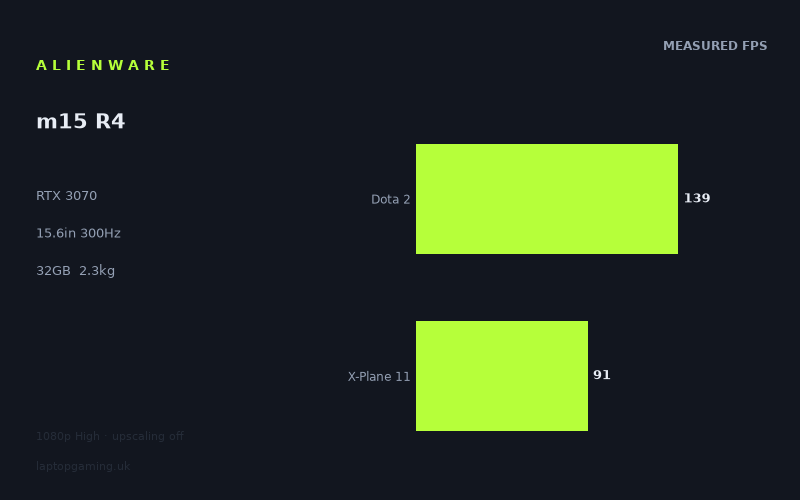
Frame rates
1920×1080, High preset, upscaling off.
Measured on this machine. Source: Notebookcheck, 2021-04-06.
Not scored: incomplete benchmark suite
Every scored laptop on this site is averaged over the same 5 games, and this one is short of Cyberpunk 2077, Baldur's Gate 3, GTA V. A mean over 3 games is not comparable to a mean over 5, so we publish the figures we have and leave the score blank rather than rank it against machines tested on a different set. The numbers below are real - the suite is just incomplete.
How these numbers were produced
Frame rates here are not measured by us, and we label how each one was arrived at. A figure marked measured comes from a published run on that exact machine. A figure marked representative is derived from the GPU and its power limit (TGP) and cross-referenced against published reviews - a sound estimate of what that configuration delivers, but not a measurement of that specific laptop. Unless stated otherwise, numbers are 1920x1080, High preset, upscaling off. Where a laptop ships in several power configurations we use the wattage of the exact SKU listed, because a 140W RTX 5070 and a 115W one are not the same product.
In use
The short version
The Alienware m15 R4 is a powerful older-generation gaming laptop whose published benchmark data still shows useful 1080p performance, but it needs to be judged carefully rather than treated as an automatic recommendation. Its RTX 3070, Core i9-10980HK and 32GB of memory form a high-end specification on paper, while the 15.6in IPS display offers a very fast 300Hz refresh rate. The problem is not that the machine lacks gaming ability. The problem is that the measured figures do not support the idea that it can make full use of that 300Hz panel in the demanding games covered here.
Notebookcheck’s figures at 1920x1080, High settings and with upscaling off are 139fps in Dota 2, 91fps in X-Plane 11 and 62fps in Final Fantasy XV. That is a broad spread, and it matters more than the mean alone. Dota 2 runs quickly enough to benefit visibly from a high-refresh display, although it still does not reach the panel’s full refresh rate. X-Plane 11 is clearly playable but lands far below the screen’s ceiling. Final Fantasy XV is the harder result: 62fps is a reasonable outcome for a demanding game at High settings without upscaling, but it is nowhere close to the kind of frame rate that makes a 300Hz screen central to the buying decision.
The measured average across the available scoring-suite games is 97fps. That is respectable performance for 1080p High gaming, but it is only a partial picture. We do not have figures for GTA V or Strange Brigade, so this laptop cannot be ranked fairly against fully measured systems. Every ranked laptop needs the same game set, and using an incomplete set would create a misleading comparison.
Buy the Alienware m15 R4 only if the exact configuration is available at a sensible price, if its combination of 32GB memory and RTX 3070 suits the games and workloads you actually run, and if you understand that the screen is more ambitious than the published gaming results. It looks more convincing as a laptop for fast competitive and lighter games than as a machine intended to deliver exceptionally high frame rates in every modern demanding title.
It is not the right choice for someone buying specifically for a 300Hz gaming experience in graphically heavy games. Nor is it an easy recommendation for a buyer who expects a clean performance advantage over every other RTX 3070 laptop. The comparison data shows that it is effectively level with the closest RTX 3070 machines in the shared games. That is not a flaw in itself, but it means the Alienware needs to justify itself through its available configuration, screen preference and price rather than through a clear benchmark lead.
Performance
The available benchmark data
The most useful way to read the Alienware m15 R4’s performance is game by game. A mean can make the machine look neatly balanced, but the individual results show a laptop whose practical experience will depend heavily on what is being played.
- Dota 2: 139fps
- X-Plane 11: 91fps
- Final Fantasy XV: 62fps
- Mean across the available scoring-suite games: 97fps
These are Notebookcheck’s measured figures, using 1920x1080, the High preset and no upscaling. That common test condition is important. The results are useful for comparing the laptop with other systems tested in the same way, but they should not be mistaken for a promise that every game will run at the same speed. Dota 2, X-Plane 11 and Final Fantasy XV place very different demands on a laptop. The m15 R4’s range from 139fps to 62fps makes that clear.
Dota 2 is the standout result. At 139fps, the Alienware has no difficulty producing a high frame rate at the stated settings. This is the result that best suits the 300Hz display. Movement and input can benefit from a high-refresh panel even when frame rate is below the panel maximum, and the measured result leaves substantial headroom compared with the other games in the data set. For players focused on Dota 2 and similarly lighter or more CPU-limited titles, the m15 R4’s screen is not wasted. It is still operating below 300Hz, but the display’s high refresh rate is relevant rather than merely decorative.
X-Plane 11 at 91fps is a different kind of result. It is above the level most players would consider merely adequate, and it should support smooth play at the tested settings. But it does not put the machine in a position where a 300Hz screen becomes the defining feature of the experience. The panel can refresh far more often than the benchmarked game output. That does not make the screen bad; it simply means the GPU and CPU combination are not delivering the sort of frame rate that would fully exploit it in this title.
Final Fantasy XV at 62fps is the most sobering figure. It remains a playable result at 1080p High without upscaling, but it is much closer to conventional gaming performance than to high-refresh esports performance. The gap between this result and Dota 2 should guide expectations. A buyer should not look at the RTX 3070 badge, the Core i9 name or the 300Hz specification and assume that all games will run at similarly elevated frame rates. The benchmark data says otherwise.
The 97fps mean is therefore best treated as a shorthand, not a verdict. It describes a system that is generally strong at the tested 1080p settings, but it hides the fact that one game is well into high-refresh territory, one is in a solid middle ground, and one is only a little above the frame rate many players would regard as a baseline target for demanding single-player gaming. The spread is the story.
What the RTX 3070 means here
The m15 R4 uses an RTX 3070, but the fact sheet does not provide a confirmed GPU power limit for this particular machine. That omission matters. Laptop GPU names alone do not tell the whole performance story, because power configuration can affect how much room a GPU has to operate. We should not assign this Alienware a wattage that has not been confirmed, and we should not use the power limits of other laptops as if they applied here.
What can be said from the measured figures is that this RTX 3070 implementation delivers credible 1080p High performance, but it does not show a decisive advantage over the comparable RTX 3070 systems in the provided rival list. The Alienware is level with the Lenovo Legion 5 Pro 16ACH6H in the shared games and effectively level with the MSI GP76 Leopard as well. That makes the m15 R4’s result look normal for the surrounding RTX 3070 field rather than unusually fast or unusually slow.
This is precisely why published frame rates are more useful than a GPU name on its own. A buyer may see RTX 3070 and expect a fixed level of performance. The rival results show that the practical answer is more nuanced. In the shared titles, this Alienware does not establish itself as the RTX 3070 laptop to buy for a clear performance lead. It sits alongside its closest RTX 3070 alternatives.
Against the MSI Prestige 15 with RTX 3050 Ti graphics, the Alienware has a substantial advantage in the shared games. Against the MSI Raider GE77 HX with RTX 3080 Ti graphics, it is substantially behind. Those are the expected broad directions for the comparison, but the exact shared-game gaps matter because they show where the m15 R4 sits in a wider performance spread: well ahead of a lower-tier GPU system, but not close to a much more powerful RTX 3080 Ti laptop.
The important practical conclusion is that the m15 R4 should be bought for capable 1080p gaming rather than for the assumption that its hardware will overwhelm every game at the highest possible refresh rates. The benchmark data does not support that stronger claim. It supports a more grounded one: this is a laptop that can run the tested games well at the stated settings, with very good results in the lighter title and more restrained results in the demanding title.
Why the frame-rate spread matters
The difference between 139fps in Dota 2 and 62fps in Final Fantasy XV is not a minor fluctuation. It changes what settings, screen features and upgrade expectations mean for the owner. A system that holds a similar rate across titles can be described simply. This one cannot. It needs a game-by-game reading.
In Dota 2, the high result suggests that the m15 R4 has enough performance for players who value responsiveness and who are likely to spend their time in games where frame rate can climb well above the rates seen in demanding cinematic releases. The 300Hz panel is most relevant in this use case. A player who wants a fast 15.6in laptop for titles in this category has a reasonable case for considering the Alienware.
In X-Plane 11, the result points to a more balanced scenario. The laptop is not struggling, but neither is it delivering output that makes the screen’s maximum refresh rate the key attraction. The experience implied by 91fps is one where the system has useful performance headroom compared with Final Fantasy XV, while still leaving a large part of the panel’s capability unused. Buyers interested in simulation-style workloads should focus on this kind of result rather than assuming that the strongest figure from Dota 2 will carry over.
In Final Fantasy XV, the m15 R4 looks like a conventional high-performance laptop rather than a 300Hz specialist. A result of 62fps at the stated settings is not poor in isolation. The test uses High settings at 1920x1080 with upscaling off, and the machine remains above 60fps. But when this result is considered alongside a 300Hz display, the message is clear: the panel is capable of much more than the laptop can deliver in this demanding benchmark.
That mismatch is not necessarily wasteful. A fast panel can still be attractive for desktop use, for lighter games and for games that react well to high frame rates. But a buyer should not pay extra solely for the idea of reaching 300fps in demanding games, because none of the measured results reaches the screen’s 300Hz refresh rate. The available figures do not even put the quickest result at half the stated refresh rate. The display is an asset, but not one that the tested demanding workloads can fully unlock.
What we cannot conclude
The benchmark set is useful but incomplete. We have no published figures here for GTA V or Strange Brigade. That means there is no full scoring-suite result and no fair overall ranking against laptops that have been measured across the complete suite. It would be misleading to take the 97fps mean from the available games and present it as if it were directly comparable with a full five-game average.
The missing results also mean that the m15 R4’s performance range may be broader or narrower than the three available games suggest. We know how it behaves in Dota 2, X-Plane 11 and Final Fantasy XV under the stated conditions. We do not know, from this fact sheet, how it performs in the two missing scoring games. A careful buyer should treat the published data as evidence of capability rather than as a complete performance map.
We also do not have a confirmed GPU power limit for the Alienware. It would be tempting to explain every rival difference through GPU wattage, especially because one rival’s power limit is supplied. But that would go beyond the evidence. The right conclusion is simpler: the Alienware’s measured results place it alongside the nearest RTX 3070 alternatives in the shared games, and the available information does not establish a unique power configuration advantage for it.
The screen
The Alienware m15 R4 has a 15.6in IPS display with a 1920x1080 resolution and a 300Hz refresh rate. This is an uncompromisingly gaming-focused screen specification. The 1080p resolution keeps the pixel load lower than a higher-resolution panel, while 300Hz signals an emphasis on high frame rates and fast-moving competitive games.
The IPS panel type is also relevant because it identifies the display technology supplied in this configuration. Beyond that, the fact sheet does not provide measurements for brightness, colour coverage, contrast, response times or outdoor visibility, so those aspects should not be assumed. The available screen story is about size, resolution, panel type and refresh rate, not about unmeasured image-quality claims.
A 300Hz panel with sub-300fps results
The central question is whether the hardware can drive the display at its intended speed. In the available Notebookcheck data, the answer is: not fully in any of the measured games. Dota 2 reaches 139fps, X-Plane 11 reaches 91fps and Final Fantasy XV reaches 62fps. Each result is below 300Hz.
That does not mean the panel has no benefit. The Dota 2 figure is high enough that a fast screen remains meaningful. The laptop is producing a much higher frame rate there than in the other two titles, and a player whose library is dominated by lighter competitive games is likely to get more from the panel than a player focused on graphically demanding releases.
However, there is a crucial difference between benefiting from a high-refresh display and fully utilising a 300Hz display. The m15 R4 can do the former in the quicker benchmarked title. The published numbers do not show it doing the latter. Anyone buying this laptop primarily because of the 300Hz label should be clear about that distinction.
X-Plane 11 reinforces the point. At 91fps, the system is delivering a solid frame rate, but the display has far more refresh capability than the game output shown in the benchmark. In Final Fantasy XV, the gap is larger still. The 300Hz screen is not a performance guarantee; it is a ceiling that the rest of the system must be able to approach in a given game and settings combination.
1080p is the sensible resolution for the measured performance
The 1920x1080 resolution suits the performance evidence better than a more demanding display resolution would. The measured figures are already taken at 1080p, High settings and with upscaling off. That gives a clear view of what the laptop can do without relying on image-upscaling techniques to raise the frame rate.
At this resolution, Dota 2 is fast, X-Plane 11 is solid and Final Fantasy XV remains above 60fps. Those are useful outcomes. More importantly, they show that 1080p is not a compromise that leaves the RTX 3070 looking underused. The laptop’s GPU has enough work to do in the demanding games, even at this resolution. Final Fantasy XV demonstrates that plainly.
For a buyer who values frame rate over additional display pixels, the screen specification is coherent. The concern is not that the panel has the wrong resolution. The concern is that the refresh rate is so high that it creates expectations the benchmark data cannot meet across the measured games. A lower refresh ceiling would fit the heavier results more naturally, while the 300Hz panel is best understood as an advantage for the games that can run much faster.
Who will value this display most
The display makes most sense for players who spend significant time in Dota 2 or other games that can produce high frame rates on this class of hardware. The measured 139fps result is the strongest case for the panel. It does not reach 300Hz, but it is sufficiently elevated to make a fast screen more relevant than it would be at 62fps.
It is less compelling for someone whose gaming is dominated by demanding titles similar to Final Fantasy XV. In that use case, the measured figure points towards a more conventional frame-rate experience. The screen remains a good specification in isolation, but it should not be the reason to choose this laptop over another well-priced RTX 3070 system unless the buyer has a clear preference for a 300Hz 15.6in IPS panel.
For X-Plane 11 players, the answer is between those extremes. The measured 91fps result is strong enough to make smoothness a realistic priority, but not strong enough to make full 300Hz output a realistic expectation at the tested settings. It is a good match for someone who wants a high-refresh panel available for a mixed library, rather than someone expecting every title to operate near the panel maximum.
Build, size and portability
The Alienware m15 R4 is a 15.6in gaming laptop weighing 2.3kg. That places it firmly in the category of portable gaming machine rather than lightweight everyday laptop. It can be moved between rooms, homes, university accommodation or work locations, but its weight means it is best thought of as a laptop that can travel when necessary rather than one designed to disappear into a bag without consequence.
The 15.6in screen size is a practical middle ground. It is smaller than the larger MSI Raider GE77 HX in the rival list, at least by model designation, but the fact sheet does not provide dimensions for either laptop and no direct physical-size claim should be made from the available data. What is known is that the Alienware combines a 15.6in display with a 2.3kg weight. That is enough to establish its basic role: a full gaming laptop with a relatively compact display class, not a thin-and-light machine defined by minimal carry weight.
There are no confirmed dimensions in the fact sheet. As a result, we cannot responsibly describe it as slim, thick, compact in footprint or especially easy to fit into a particular bag. Those details matter for portability, but they need confirmed measurements. The 2.3kg weight is the available hard evidence.
What 2.3kg means in practice
At 2.3kg, the m15 R4 is likely to be most appealing to someone who wants one machine for both desk use and occasional transport. The 15.6in format is more manageable than a larger desktop-replacement style laptop, while the weight makes clear that mobility is not the primary design goal. It is a gaming system first, with portability as a secondary benefit.
That positioning fits the hardware. The RTX 3070, Core i9-10980HK, 32GB memory and 300Hz display are all specifications aimed at performance. A buyer looking for something primarily for note-taking, commuting or all-day carrying should not assume that a 2.3kg gaming laptop will feel equivalent to a lighter general-purpose machine. The m15 R4 should be selected because its gaming specification is useful, not because it is the easiest machine to carry.
The 86Wh battery is a meaningful specification, but the fact sheet does not include measured battery life. We therefore cannot state how long the m15 R4 lasts away from mains power, whether during gaming, video playback, web use or mixed work. Buyers who need dependable unplugged endurance should regard that as an unanswered question rather than inferring it from battery capacity alone.
Similarly, there are no supplied temperature or noise measurements. Gaming laptops can differ substantially in how they manage heat and fan noise, but there is no evidence here that permits a claim about the Alienware’s behaviour. A buyer sensitive to fan noise or chassis temperature should seek published measurements before treating the m15 R4 as suitable for quiet shared spaces or long gaming sessions away from headphones.
Memory and storage
The m15 R4 configuration listed here has 32GB of memory and a 512GB SSD. The 32GB memory allocation is a strong part of the specification because it avoids the sense that the machine has been paired with a minimal memory configuration despite its Core i9 and RTX 3070 hardware. The fact sheet does not provide memory speed, upgrade information or storage expansion details, so those should not be assumed.
The 512GB SSD is a more modest capacity alongside the rest of the specification. It may be enough for a focused game library and everyday files, but the fact sheet does not state usable capacity after system software, drive performance or whether additional storage can be fitted. The sensible reading is simply that this configuration begins with 512GB rather than with a larger drive. Buyers with a large installed library should check expansion options and current configuration details before purchasing.
How it compares
The rival data is useful because it avoids the usual mistake of comparing a laptop only with one similarly named machine. The supplied alternatives cover a lower-tier RTX 3050 Ti laptop, two close RTX 3070 competitors and a much faster RTX 3080 Ti system. The results are based only on games held in common, with preference given to the scoring-suite titles. That makes the comparison narrower than a full benchmark ranking, but still valuable.
The most important limitation remains: the Alienware has incomplete scoring-suite data. We do not have its GTA V or Strange Brigade figures, so it cannot be given a fair five-game position against laptops with complete results. The comparisons below are shared-game comparisons, not a substitute for a complete ranking.
Against the MSI Prestige 15
Against the MSI Prestige 15 with RTX 3050 Ti graphics at 105W, the Alienware m15 R4 averages 44fps ahead across the three shared games. That is the clearest performance advantage in the supplied comparison set.
The gap supports the view that the m15 R4 is meaningfully stronger than a lower-tier GPU laptop when both are judged in the same games. For a buyer deciding between these two machines primarily for gaming, the Alienware’s benchmark lead is substantial enough to matter. Its 300Hz screen also makes more sense alongside the stronger GPU, even though the available figures still do not show it reaching 300fps.
There is no confirmed UK price for the MSI Prestige 15 in the fact sheet, and there is no confirmed UK price for the Alienware m15 R4 either. That prevents a value judgement based on cost. The Alienware is faster in the shared games, but we cannot say whether that performance advantage is worth any particular price difference without confirmed pricing.
Against the Lenovo Legion 5 Pro 16ACH6H
Against the Lenovo Legion 5 Pro 16ACH6H with RTX 3070 graphics, the Alienware averages 0fps ahead across the three shared games. In practical terms, that is a tie in the supplied shared-game data.
A near-zero result is not an error to be ignored. It is a real outcome, and the supplied context explains why these small differences can happen: at 1080p, lighter titles in the shared set can be CPU-bound and compress genuine GPU gaps. In other words, the shared-game average does not prove that every internal difference between these laptops is irrelevant. It does show that, under the tested conditions and in the games they share, there is no meaningful measured lead for the Alienware.
This matters for buying advice. The Alienware should not be chosen over the Lenovo on an expectation of noticeably better shared-game performance. If both are available, the decision should turn on verified configuration, display preference, size, weight, storage, condition and price rather than on a claimed benchmark advantage that the data does not show.
The fact sheet does not provide a confirmed UK price for the Lenovo. Without pricing, neither machine can be declared better value from the information available. Performance is effectively level in the shared games; value remains unresolved.
Against the MSI GP76 Leopard
Against the MSI GP76 Leopard with RTX 3070 graphics at 95W, the Alienware averages 0fps behind across the three shared games. Again, that is effectively a tie.
The wording matters here. The Alienware is not shown as meaningfully slower in the shared games, despite the GP76 Leopard’s specified 95W RTX 3070. Nor is it shown as faster. The measured comparison is so close that a buyer should not treat either laptop as the obvious performance winner on this evidence.
The same 1080p CPU-bound explanation applies. Lighter games in the shared set can compress genuine GPU differences, meaning that a zero-gap shared average should not be stretched into a claim that every game, every setting and every workload will behave identically. But the data is still valuable: it removes any basis for claiming that the Alienware has a clear edge over this RTX 3070 rival.
There is no confirmed UK price for the GP76 Leopard. As with the Lenovo comparison, the absence of pricing means the sensible conclusion is limited to performance: in the shared games, the machines are effectively level.
Against the MSI Raider GE77 HX
Against the MSI Raider GE77 HX with RTX 3080 Ti graphics at 175W, the Alienware averages 45fps behind across the three shared games. This is the largest deficit in the supplied rival set, and it establishes the upper boundary of where the m15 R4 sits.
The Raider is not a close alternative in performance terms. The 45fps average gap is large enough that it should influence a buyer who wants the highest possible frame rates in demanding games. The Alienware’s 62fps result in Final Fantasy XV already shows that it cannot assume high-refresh performance in every title. A substantially faster rival with RTX 3080 Ti graphics is therefore a different class of option for someone whose priority is pushing frame rates harder.
That does not make the Alienware obsolete. The m15 R4 still has useful 1080p results, particularly in Dota 2 and X-Plane 11. But the comparison demonstrates that an RTX 3070 laptop should not be treated as equivalent to a higher-powered RTX 3080 Ti machine simply because both are gaming laptops with high-refresh screens available in their ranges.
No confirmed UK price is provided for the Raider either. We cannot say whether its larger performance lead comes at a price premium that is sensible for a particular buyer. We can only say that, in the shared games, it is substantially faster than the Alienware.
Who it’s for
The Alienware m15 R4 is for a buyer who wants a 15.6in 1080p gaming laptop with an RTX 3070, 32GB of memory, a Core i9-10980HK and a fast IPS display, and who is comfortable evaluating it on measured performance rather than badge appeal. It is especially plausible for someone whose library includes Dota 2 and other games where frame rates can climb well beyond the heavier results seen in the benchmark set.
It is also suitable for someone who values a high-refresh display as part of a mixed gaming setup. The 300Hz panel will not be fully exploited in the measured games, but the Dota 2 result shows that the machine can produce sufficiently high output for the screen to be more than a specification-sheet flourish. The right buyer sees 300Hz as available headroom for the right games, not as a promise of 300fps performance everywhere.
The 32GB memory configuration may appeal to buyers who do not want to begin with a lower memory allocation. The 512GB SSD is less persuasive for someone with a large game library, but it can be acceptable for a buyer whose storage needs are more limited, provided expansion details are checked separately.
The 2.3kg weight makes the m15 R4 appropriate for someone who moves their gaming laptop occasionally and wants a smaller display class than a larger desktop-replacement machine. It is not the obvious choice for a buyer whose priority is daily light travel. The machine can be portable without being lightweight, and those are different requirements.
Who should buy something else
Buy something else if your main reason for considering the m15 R4 is the 300Hz screen and your gaming is dominated by demanding titles. Notebookcheck’s 62fps result in Final Fantasy XV and 91fps result in X-Plane 11 show that the laptop cannot be expected to approach the display’s maximum refresh rate in every game at 1080p High with upscaling off. The screen is fast, but the measured results are game-dependent.
Buy something else if you need confirmed battery-life evidence. The laptop has an 86Wh battery, but no battery-runtime measurements are supplied. Capacity is not runtime, and there is no basis here for a claim about unplugged endurance.
Buy something else if quiet operation or low chassis temperatures are essential. No noise or temperature measurements are included in the fact sheet. A buyer with those priorities needs evidence that is not available here.
Buy something else if you want the strongest possible gaming performance from the listed alternatives. The MSI Raider GE77 HX is 45fps ahead on average across the shared games. Its RTX 3080 Ti at 175W places it in a clearly faster performance tier in this comparison. Whether it is worth choosing depends on factors not supplied here, especially price, but the Alienware does not match it on frame rate.
Buy something else if a clear RTX 3070 performance lead is the goal. The Alienware is effectively tied with both the Lenovo Legion 5 Pro 16ACH6H and MSI GP76 Leopard in the shared games. That means it needs to win on the specifics of the deal rather than on an assumed GPU advantage. If either rival is available in a better configuration or at a better price, the benchmark evidence does not give the Alienware enough of a performance cushion to override that.
Finally, do not buy the Alienware m15 R4 on the basis of an overall benchmark rank. We do not have its figures for GTA V or Strange Brigade, so its scoring-suite data is incomplete. The available 97fps mean across Dota 2, X-Plane 11 and Final Fantasy XV is useful context, but it is not a five-game ranking figure. The honest verdict is therefore specific: this is a capable 1080p RTX 3070 laptop with a very fast screen, strong results in Dota 2, solid performance in X-Plane 11, more limited headroom in Final Fantasy XV, and no demonstrated performance advantage over the closest RTX 3070 rivals.