Performance analysis
Total War Pharaoh (2023): what it takes to run it
Measured on 3 gaming laptops at 1920×1080, High preset, upscaling off.

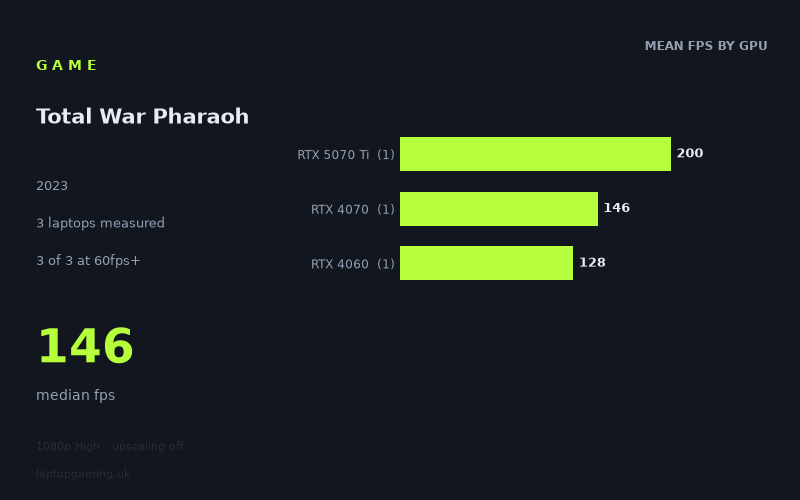
Every laptop we have figures for
Frame rates measured by Notebookcheck.
What it asks of a laptop
Total War Pharaoh looks relatively forgiving at the measured 1920x1080 High preset with upscaling disabled, at least on the three laptops in Notebookcheck’s figures. Every machine recorded well above 60fps, the slowest result was still 128fps, and even the median score was 146fps.
That is encouraging, but this is also a very small sample: only three laptops are represented, with one result for each GPU tier. The numbers show what these specific 140 W implementations achieved rather than establishing a guaranteed result for every laptop carrying an RTX 4060, RTX 4070 or RTX 5070 Ti.
The measured spread runs from 128fps on the Lenovo Legion Slim 7 with an RTX 4060 to 200fps on the Chuwi Gamebook R9 with an RTX 5070 Ti, a difference of 72fps. That is a substantial absolute gap, although it appears above an already high baseline. In practical terms, the RTX 4060 result is already far beyond a basic 60fps target at these settings, while the faster GPUs provide more scope for a high-refresh-rate display.
The separation between tiers is clear in Notebookcheck’s numbers. The RTX 4060 machine reached 128fps, the RTX 4070 machine reached 146fps, and the RTX 5070 Ti machine reached 200fps. The step from RTX 4060 to RTX 4070 was 18fps in this sample, while the RTX 5070 Ti result was 54fps ahead of the RTX 4070 machine. Those figures suggest that Total War Pharaoh can benefit from more graphics performance at 1080p High, but the available data does not justify treating the GPU label alone as a universal prediction.
All three tested laptops used GPUs listed at 140 W, which makes the comparison more useful than one mixing very different power limits. Even so, there are still only three results, so treat this as a narrow snapshot rather than a complete buying guide for every configuration.
What runs it
For a 60fps target, every laptop in the measured group cleared it comfortably. Notebookcheck’s lowest result was 128fps from the Lenovo Legion Slim 7 with an RTX 4060 at 140 W. On this evidence, that particular machine has a very large margin over 60fps at 1920x1080 High with upscaling off.
- RTX 4060 at 140 W: Lenovo Legion Slim 7, 128fps. This is the lowest measured result, but it still clears 60fps and 100fps by a wide margin. It falls short of 144fps in this result.
- RTX 4070 at 140 W: Schenker XMG Pro 16 Studio (Mid 23), 146fps. This clears 60fps, 100fps and 144fps, albeit only just over the latter threshold.
- RTX 5070 Ti at 140 W: Chuwi Gamebook R9, 200fps. This is the fastest recorded result and clears 60fps, 100fps and 144fps with considerable room to spare.
For a 100fps target, the result is equally straightforward within this sample: all three machines achieved it. The Lenovo’s 128fps result is the relevant lower-end figure here, while the RTX 4070 and RTX 5070 Ti systems produced 146fps and 200fps respectively.
A 144Hz target is where the three results begin to divide. Two of the three laptops reached at least 144fps: the Schenker XMG Pro 16 Studio managed 146fps and the Chuwi Gamebook R9 reached 200fps. The Legion Slim 7’s 128fps is still fast, but it does not meet a 144fps threshold in the measured run. Since the RTX 4070 result is only 2fps above 144fps, it would be unwise to present that as a firm promise that every RTX 4070 laptop will hold 144fps under all circumstances.
The median measured score is 146fps, which is useful context for buyers considering a 144Hz gaming laptop. In this limited group, 144Hz is achievable, but the results do not support assuming that it is guaranteed from every GPU tier represented.
The cheapest laptop that handles it
The fact sheet does not provide laptop prices, so it is not possible to identify the cheapest measured machine in GBP without inventing information. What can be said is that the least powerful GPU represented in the figures, the RTX 4060 at 140 W in the Lenovo Legion Slim 7, recorded 128fps at 1920x1080 High with upscaling disabled.
That makes the Lenovo the lowest-tier measured option that handles the game very comfortably at the tested settings. However, it should not automatically be treated as the cheapest laptop to buy, because no pricing information has been supplied for the Lenovo Legion Slim 7, Schenker XMG Pro 16 Studio (Mid 23), or Chuwi Gamebook R9.
What this means if you’re buying
If your aim is simply a consistently playable 60fps experience at 1080p High without upscaling, all three measured laptops are more than sufficient. The Lenovo Legion Slim 7 is particularly important here: its 128fps result shows that, in this small sample, the RTX 4060 system was not close to struggling.
If you are shopping for a 120Hz or 144Hz display, the RTX 4070 and RTX 5070 Ti results are more relevant. The Schenker XMG Pro 16 Studio reached 146fps, effectively matching a 144Hz target in the measured run, while the Chuwi Gamebook R9’s 200fps result offers a much larger margin. The RTX 4060-equipped Lenovo reached 128fps, which suits a 120Hz-class target more naturally than a strict 144fps goal based on these figures.
Do not over-read the generational ladder, though. There is one laptop per GPU tier, all at 140 W. Notebookcheck’s numbers support saying that these three specific machines run Total War Pharaoh quickly at 1080p High with upscaling off; they do not support broad claims about every laptop using the same GPUs. For a purchase decision, use the results as evidence that the game is not especially punishing for the tested hardware, then compare the exact laptop configuration, display refresh rate and price before deciding how much performance headroom is worth paying for.
How these numbers were produced
Frame rates here are not measured by us, and we label how each one was arrived at. A figure marked measured comes from a published run on that exact machine. A figure marked representative is derived from the GPU and its power limit (TGP) and cross-referenced against published reviews - a sound estimate of what that configuration delivers, but not a measurement of that specific laptop. Unless stated otherwise, numbers are 1920x1080, High preset, upscaling off. Where a laptop ships in several power configurations we use the wattage of the exact SKU listed, because a 140W RTX 5070 and a 115W one are not the same product.