Performance analysis
007 First Light (2026): what it takes to run it
Measured on 3 gaming laptops at 1920×1080, High preset, upscaling off.
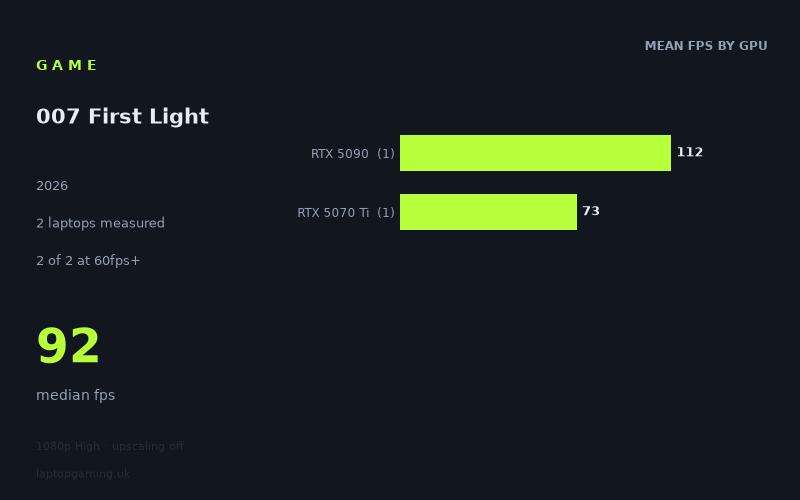
Every laptop we have figures for
Frame rates measured by Notebookcheck.
What it asks of a laptop
The data set is very small: Notebookcheck’s measured figures cover only two laptops, both tested at 1,920 x 1,080 using the High preset with upscaling disabled. That is enough to show what these two machines achieved, but not enough to make broad claims about every laptop using the same GPU names or about lower GPU tiers.
On those measured settings, 007 First Light appears demanding rather than especially forgiving. The fastest result was 112fps from the Asus ROG Strix Scar 18 with an RTX 5090 running at 175W, while the Asus ROG Zephyrus G14 with an RTX 5070 Ti managed 73fps. The 39fps gap between the two results is substantial, particularly as both machines are clearly high-end gaming laptops.
The median result is 92fps, although that figure should be treated cautiously because it is derived from only two laptops. More useful is the spread: both recorded machines exceeded 60fps, only one reached 100fps, and neither reached 144fps. At High settings without upscaling, the measured numbers therefore point towards a game that can run smoothly on powerful laptops, but which still benefits significantly from the fastest available graphics hardware.
The separation between the two GPU tiers is also important. Notebookcheck’s RTX 5090 result was 112fps, compared with 73fps for the RTX 5070 Ti. That does not establish a universal RTX 5090-versus-RTX-5070-Ti performance difference, as each tier is represented by only one laptop and laptop GPU performance depends on the specific machine. It does show that, in these two tested systems, moving from the Zephyrus G14’s RTX 5070 Ti to the 175W RTX 5090 in the Strix Scar 18 changed 007 First Light from a solid 60fps-plus experience into one capable of exceeding 100fps.
What runs it
For a 60fps target at 1,920 x 1,080, High settings and no upscaling, both measured laptops cleared the line.
- RTX 5090: 112fps across one measured laptop, the Asus ROG Strix Scar 18 with a 175W RTX 5090.
- RTX 5070 Ti: 73fps across one measured laptop, the Asus ROG Zephyrus G14.
That makes the RTX 5070 Ti result the more relevant of the two for buyers whose priority is simply maintaining more than 60fps on the tested settings. The Zephyrus G14 averaged 73fps, leaving a 13fps margin over 60fps. It is still only one result, however, so this should be read as evidence of what that particular RTX 5070 Ti laptop achieved, not as a guarantee for every RTX 5070 Ti machine.
For a 100fps target, only the RTX 5090 system made it. The ROG Strix Scar 18 reached 112fps, 12fps above the target. The RTX 5070 Ti-equipped G14 did not: its 73fps result was 27fps short of 100fps.
For a 144fps target, neither tested laptop was sufficient at the stated settings. The RTX 5090 result of 112fps was the closest, but remained 32fps below 144fps. The RTX 5070 Ti result was 71fps below that target. If your display is a 144Hz panel and you want the game to run at 144fps at 1080p High with upscaling off, the available figures do not show a laptop that achieves it.
There are no measured figures here for lower GPU tiers, different presets, other resolutions or enabled upscaling. It would therefore be unsafe to state what an RTX 5060, RTX 5070, older GPU, or a lower-powered version of either measured GPU will deliver.
The cheapest laptop that handles it
The supplied figures include a price for only one of the two laptops: the Asus ROG Zephyrus G14 with RTX 5070 Ti, listed at £2,900. It produced 73fps at 1,920 x 1,080, High settings and upscaling off, so it is the lowest-priced priced machine in this data that clears 60fps.
That is not the same as proving it is the cheapest laptop capable of running 007 First Light well. No price is supplied for the Asus ROG Strix Scar 18, and the fact sheet contains no results or prices for less expensive machines. Based strictly on the available information, £2,900 is the lowest documented price attached to a laptop that achieved more than 60fps.
The other measured option is the Asus ROG Strix Scar 18 with RTX 5090 at 175W, which reached 112fps. Its price is not provided, so a direct value comparison cannot be made from these figures.
What this means if you’re buying
If your aim is a consistent-looking 60fps-plus result at 1080p High without upscaling, the measured Zephyrus G14 result is encouraging: it achieved 73fps. For buyers considering that exact £2,900 laptop, Notebookcheck’s number suggests it has enough performance for the tested target, with some headroom rather than a huge surplus.
If you are buying around a 100fps target on the same settings, the RTX 5090-equipped Strix Scar 18 is the only measured laptop that qualifies, at 112fps. The result also illustrates the cost of pursuing higher refresh-rate performance in this game: the RTX 5070 Ti machine was comfortably above 60fps but did not approach 100fps.
Do not buy on the assumption that 144fps is available at 1080p High with upscaling off. Neither of the two tested laptops reached that point, including the 175W RTX 5090 system. With only two measurements, the sensible conclusion is narrow: these figures identify 60fps and 100fps options among two specific laptops, but they do not yet provide enough coverage to map the wider gaming-laptop market.
How these numbers were produced
Frame rates here are not measured by us, and we label how each one was arrived at. A figure marked measured comes from a published run on that exact machine. A figure marked representative is derived from the GPU and its power limit (TGP) and cross-referenced against published reviews - a sound estimate of what that configuration delivers, but not a measurement of that specific laptop. Unless stated otherwise, numbers are 1920x1080, High preset, upscaling off. Where a laptop ships in several power configurations we use the wattage of the exact SKU listed, because a 140W RTX 5070 and a 115W one are not the same product.